
Central Bank Independence Under Siege: How Fed Governance Risks Reshape Bond and Equity Markets
The Federal Reserve's independence has long been a cornerstone of U.S. monetary policy, enabling it to act as a stabilizing force in turbulent economic climates. However, recent years have seen mounting political pressure on the institution, raising concerns about its ability to maintain credibility and effectiveness. As of 2025, these governance risks are not merely theoretical-they are already influencing bond yields and equity markets, with implications for investors navigating an increasingly uncertain landscape.
The Erosion of Independence
Since 2023, the Fed has faced sustained political pressure from the administration, including public calls for rate cuts and contested removals of board members like Lisa Cook. These actions have sparked fears that the Fed could lose its independence, a concern echoed in academic research. According to a report by the Brookings Institution, political attacks on central bank independence can raise inflation expectations even without actual policy changes, a dynamic that risks destabilizing the economy. This echoes historical precedents, such as the Arthur Burns era of the 1970s, when political interference contributed to unanchored inflation expectations and costly economic outcomes.
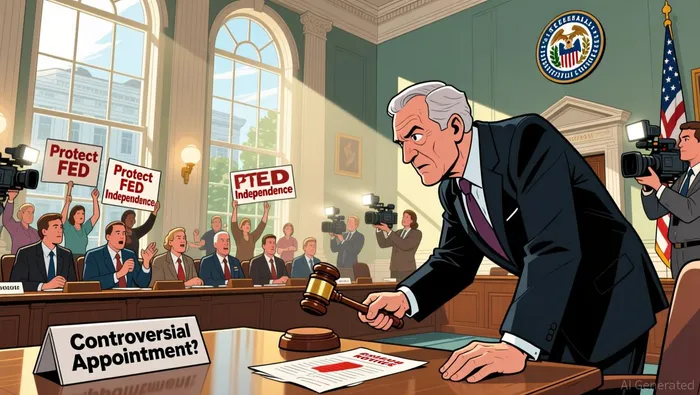 The Federal Reserve Act provides legal safeguards for independence, but recent appointments and contested decisions suggest a shift in power dynamics. A 2023 study published in found that monetary policy tends to become more expansionary in the lead-up to national elections, with an average 1.45% increase in monetary mass growth prior to such events. This "political monetary cycle" underscores how electoral pressures can distort policy, further eroding the Fed's autonomy.
Bond Yields: A Barometer of Governance Risk
The impact of these governance risks is evident in bond markets. Political pressure on the Fed has been linked to higher long-term Treasury yields, driven by rising inflation expectations. For example, research from Emerald shows that expectations of Donald Trump's re-election in 2024 led to a measurable rise in U.S. Treasury yields, reflecting investor concerns about potential policy shifts. Similarly, a 2025 analysis by the Federal Reserve Bank of New York noted brief liquidity deterioration in Treasury markets following tariff announcements, though conditions stabilized as policies were adjusted.
These trends align with broader empirical findings: political interference in central banking raises inflation and bond yields, even in the absence of immediate policy changes. The mechanism is straightforward-when investors doubt the Fed's ability to resist political pressure, they price in higher inflation, pushing yields upward.
Equity Markets: Valuations Under Pressure
Higher bond yields have direct and indirect effects on equity markets. Goldman Sachs Research highlights that a 100-basis-point increase in real Treasury yields is associated with a roughly 7% decline in the S&P 500's forward P/E multiple. While the relationship between interest rates and stock returns is not always linear, the valuation impact is significant. For instance, rising yields driven by fiscal concerns or trade tensions can limit the growth potential of equities, particularly in sectors sensitive to interest rates, such as technology and real estate.
The interplay between governance risks and equity performance is further complicated by investor sentiment. When political uncertainty dominates, markets often price in the risk of policy instability, leading to volatility. This was evident in 2025, when Treasury market liquidity briefly deteriorated amid tariff-related uncertainty, signaling broader concerns about the Fed's ability to navigate political pressures.
Implications for Investors and Reform Proposals
For investors, the erosion of Fed independence introduces a new layer of risk. Bonds and equities are no longer insulated from political dynamics, requiring strategies that hedge against inflation and governance-related volatility. Diversification into inflation-protected assets, such as TIPS or commodities, may become increasingly important.
Academic and policy debates have also focused on structural reforms to preserve the Fed's independence while enhancing accountability. Proposals include restructuring board member terms and rebalancing power within the Federal Open Market Committee (FOMC) to reduce the president's influence. Such reforms aim to create a system where the Fed can act independently in the short term while remaining answerable to democratic institutions over the long term.
Conclusion
The Federal Reserve's independence is under siege, with political pressures already reshaping bond and equity markets. As governance risks crystallize into tangible economic outcomes, investors must adapt to a new reality where monetary policy is increasingly entangled with political agendas. The path forward lies in both strategic portfolio adjustments and sustained advocacy for institutional safeguards that preserve the Fed's core mandate.







Comentarios
Aún no hay comentarios