
Central Bank Divergence and Canadian Financial Assets: Assessing BMO's December Rate Cut Forecast
The Bank of Canada's (BoC) December 2025 rate cut forecast, led by BMO's projection of a 25-basis-point reduction to 2.25%, has sparked debate amid conflicting economic signals. While the BoC's September 2025 decision to cut rates to 2.5% was justified by a weakening labor market and reduced inflation risks, according to a Bank of Canada press release, December's anticipated move faces headwinds from strong employment data. Canada added 91,000 jobs in December 2024, with the unemployment rate dropping to 6.7%-its lowest since January 2023, according to Canadian Mortgage Trends. This divergence between macroeconomic fundamentals and central bank policy raises critical questions for investors: Is the market underestimating the BoC's pivot potential, and how should portfolios be positioned for a soft landing scenario?
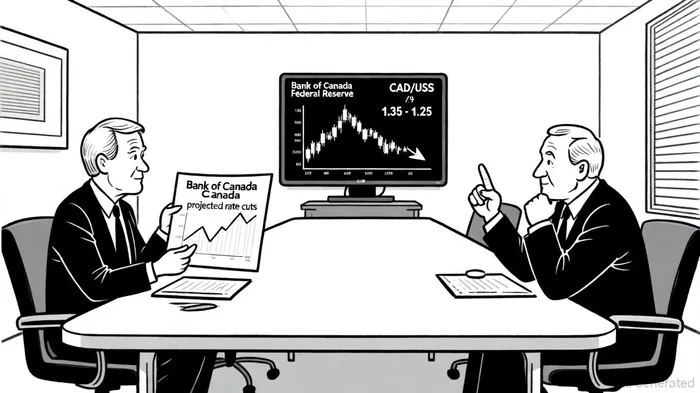
BMO's Rationale: Balancing Employment and Structural Risks
BMO economists, including Douglas Porter, argue that the BoC's December cut is necessary despite robust job growth. They emphasize structural risks such as U.S. tariff threats, a weak Canadian dollar, and divergent Fed policy in BMO's September rate scenario. While the December 2024 employment report showed a resilient labor market, BMOBMO-- highlights that public-sector hiring-rather than private-sector growth-drove the gains, as noted by the Financial Post. This distinction is crucial: private-sector momentum remains fragile, with wage growth at 3.8% year-over-year, below pre-pandemic levels, according to a Desjardins note.
The BoC's September 2025 rate cut to 2.5% already reflected a shift toward easing policy, citing a 7.1% unemployment rate in August 2025 and slowing GDP growth, as reported by Canadian Mortgage Trends. BMO's December forecast assumes further deterioration in trade relations and a lagged response to inflation moderation. However, the central bank's cautious stance-avoiding explicit forward guidance-has left investors uncertain. As of late 2025, rate futures implied a 48% probability of a December cut, per a market survey, suggesting the market may not fully price in BMO's 2.25% terminal rate.
Policy Divergence: Implications for Canadian Assets
The BoC's aggressive rate cuts contrast with the Federal Reserve's more measured approach. While the Fed reduced rates by 25 bps in September 2025 to 4.25-4.50%, it has signaled only one additional cut for 2025, according to Morningstar. This divergence has exacerbated the Canadian dollar's depreciation, with CAD/USD falling 7.7% in 2024, as shown in a Bank of Canada staff note. For investors, this creates a dual-edged sword:
1. Equities: Export-oriented sectors (e.g., energy, manufacturing) benefit from a weaker CAD, but import-dependent industries face margin pressures, per an Invezz forecast.
2. Bonds: Canadian government bond yields remain below U.S. Treasuries, reflecting lower inflation and a more aggressive rate-cutting path, according to S&P Global analysis. This negative yield spread could persist if the BoC continues to ease.
3. Currency: The CAD's vulnerability to rate differentials and trade tensions means further depreciation is likely, though hedging strategies may mitigate risks, as discussed in a TD article.
Investment Strategies for a Soft Landing
A soft landing scenario-where inflation normalizes without a recession-requires balancing growth and risk management. For Canadian investors, the following strategies align with BMO's forecast and the BoC's cautious approach:
1. Fixed-Income Duration: Extend duration in government bonds to capitalize on expected rate cuts. Canadian 10-year yields at 3.16%, according to Bank of Canada data, offer attractive returns relative to U.S. Treasuries (4.04%), per Bloomberg rates.
2. Sector Rotation: Overweight sectors benefiting from a weaker CAD (e.g., energy, mining) and underweight import-sensitive industries (e.g., retail, automotive), following a CBOE guide.
3. Currency Hedging: Use forward contracts or CAD-denominated assets to offset exposure to U.S. dollar swings, as suggested by a Wealthtrack guide.
4. Low-Risk Instruments: High-interest savings accounts (HISAs) and GICs, offering 3-5.25% yields, remain attractive; see Bank of Canada Odds for live probabilities and rates.
Market Pricing vs. BMO's Forecast: A Mismatch?
The discrepancy between BMO's 2.25% terminal rate and market expectations (2.5% as of September 2025), per the CADTod rate tracker, suggests the market may underestimate the BoC's pivot potential. Rate futures assign a 34% probability to a December cut (the market survey cited above gave similar probabilities), while BMO's analysis implies a higher likelihood. This gap could narrow if trade tensions escalate or inflation undershoots targets. Investors should monitor BoC minutes and employment data for clues, but the central bank's reluctance to commit to forward guidance means surprises remain possible.
Conclusion
BMO's December 2025 rate cut forecast reflects a nuanced assessment of structural risks, even as employment data complicates the BoC's mandate. While the market appears cautious, policy divergence with the Fed and a weaker CAD create tailwinds for Canadian financial assets. Investors positioning for a soft landing should prioritize duration, sectoral diversification, and currency hedging. As Governor Tiff Macklem noted, "Monetary policy cannot fully offset trade shocks, but it can provide a floor for growth," in his opening statement. In this environment, agility and a focus on macroeconomic trends will be key.





Comentarios
Aún no hay comentarios