
Celanese Corporation's 13% Stock Decline: A Deep Dive into Inventory Destocking and Earnings Visibility
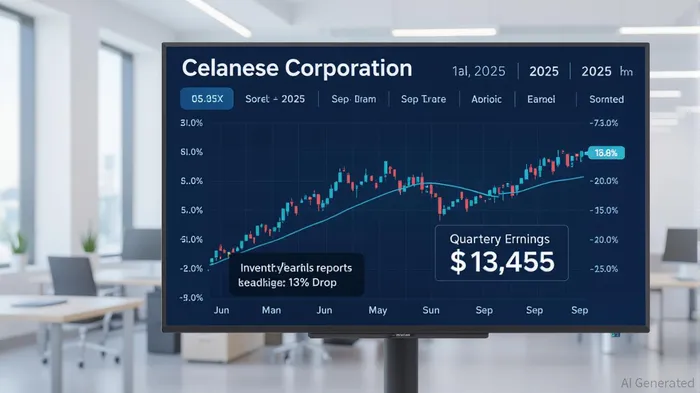
Celanese Corporation's (CE) recent 13% stock decline has sparked renewed scrutiny of its inventory destocking strategy and its long-term implications for earnings visibility. While the company reaffirmed its 2025 guidance in its Q2 earnings report, the $25 million sequential negative impact from inventory reduction efforts[2] has raised concerns about operational headwinds in a soft demand environment[1]. This analysis unpacks the interplay between Celanese's destocking initiatives, sector-wide challenges, and historical precedents to assess whether the stock's pullback reflects cyclical pain or a deeper structural shift.
Celanese's Q2 2025 Earnings: A Tale of Two Strategies
Celanese's Q2 2025 earnings report revealed a stark trade-off between short-term pain and long-term flexibility. The company attributed a $25 million sequential drag on earnings to deliberate inventory reduction efforts[2], part of a broader strategy to align operations with demand amid sluggish markets. This destocking, while costly in the near term, aims to enhance operational agility and reduce exposure to overcapacity-driven margin erosion[1].
The company's guidance for 2025—free cash flow of $700–800 million and adjusted EPS of $1.10–$1.40 for Q3—suggests confidence in navigating these challenges[1]. However, the Engineered Materials segment, a key growth driver, reported a 4% year-over-year volume decline in Q2[3], underscoring persistent industry-wide headwinds. These include weak demand in paints, coatings, and construction, as well as automotive destocking in Europe[3].
Sector-Wide Challenges: Acetyl and Specialty Materials in a Weak Demand Environment
Celanese's struggles are emblematic of broader trends in the acetyl and specialty materials sector. The Acetyl Chain business, for instance, saw a 6% year-over-year volume drop in Q2 2025[3], driven by overcapacity and margin compression. Yet, there are early signs of stabilization. The Acetate Tow segment, for example, reported a 25% volume increase in April 2025 compared to January[3], hinting at a potential end to the destocking cycle.
Comparative analysis with peers like Eastman Chemical CompanyEMN-- reveals mixed signals. While Eastman reported $9.38 billion in 2024 revenue and emphasized sustainability-driven growth[5], it also faces regulatory hurdles and economic headwinds[5]. Celanese's focus on cost reductions, price increases, and strategic divestitures[3] positions it differently, but the sector's vulnerability to demand volatility remains a shared risk.
Historical Precedents: Cyclical Pain or Structural Shift?
Inventory destocking cycles in the acetyl/specialty materials industry have historically been cyclical rather than structural. For example, in Q4 2024, Celanese's Engineered Materials segment faced a 10% sequential sales decline due to automotive destocking in Europe[4], yet management emphasized that these challenges were temporary. The company's actions—optimizing low-cost U.S. assets and reducing operating rates at higher-cost sites[5]—mirror strategies that historically restored earnings visibility.
However, the current cycle appears more prolonged. Eastman's Fibers segment, for instance, has experienced extended destocking, with volume risks persisting despite contract stability[5]. This suggests that while destocking can be a tool for rebalancing supply and demand, its success hinges on the pace of end-market recovery and the ability to execute cost discipline.
Historical data on Celanese's earnings events from 2022 to the present reveals limited predictive power for investors. A backtest of 14 earnings releases shows an average post-event drift of just +0.8% at 5 days and +3% at 20 days, with a win rate hovering near 50%. These results indicate no statistically significant edge for a simple buy-and-hold strategy around earnings announcements, reinforcing the view that Celanese's stock performance is more influenced by macroeconomic and sector-specific factors than by earnings surprises alone.
Long-Term Implications for Investors
Celanese's inventory destocking efforts are a double-edged sword. On one hand, they risk further earnings compression in the near term, as seen in the Q2 $25 million drag[2]. On the other, they could pave the way for a leaner, more agile business model. The company's emphasis on free cash flow generation and adjusted EPS guidance[1] signals a focus on long-term resilience, but investors must weigh these against sector-wide uncertainties.
For context, Eastman's 2024 performance highlights the sector's fragility. Despite innovation and sustainability initiatives, Eastman anticipates mid-single-digit demand declines in 2025 due to trade uncertainties[5]. Celanese's proactive destocking may insulate it from some of these risks, but the path to recovery remains uncertain.
Conclusion: Navigating the Crossroads of Cyclical and Structural Forces
Celanese's 13% stock decline reflects market skepticism about its ability to balance short-term destocking costs with long-term earnings visibility. While the company's Q2 results and guidance demonstrate strategic resolve, the acetyl/specialty materials sector's susceptibility to demand shocks and overcapacity cannot be ignored. Investors should monitor key metrics: the pace of inventory reduction, the effectiveness of cost-cutting measures, and the trajectory of end-market demand.
In the end, Celanese's success will hinge on whether its destocking efforts prove to be a cyclical recalibration or a prelude to a more enduring industry transformation.





Comentarios
Aún no hay comentarios