
CBB Bancorp's Q3 2025 Financial Performance: Navigating Profitability in a Low-Interest-Rate Environment
Q3 2025 Performance: A Mixed Picture
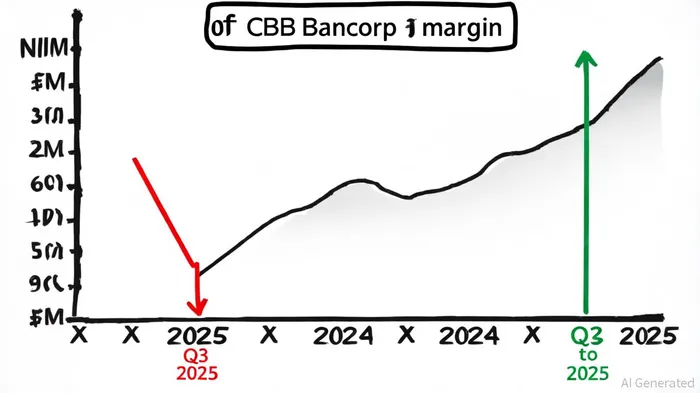
CBB Bancorp's Q3 2025 net interest margin stood at 3.49%, a slight increase from 3.46% in Q2 2025 but a decline from 3.71% in the same quarter of 2024, consistent with the earlier GuruFocus coverage of quarter-to-quarter comparisons. This trend aligns with broader industry patterns, where NIMs for community banks rose from a post-pandemic low of 3.34% in late 2023 to 3.52% by year-end 2024, driven by higher asset yields and slower cost-of-funds growth, according to a Bank Trends analysis. However, Deloitte's 2025 outlook warns that NIMs could dip to 3% by year-end as the Federal Reserve's rate cuts reduce funding costs. For CBB, this implies a narrowing window to capitalize on current margin levels before facing steeper headwinds.
Total revenue for Q3 2025 came in at $63.997 million, slightly below the estimated $64.20 million reported in the GuruFocus item. Noninterest income, a critical diversification lever, declined to $10.2 million, down from $10.3 million in Q2 2025 and $10.5 million in Q3 2024, as noted in the same GuruFocus coverage. This contraction, coupled with an efficiency ratio of 40.3%-indicating rising operating costs relative to revenue-highlights the bank's vulnerability to margin compression.
Strategic Adaptations in a Low-Rate Environment
CBB Bancorp's Q3 results suggest a partial reliance on traditional capital optimization strategies. The bank's cost of funds decreased to 3.29% in Q2 2025, down from 3.52% in Q2 2024, contributing to a 3 basis point increase in asset yields, according to CBB's second-quarter 2025 results. However, these gains were offset by an 11% year-over-year decline in noninterest income, partly due to a $67,000 loss on the sale of other real estate owned (OREO), as reported by Yahoo Finance. This underscores the fragility of noninterest income as a buffer in a low-rate environment, where alternative revenue streams-such as wealth management or fee-based services-are often underdeveloped for smaller banks, a point highlighted in a St. Louis Fed analysis on banking analytics and NIMs St. Louis Fed analysis.
To mitigate margin pressures, CBB has focused on reducing excess reserves and improving capital efficiency. As of June 30, 2025, the bank maintained a Common Equity Tier 1 Risk-Based Capital Ratio of 18.94% and a Leverage Ratio of 14.45%, both well above regulatory thresholds, according to the Yahoo Finance release. These metrics position CBB to explore capital-return initiatives like share buybacks, a strategy Deloitte recommends to offset declining NIMs. However, the bank's efficiency ratio of 59.99% in Q2 2025-though improved from prior quarters-remains a concern, as higher operating costs erode the benefits of capital optimization reported in CBB's press release.
Industry Context and Long-Term Outlook
The broader banking sector's shift toward capital-efficient models and risk-mitigation tools-such as credit risk transfers and bond swaps-offers a roadmap for CBB's future strategies, as Deloitte notes. For instance, repricing lower-yielding assets through bond swaps or pre-funding strategies could help stabilize NIMs, though these approaches carry short-term risks like realized losses or increased interest expenses, as discussed in the Bank Trends analysis. CBB's Q3 results suggest limited engagement with such proactive measures, relying instead on cost-cutting and deposit-cost management to sustain margins.
Investors must also consider the structural challenges facing community banks. Unlike large institutions, which can offset low NIMs with robust noninterest income from investment banking or asset management (a point emphasized in the St. Louis Fed analysis), CBB's revenue base remains heavily tied to traditional lending and deposit activities. This exposes the bank to cyclical volatility, particularly as Deloitte projects a 3% NIM floor for the industry by year-end 2025.
Conclusion: A Cautionary Path Forward
CBB Bancorp's Q3 2025 performance reflects a bank navigating a precarious balance between margin preservation and operational efficiency. While its capital position remains strong, the decline in noninterest income and rising efficiency ratio signal vulnerabilities in a low-rate environment. To enhance sustainability, CBB must accelerate diversification efforts and adopt more aggressive asset-repricing strategies. For investors, the key question is whether the bank can replicate the industry's capital-optimization successes without compromising its core profitability.





Comentarios
Aún no hay comentarios