
Cathay Pacific's 777-9 Order: Strategic Fleet Modernization and Its Implications for Long-Term Profitability
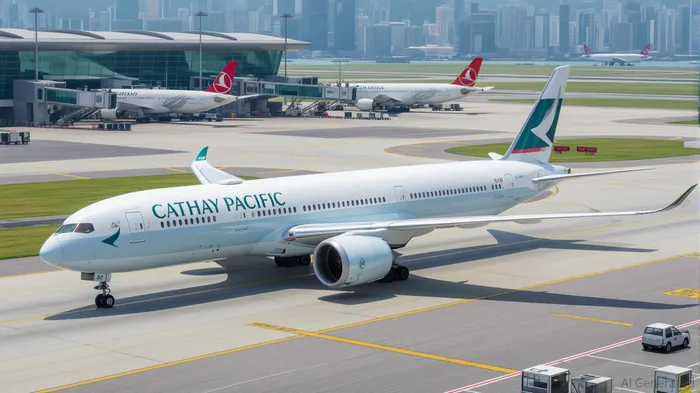
Cathay Pacific's recent order for 14 BoeingBA-- 777-9 aircraft, with options for seven more, marks a pivotal step in its fleet modernization strategy. This $8.1 billion investment, set to begin deliveries by 2034, underscores the airline's ambition to reclaim its position as a leader in long-haul aviation while addressing evolving market demands and environmental pressures. The decision to adopt the 777-9—a next-generation widebody jet—reflects a calculated response to rising fuel costs, the need for operational efficiency, and the strategic expansion of Hong Kong's airport infrastructure. For investors, the move raises critical questions: How does this order position Cathay to compete with regional rivals like Emirates and Singapore Airlines? What are the long-term profitability implications of this high-stakes bet on fuel efficiency and capacity?
Strategic Alignment with Long-Haul Demand and Fuel Efficiency
The 777-9's adoption is rooted in Cathay's need to optimize its long-haul fleet for both economic and environmental sustainability. The aircraft's 10% fuel efficiency improvement over the 777-300ER and 5% edge in fuel burn per seat over the Airbus A350-1000 positions it as a cost-effective solution for high-demand routes such as Hong Kong to New York or London. This efficiency is driven by advanced GE9X engines, aerodynamic enhancements, and a larger seating capacity (426 seats in a two-class configuration), which spreads fixed costs across more passengers. For Cathay, this translates to lower cost per available seat mile (CASM) and higher profitability on transcontinental routes, where premium seating and cargo revenue are critical.
The timing of the order also aligns with Hong Kong International Airport's ongoing expansion, including the completion of a third runway by 2024. This infrastructure upgrade will enable Cathay to operate more flights and accommodate larger aircraft, directly supporting the 777-9's integration into its network. The aircraft's folding wingtips, designed to fit existing gate infrastructure, further reduce operational friction, making it a practical choice for an airport with limited space.
Competitive Positioning Against Regional Rivals
Cathay's 777-9 order places it in direct competition with Emirates and Singapore Airlines, both of which have invested heavily in next-generation widebody aircraft. Emirates, for instance, has ordered 150 777-9s, leveraging the aircraft's capacity and range to dominate long-haul markets. Singapore Airlines, meanwhile, has prioritized the A350-1000 for its superior fuel efficiency and range, which are critical for ultra-long-haul routes like Singapore to New York.
Cathay's strategy, however, is distinct. By adopting the 777-9, the airline aims to balance capacity and efficiency, targeting high-yield routes where its larger seating capacity can offset slightly higher fuel burn. This approach is particularly advantageous on routes with strong premium demand, such as trans-Pacific and transatlantic corridors, where the 777-9's ability to carry more first and business class passengers can drive revenue. Additionally, the aircraft's freighter potential—enabled by its larger cargo hold—positions Cathay to capitalize on the growing demand for air cargo, a sector where Singapore Airlines and Emirates also compete fiercely.
Risks and Mitigation: Delivery Delays and Financial Constraints
Despite the strategic rationale, challenges remain. Boeing's certification delays for the 777-9—pushed to 2025—have forced Cathay to reconsider its order size, with reports suggesting a potential reduction from 21 to 10–15 aircraft. While this could save billions in capital expenditures, it also risks delaying the fleet's modernization and the associated cost savings. Cathay's recent order for 30 Airbus A330neos, primarily for regional routes, indicates a hedging strategy to maintain flexibility while waiting for the 777-9s.
Financially, Cathay's 2023 net profit of HKD9.8 billion (USD1.25 billion) provides a buffer for such investments. However, the airline's reliance on debt financing—through loans and leases—exposes it to interest rate volatility and liquidity risks. Investors should monitor Cathay's debt-to-equity ratio and cash flow generation, particularly as it returns older aircraft to lessors and integrates the 777-9 into its fleet.
Investment Implications and Outlook
For investors, Cathay's 777-9 order represents a long-term bet on the recovery of global travel demand and the airline's ability to execute its modernization plan. The aircraft's fuel efficiency and capacity are expected to reduce operating costs by 7–10% on key routes, improving margins as fuel prices remain volatile. However, the success of this strategy hinges on Boeing's ability to deliver the aircraft on time and Cathay's capacity to manage its debt burden.
Investment Advice: Cathay's 777-9 order is a strategic move that, if executed successfully, could enhance its competitive positioning and profitability. However, investors should remain cautious about short-term risks, including delivery delays and macroeconomic headwinds. A long-term hold is recommended, with a focus on monitoring Boeing's certification progress, Cathay's debt management, and the airline's ability to leverage Hong Kong's expanded airport infrastructure. For a diversified portfolio, pairing Cathay with regional peers like Singapore Airlines or Qantas, which are also modernizing their fleets, could mitigate sector-specific risks.
In conclusion, Cathay Pacific's 777-9 order is a bold step toward a more efficient and competitive long-haul fleet. While challenges remain, the potential rewards—lower operating costs, higher capacity, and a stronger foothold in key markets—make this a compelling investment opportunity for those with a long-term horizon.







Comentarios
Aún no hay comentarios