
Caterpillar's Position in the AI-Driven Power Infrastructure Revolution
Caterpillar Inc. (CAT) has emerged as a pivotal player in the AI-driven power infrastructure revolution, with its Energy and Transportation segment-renamed Power and Energy-experiencing unprecedented growth. In Q3 2025, the segment reported a 17% year-over-year sales increase to $7.2 billion, with power generation for data centers contributing the most significant portion of this growth. This surge is driven by surging demand for reciprocating engines and turbine generators to power AI workloads, particularly in hyperscale data centers. For instance, CaterpillarCAT-- recently secured a major contract to supply 4 gigawatts of energy to Joule Capital Partners' High Performance Compute Data Center Campus in Utah, leveraging its G3520K generator sets.
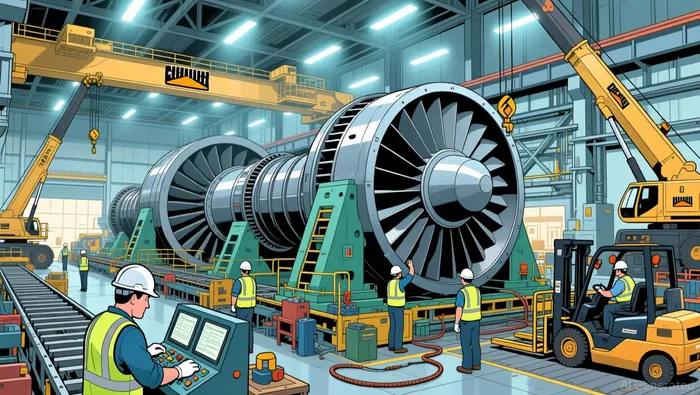
The company's strategic investments further underscore its commitment to this sector. A $725 million expansion at its Lafayette, Indiana, plant aims to double turbine engine capacity by 2030, aligning with industry projections that AI-driven data center power infrastructure spending will grow from $236.44 billion in 2025 to $933.76 billion by 2030 at a 31.6% compound annual growth rate (CAGR). This trajectory, supported by IoT Analytics and Grand View Research, suggests a structural shift rather than a cyclical bounce.
Caterpillar's capital allocation strategy reinforces this narrative. The company's record backlog of $37.5 billion in Q2 2025-up $2.5 billion sequentially-reflects sustained order demand despite short-term headwinds like unfavorable pricing and manufacturing costs. Management has projected annual sales growth of 5%–7%, surpassing its historical 4% average, a target that hinges on long-term AI infrastructure demand rather than transient market conditions.
Industry dynamics further validate Caterpillar's structural positioning. According to Deloitte's 2025 AI Infrastructure Survey, 79% of power and data center executives anticipate AI will increase power demand through 2035, with grid capacity and supply chain constraints emerging as critical bottlenecks. This aligns with Caterpillar's focus on on-site power generation, which allows data centers to bypass strained regional grids-a trend expected to accelerate as AI workloads intensify.
Caterpillar's
However, short-term challenges persist. Caterpillar's Q2 2025 earnings revealed a 1% revenue decline year-over-year and a 18% drop in operating profit, attributed to unfavorable price realization and manufacturing costs. While these factors may reflect cyclical pressures, the company's robust backlog and strategic investments suggest these are temporary hurdles rather than indicators of a broader downturn.
Competitor actions and market forecasts also highlight the sector's structural potential. Hyperscalers like Microsoft, Amazon, and Meta are projected to account for $200 billion in 2024 capital expenditures alone, with AI-ready data center capacity expected to grow at a 33% annual rate through 2030. Caterpillar's expertise in high-density power solutions-such as its piston-driven engines and hybrid renewable-energy systems-positions it to capture a significant share of this demand.
In conclusion, Caterpillar's momentum in the AI-driven power infrastructure market appears rooted in a structural re-rating rather than a cyclical bounce. The company's capital investments, alignment with industry growth projections, and strategic partnerships with major data center operators underscore its long-term positioning. While near-term margin pressures exist, the broader trend of AI-driven power demand-projected to triple U.S. data center grid-power needs by 2030-suggests Caterpillar is well-positioned to benefit from a multi-year inflection in the sector.





Comentarios
Aún no hay comentarios