
Caspian Pipeline Consortium's Operational Resilience Amid Recent Disruptions
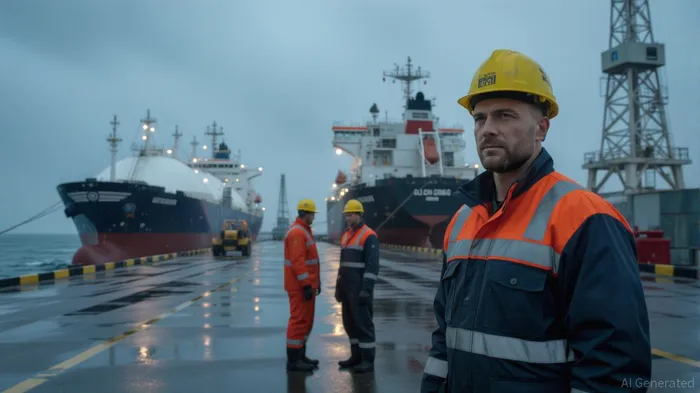
The Caspian Pipeline Consortium (CPC), a linchpin for Kazakhstan’s energy exports, has faced a cascade of operational and geopolitical challenges in 2025. From oil spills and drone attacks to Russian-ordered inspections, the pipeline’s resilience has been tested. Yet, its ability to maintain partial operations—such as keeping one of three mooring points active during a major spill—demonstrates a capacity for adaptation in a volatile environment [1]. For investors, the CPC’s story is a case study in balancing strategic risk with recovery potential in critical oil infrastructure.
Strategic Risks: A Perfect Storm of Geopolitics and Operational Fragility
The CPC’s vulnerabilities stem from its dual exposure to technical failures and geopolitical manipulation. In March 2025, a Russian-ordered inspection at the Novorossiysk terminal suspended two of three single-point moorings, halving throughput and forcing Kazakhstan to divert crude to the Baku-Tbilisi-Ceyhan (BTC) pipeline [1]. This incident underscored Russia’s leverage over the CPC, as its regulatory control—including FSB approval for foreign vessels—creates bottlenecks and raises fears of weaponized oil flows [1].
Compounding these risks, a February 2025 Ukrainian drone strike on the Kropotkinskaya pumping station reduced flows by 30%, inflicting $600 million in economic losses on Kazakhstan [1]. Such attacks highlight the pipeline’s susceptibility to regional conflicts, particularly as the Russia-Ukraine war prolongs instability in the Black Sea. Meanwhile, shareholder disputes, like Kazakhstan’s $160 billion arbitration case against foreign operators over the Kashagan field, reveal tensions over revenue control and geopolitical alignment [1]. These factors collectively erode trust in the CPC’s long-term stability.
Recovery Strategies: Diversification and Resilience in Action
Despite these challenges, the CPC has initiated measures to mitigate risks. Scheduled maintenance, such as replacing hoses at the CPC-3 Single Point Mooring, aims to prevent future disruptions [5]. More ambitiously, Kazakhstan is pursuing infrastructure diversification. The BTC pipeline’s capacity is set to expand to 6.5 million tons per year by 2027, while refining projects like KazMunayGas’s $2.6 billion polypropylene plant in Atyrau seek to add downstream value and reduce reliance on Russian-controlled routes [4].
However, these strategies face hurdles. The BTC pipeline’s capacity remains limited, and trans-Caspian shipping is constrained by shallow waters that restrict heavy oil barges [2]. Additionally, Kazakhstan’s nuclear energy projects, which rely on Russian technology, risk entrenching geopolitical dependencies [1]. For diversification to succeed, technical challenges must align with political support from countries like Azerbaijan and Turkey [1].
Investor Implications: Navigating Uncertainty
For investors, the CPC’s future hinges on three pillars: geopolitical stability, regulatory reforms, and infrastructure diversification. While the pipeline currently transports over 1% of global oil [1], its long-term viability depends on resolving shareholder disputes and reducing Russian influence. Regulatory reforms in Kazakhstan must balance environmental accountability with international partnerships, a delicate balancing act [1].
The CPC’s resilience also relies on adopting global best practices in operational resilience, such as embedding AI-driven monitoring and third-party risk management into governance frameworks [3]. These measures could mitigate cascading failures and ensure continuous operations during disruptions.
Conclusion: A Pipeline of Opportunities and Perils
The CPC’s journey in 2025 illustrates the fragility of critical oil infrastructure in a geopolitically charged world. While its operational resilience—keeping one mooring point active during a spill—offers hope, the pipeline’s survival will depend on navigating a complex web of technical, political, and economic challenges. For investors, the CPC represents both a high-risk, high-reward proposition and a microcosm of the broader energy transition.
Source:
[1] Geopolitical and Operational Risks in the Caspian Pipeline Consortium [https://www.ainvest.com/news/geopolitical-operational-risks-caspian-pipeline-consortium-impact-energy-markets-2508/]
[2] CPC Mooring Suspension: A Catalyst for Oil Market Realignment [https://www.ainvest.com/news/cpc-mooring-suspension-catalyst-oil-market-realignment-investment-opportunities-2508/]
[3] Operational Resilience 2025: Strategy Beyond Compliance [https://swissgrc.com/en/operational-resilience-in-2025-from-regulatory-mandate-to-strategic-muscle/]
[4] CPC Mooring Suspension: A Catalyst for Oil Market Realignment [https://www.ainvest.com/news/cpc-mooring-suspension-catalyst-oil-market-realignment-investment-opportunities-2508/]
[5] Caspian Pipeline Consortium Initiates Crucial Maintenance [https://caspianpost.com/economics/caspian-pipeline-consortium-initiates-crucial-maintenance-to-ensure-steady-oil-flow]







Comentarios
Aún no hay comentarios