
Casey's General Stores: A High-Margin Retail Play in a Resilient Convenience Sector
The convenience retail sector has long been a barometer for consumer spending, but 2025 has tested its mettle. Volatile fuel markets, inflationary pressures, and rising operational costs have created a challenging backdrop. Yet, Casey's General StoresCASY-- (CASY) has emerged as a standout performer, leveraging strategic margin management and fuel volume gains to outpace peers. For investors seeking a high-margin retail play, Casey'sCASY-- offers a compelling case study in operational resilience and sector-specific advantages.
Margin Expansion: A Dual-Engine Strategy
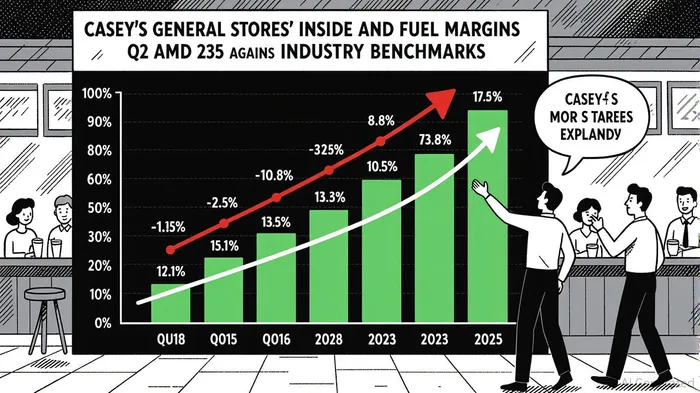
Casey's Q2 and Q3 2025 results underscore its ability to drive profitability through two key levers: inside margin expansion and fuel margin optimization. In Q2, the company reported an inside margin of 41.9%, contributing to a 14.8% year-over-year increase in total inside gross profit to $705.5 million[1]. By Q3, despite a slight dip to 40.9%, the inside margin remained robust, supported by strong performance in high-margin categories like prepared food and dispensed beverages[1].
Fuel margins, meanwhile, have been a cornerstone of Casey's strategy. In Q2, the company achieved a fuel margin of 41.0 cents per gallon, translating to a 18.8% year-over-year rise in total fuel gross profit to $373.6 million[1]. While Q3 saw a marginal decline to 36.4 cents per gallon[1], this still outperformed industry benchmarks. For context, Murphy USAMUSA-- reported an all-in fuel margin of 32 cents per gallon in Q2 2025[2], highlighting Casey's superior margin discipline.
Fuel Volume Gains: Sustaining Growth Amid Sector Headwinds
Fuel volume growth has been another critical driver. Casey's reported a 1.7% year-over-year increase in same-store fuel gallons in Q2 and a 1.8% rise in Q3[1]. These gains are particularly notable given the broader industry's struggles. In 2024, convenience retail fuel volume grew by just 0.7%, with sales declining due to lower gas prices rather than increased demand[3]. Casey's ability to grow fuel volume—while peers stagnate—reflects its strategic focus on customer retention and loyalty programs, which drive repeat visits and incremental sales.
The company's operational efficiencies further amplify these gains. By reducing same-store labor hours[1], Casey's has offset rising labor costs without compromising service quality. This lean approach, combined with a focus on high-margin merchandise, has allowed it to maintain profitability even as industry-wide fuel margins face downward pressure.
Strategic Expansion: Fueling Long-Term Resilience
Casey's has also prioritized geographic expansion to solidify its market position. Since the start of fiscal 2025, the company has acquired 228 stores and built 21 new locations[1]. This expansion strategy not only increases its footprint but also diversifies revenue streams, reducing reliance on any single market. In contrast, global peers like Alimentation Couche-Tard (ACT) have faced integration challenges from recent acquisitions, with net earnings dipping to $0.47 per share in Q4 2024[2]. Casey's disciplined approach—focusing on organic growth and strategic acquisitions—positions it to capitalize on regional demand trends.
Industry Context: A Sector Under Pressure, but Casey's Stands Out
The convenience retail sector's 2025 performance has been mixed. While the U.S. Redbook Retail Sales Index grew 6.5% year-over-year in August[1], convenience stores faced margin compression due to fuel price volatility. ACT, for instance, maintained a 34.0% merchandise and service gross margin in the U.S. in Q3 2025[3], but its fuel margins have lagged behind Casey's. Meanwhile, Casey's fuel margin of 36.4 cents per gallon in Q3 2025[1] aligns with industry expectations for steady 2025 fuel margins[2], suggesting its performance is both sustainable and competitive.
Investment Thesis: A High-Margin Play with Structural Advantages
Casey's General Stores exemplifies how strategic execution can turn sector-wide challenges into opportunities. Its dual focus on margin expansion and fuel volume growth has delivered consistent profitability, even as rivals grapple with integration costs and margin erosion. For investors, the company's disciplined cost controls, operational agility, and expansion pipeline make it a rare high-margin play in a sector often characterized by thin margins and cyclical volatility.





Comentarios
Aún no hay comentarios