
The Case for XRP as a 2026 Breakout Play in the Post-SEC Resolution Era
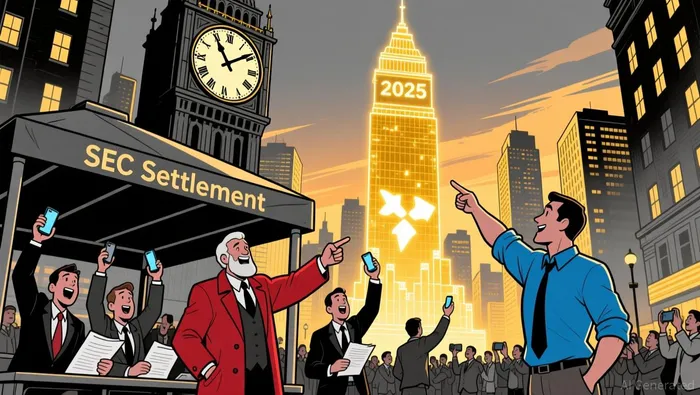
The cryptocurrency market has long been haunted by regulatory uncertainty, but 2025 marked a turning point. The landmark settlement between the U.S. Securities and Exchange Commission (SEC) and Ripple Labs in December 2025 has not only resolved a five-year legal battle but also created a framework for how digital assets might be classified in the future. For XRPXRP--, the native token of Ripple's blockchain network, this resolution has unlocked a new chapter-one defined by regulatory clarity and the potential for explosive institutional adoption.
Regulatory Clarity: A Definitive Win for XRP
The SEC's case against Ripple hinged on whether XRP qualified as a security under U.S. law. After years of litigation, a federal court ruled in 2023 that XRP is not a security when traded on public exchanges but remains one in institutional sales. This nuanced distinction was codified in the 2025 settlement, which saw Ripple pay a $50 million civil penalty to the SEC. Crucially, the ruling affirmed that XRP's utility in cross-border payments and decentralized exchanges does not fall under the Howey Test-a framework used to define securities.
This outcome is monumental. For the first time, a major digital asset has received a clear regulatory designation in the U.S. Unlike other cryptocurrencies, which remain in legal limbo, XRP now operates under a defined framework. As stated by legal analysts at Gordon Law, the case "sets a precedent that could reshape how regulators evaluate utility tokens versus investment contracts." This clarity reduces compliance risks for exchanges, developers, and investors, making XRP a safer bet in a market historically plagued by ambiguity.
Market Validation: Price Surges Reflect Confidence
The market has already priced in much of this optimism. Following the 2025 settlement, XRP's price surged from approximately $0.50 to over $3 within months. This 500% rally mirrors the trajectory of BitcoinBTC-- post-2017, where regulatory clarity (or the perception of it) catalyzed mainstream adoption. While XRP still trades below its 2021 highs, its valuation now reflects a fundamental shift: investors are no longer betting against the possibility of a SEC enforcement action.
Institutional Adoption: The Next Catalyst
Regulatory clarity is the first step; institutional adoption is the next. While specific data on post-2025 institutional investments in XRP remains scarce, the logical inference is clear: institutions cannot scale exposure to an asset without knowing its legal status. The SEC's resolution removes that barrier.
Consider the broader context. Ripple's XRP Ledger has long been optimized for real-time gross settlement systems, targeting banks and financial intermediaries seeking faster, cheaper cross-border transactions. With XRP now deemed a non-security in retail contexts, traditional financial players can integrate it into their infrastructure without fear of regulatory reprisal. For example, a major U.S. bank could now offer XRP-based remittance services or list it on a regulated exchange, activities previously deemed too risky.
Moreover, the 2025 settlement coincided with a leadership shift at the SEC under President Trump's administration, which has signaled a more business-friendly approach to crypto. This political tailwind further reduces the likelihood of future overreach, making XRP an attractive hedge against regulatory volatility in the sector.
Why 2026 Could Be the Breakout Year
The pieces are now in place for XRP to outperform in 2026. Regulatory clarity has resolved the "liability overhang" that once plagued the asset, while its unique utility in payments creates a use case that aligns with institutional needs. Additionally, the token's supply dynamics-Ripple Labs releases XRP gradually and burns tokens used for transactions-suggest long-term scarcity, a trait that typically drives value appreciation.
Critics may argue that institutional adoption has yet to materialize, but history shows that regulatory milestones often precede adoption by 12–18 months. Bitcoin's inclusion in 401(k) plans and Ethereum's ESG-driven institutional interest both followed years of legal battles. XRP is now in a similar position: the foundation has been laid, and the next phase hinges on execution.
Conclusion: A Post-Resolution Play
XRP's journey from legal uncertainty to regulatory clarity mirrors the broader evolution of cryptocurrency. The 2025 SEC settlement is not just a win for Ripple-it's a blueprint for how digital assets can coexist with traditional financial systems. For investors, the implications are straightforward: XRP is no longer a speculative bet on regulatory outcomes but a tangible play on institutional adoption and utility.
As 2026 unfolds, the question will no longer be if XRP can thrive in a regulated world, but how fast institutions will move to capitalize on its newfound legitimacy.






Comentarios
Aún no hay comentarios