
The Case for UK 10-Year Gilts: A Strategic Overweight in a Fragmented Global Asset Landscape
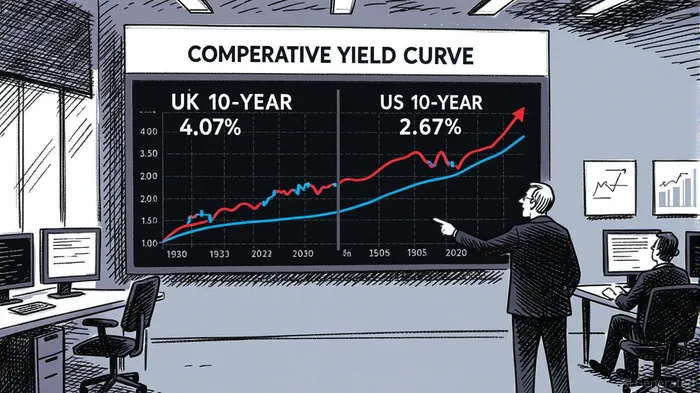
In a global bond market increasingly shaped by divergent fiscal policies and trade tensions, UK 10-year gilts present a compelling case for strategic overweighting. With yields hovering near 4.63% as of September 9, 2025, the UK's long-dated debt offers a premium over major peers such as US Treasuries (4.07%) and German Bunds (2.67%), reflecting both higher risk and higher potential reward. This analysis explores the relative value of UK gilts through the lenses of yield curve dynamics and global macroeconomic fragmentation, arguing that the current pricing incorporates a margin of safety absent in other core markets.
Relative Value: A Premium for Fiscal Uncertainty
The UK's 10-year gilt yield has surged to its highest level since January 2025, driven by concerns over the government's fiscal trajectory. Finance Minister Rachel Reeves faces mounting pressure to address public finances in the upcoming Autumn Budget, with investors pricing in a 19.63% annualized yield increase since September 2024. This premium contrasts sharply with the more stable environments in Germany and the US. While German Bund yields have risen modestly to 2.67% amid defense spending pressures, US Treasuries remain anchored by expectations of Federal Reserve rate cuts, despite a 4.07% yield on 10-year debt.
The divergence underscores a critical asymmetry: UK gilts are priced to assume a higher probability of fiscal slippage, whereas US and German bonds benefit from more predictable policy frameworks. For instance, the UK's 10-year yield premium over the US has widened to 56 basis points, the largest since the post-Brexit volatility of 2019. This spread reflects not just higher inflation expectations but also a term premium for UK-specific risks, including the potential for prolonged fiscal consolidation.
Yield Curve Positioning: A Steeper Curve, A Stronger Signal
The UK's yield curve has steepened to a 72-basis-point spread between 10-year and 2-year gilts (4.63% vs. 3.91% as of September 9, 2025), outpacing the US (45 bps) and Germany (98 bps). This steepness signals market expectations of a prolonged period of elevated short-term rates and a gradual normalization of long-term yields. Unlike the US, where the curve has flattened due to aggressive Fed rate-cut expectations, the UK's curve suggests a more cautious outlook for monetary policy easing.
This positioning is reinforced by global macroeconomic shifts. The Bank of England's Financial Stability Report notes that UK gilt yields have become more sensitive to US trade policy announcements, with term premia rising sharply in response to tariff-related uncertainties. Meanwhile, the UK's 10-year yield has outperformed Japanese government bonds (1.56%) and even emerging markets like Brazil (13.91%), where inflation-driven volatility dominates. The result is a yield curve that balances growth resilience with fiscal caution—a rare combination in today's fragmented landscape.
Strategic Implications for Investors
For investors seeking yield in a low-growth world, UK gilts offer a unique sweet spot. The 4.63% yield on 10-year debt provides a buffer against inflation expectations (currently priced at 2.4% by the Bank of England) while the steep curve allows for roll-down gains as shorter-dated bonds mature. This dynamic is particularly attractive compared to the US, where the flatter curve limits such opportunities.
However, the case is not without risks. The upcoming Autumn Budget could trigger volatility if fiscal plans fall short of market expectations. Yet, given the current pricing of a 4.64% yield for the end of Q3 2025, the market appears to have already discounted much of this uncertainty. For investors with a medium-term horizon, the margin of safety embedded in the UK's yield premium may justify the strategic overweight.
Conclusion
In a world where global bond markets are increasingly decoupling, UK 10-year gilts stand out as a strategic asset. Their relative value is underpinned by a yield premium that compensates for fiscal risks while offering a steeper curve than major peers. As central banks grapple with stagflationary pressures and trade policy shifts, the UK's gilts provide a hedge against both inflation and geopolitical uncertainty—a case for overweighting that is as pragmatic as it is timely.







Comentarios
Aún no hay comentarios