
The Case for Strategic Exposure to Industrial and Precious Metals in a Deteriorating Macro Environment
In a macroeconomic environment marked by persistent inflation, trade fragmentation, and central bank policy uncertainty, industrial and precious metals have emerged as critical components of commodity-driven portfolio rebalancing. As global GDP growth moderates to 3.1% in 2025 and 3.0% in 2026, according to the IMF World Economic Outlook Update (January 2025), while headline inflation in G20 economies remains stubbornly above central bank targets, according to the OECD Economic Outlook, investors are increasingly turning to these assets to hedge against currency devaluation and supply chain disruptions.
Macroeconomic Deterioration and Metal Market Dynamics
The interplay of tariffs, geopolitical risks, and slowing demand has reshaped industrial metal markets. U.S. tariffs on steel and aluminum-fixed at 25% since 2023-have created a fragmented global supply chain, with a J.P. Morgan outlook projecting a 1% year-over-year contraction in aluminum demand for 2025. Copper, a bellwether for global industrial activity, faces similar headwinds, with average prices expected to hover around $8,300/mt in Q2 2025 amid fears of a 60% recession probability, as noted in the Sucden Financial outlook. Meanwhile, the U.S. Bureau of Labor Statistics notes a 12.0% surge in import prices for primary metal manufacturing in 2024, driven by alumina and aluminum production costs.
Precious metals, however, have shown resilience. Gold prices approached $2,800/oz in 2025, driven by central bank purchases (18 tonnes net in early 2025) and a shift toward de-dollarization, according to The Tradable. Silver, meanwhile, has surged 70% from March 2020 lows, outpacing gold's 6.4% gain during the same period, as shown in a Gainesville Coins analysis, reflecting its dual role as an industrial and inflation-hedging asset.
Historical Precedents and Portfolio Rebalancing
Historical data underscores the efficacy of metals as inflation hedges. During the 1970s stagflation crisis, silver delivered a 32.3% compound annual growth rate (CAGR), outperforming gold's 27.0% CAGR - a performance noted in the Gainesville Coins analysis referenced above. Similarly, in the post-COVID-19 period, silver's 70% rebound in 2020-2021 contrasted with gold's more moderate gains, as documented by Moneyexcel. These patterns highlight metals' ability to outperform traditional assets during periods of monetary instability.
Modern portfolio strategies increasingly allocate 5-15% to metals for diversification. The WisdomTree Enhanced Commodity Strategy Fund (GCC), for instance, combines exposure to energy, agriculture, and metals while leveraging BitcoinBTC-- futures to optimize roll yield. Academic work also supports this allocation: a ScienceDirect study demonstrates that minimum-variance portfolios incorporating industrial metals have shown higher Sharpe ratios compared to stock-only portfolios.
Institutional Investor Strategies and Performance Metrics
Institutional investors have repositioned portfolios to prioritize metals. Central banks, including those of China and Kazakhstan, have purchased record gold reserves in 2025, reflecting a shift toward currency diversification, a trend noted earlier by The Tradable. Meanwhile, ESG-focused funds are allocating to platinum and palladium, driven by their role in hydrogen fuel cell technology, as analyzed in Energy, critical minerals, and precious metals.
Quantitative performance metrics reinforce these trends. A 2024 CFA Institute case study of university endowments found that rebalancing to include 10% gold and 5% silver improved portfolio resilience during the 2023-2025 volatility period. Similarly, a J.P. Morgan analysis of industrial metals in 2025 highlights their potential to act as "natural hedges" against trade-war-driven market turbulence.
Conclusion: Strategic Imperatives for 2025-2026
As macroeconomic deterioration persists, strategic exposure to industrial and precious metals offers a dual benefit: inflation hedging and portfolio diversification. With gold projected to trade near $3,500/oz and silver in the $30-35 range by 2026, according to a PurelyInvesting analysis, and industrial metals poised to benefit from clean energy demand as described in a World Bank blog, investors should consider rebalancing toward these assets. In an environment of elevated policy uncertainty and trade fragmentation, metals remain a cornerstone of resilient portfolio construction.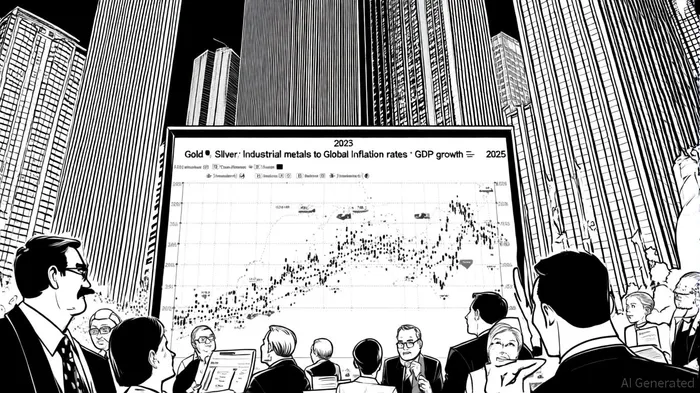






Comentarios
Aún no hay comentarios