
The Case for Strategic Altcoin Accumulation Amid Stagnant Shitcoin Season Index
The cryptocurrency market in late 2025 is navigating a complex interplay between BitcoinBTC-- dominance and altcoin performance. With Bitcoin's market capitalization share hovering near 59.11% as of late December, the broader crypto ecosystem remains in a transitional phase. While Bitcoin's dominance has declined from multi-year highs above 61% in November, this shift signals a potential reallocation of capital toward altcoins-a dynamic that investors should not overlook. This article argues for a strategic, risk-adjusted approach to altcoin accumulation, even as the Shitcoin Season Index remains stagnant, by leveraging historical patterns, institutional trends, and evolving market structures.
Bitcoin Dominance: A Barometer of Market Sentiment
Bitcoin dominance, a metric reflecting Bitcoin's share of the total crypto market cap, has long served as a proxy for risk appetite. A decline in dominance often correlates with increased investor interest in altcoins, as capital flows toward innovation-driven projects. In 2025, this trend has been amplified by macroeconomic uncertainty and the maturation of institutional-grade crypto infrastructure. For instance, Bitcoin's dominance fell from over 61% in November to 58.8% by year-end, coinciding with a surge in the Altcoin Season Index to 47-the highest level in over a month. This suggests that while Bitcoin remains the market's anchor, the conditions for altcoin outperformance are gradually materializing.
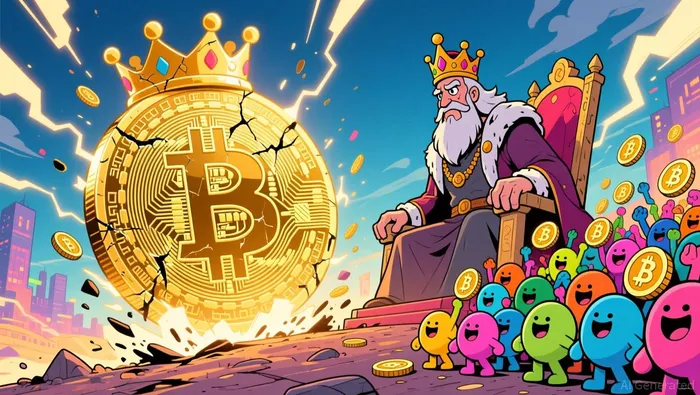
However, the broader market context remains bearish. Bitcoin's price slipped below $90,000 in late 2025, and altcoins have underperformed due to liquidity constraints and macroeconomic headwinds. This duality-declining Bitcoin dominance amid a bearish market-creates a unique opportunity for investors to selectively allocate capital to altcoins with strong fundamentals, rather than speculative tokens.
Risk-Adjusted Returns: Altcoins vs. Bitcoin
Historical data from 2023–2025 reveals a nuanced picture of risk-adjusted returns. During periods of high Bitcoin dominance (60%+), Bitcoin has consistently outperformed altcoins in terms of Sharpe ratios and volatility metrics. For example, Kaiko's research highlights that Bitcoin's Sharpe ratio exceeded that of Solana and XRP, even as altcoins exhibited larger drawdowns (up to -31.3% vs. Bitcoin's -18.05%). This underscores Bitcoin's role as a safer asset during market stress.
Yet, the narrative shifts when Bitcoin dominance declines. In late 2025, a "partial alt season" emerged, with EthereumETH-- and SolanaSOL-- outperforming Bitcoin by 23% and 31%, respectively, over a 90-day period. Grayscale's Q3 2025 report further notes that Bitcoin underperformed most crypto sectors, particularly those tied to financial infrastructure and stablecoin adoption. These patterns suggest that while Bitcoin remains a core holding, altcoins can deliver asymmetric returns when market conditions favor diversification.
Strategic Allocation: Balancing Safety and Innovation
Capital allocation strategies must adapt to Bitcoin dominance cycles. When dominance exceeds 65%, a conservative approach-allocating 70–80% to Bitcoin and 0–5% to altcoins-is prudent. This strategy prioritizes capital preservation during macroeconomic uncertainty, as smaller altcoins are more susceptible to liquidity shocks. Conversely, when dominance drops below 55%, increasing altcoin exposure to 20–40% can capture growth in innovation-driven projects.
In 2025, the institutionalization of crypto markets has further refined these dynamics. Institutional adoption of Bitcoin ETFs and regulatory clarity have solidified Bitcoin's role as a core asset, while altcoins with real-world applications (e.g., DeFi, RWA, AI-linked tokens) have shown resilience. For example, ZEC and BNB surged by 489% and 42%, respectively, during periods of declining Bitcoin dominance, illustrating the potential for asymmetric returns.
The Case for Strategic Altcoin Accumulation
Despite a stagnant Shitcoin Season Index (currently at 41), the case for altcoin accumulation rests on three pillars: 1. Fundamental Strength: Blue-chip altcoins like Ethereum and Solana have demonstrated resilience during market downturns, driven by robust use cases and developer activity. 2. Institutional Tailwinds: Regulatory clarity and ETF inflows have reduced Bitcoin's volatility, making it a less attractive speculative asset and freeing capital for altcoin rotation. 3. Historical Cycles: Bitcoin dominance peaks often precede altcoin seasons. For instance, the 2021 cycle saw Bitcoin dominance peak before altcoins surged-a pattern likely to recur as dominance declines further(https://yellow.com/en-US/learn/what-is-altcoin-rotation-how-smart-money-flows-from-bitcoin-to-altcoins-drive-crypto-market-cycles).
Investors should focus on quality over quantity, prioritizing altcoins with strong fundamentals and avoiding speculative small-cap tokens. Technical indicators like the Altcoin Season Index and on-chain metrics (e.g., developer activity, transaction volume) can help time entries.
Conclusion
The 2025 crypto market is at a crossroads. While Bitcoin dominance remains elevated, its decline signals a redistribution of capital toward altcoins-a trend that aligns with historical cycles and institutional-grade strategies. By adopting a risk-adjusted approach-allocating capital to blue-chip altcoins during periods of declining dominance-investors can balance innovation and stability. As the market matures, the key to success lies not in chasing hype but in leveraging data-driven insights to navigate the evolving crypto landscape.






Comentarios
Aún no hay comentarios