
The Case for Physical Silver in a Dovish Fed Regime and Supply-Driven Bull Market
The Federal Reserve's dovish pivot in late 2025 has created a perfect storm for physical silver, combining monetary tailwinds with structural industrial demand and supply constraints. As the Fed projects further rate cuts into 2026, investors are increasingly turning to non-yielding assets like silver to hedge against inflation and a weakening dollar. Meanwhile, industrial demand for silver-driven by solar energy, electric vehicles (EVs), and AI-driven data centers-has surged to unprecedented levels, creating a self-reinforcing cycle of price appreciation. This analysis unpacks the interplay of monetary policy, industrial fundamentals, and investment flows that position physical silver as a compelling long-term opportunity.
Dovish Fed Policy: A Tailwind for Non-Yielding Assets
The Federal Reserve's Q4 2025 policy stance has been unequivocally dovish. The FOMC's median federal funds rate projection of 3.6% by year-end 2025 reflects a continuation of rate cuts initiated in September 2025, with further easing expected to reach 3.4% by 2026 according to market analysis. This shift is driven by a weakening labor market-unemployment rose to 4.3% in August 2025-and persistent inflation, particularly in the service sector, where businesses have absorbed tariff-related costs.
Lower interest rates reduce the opportunity cost of holding non-yielding assets like silver, which historically performs best in low-rate environments. As the Fed's dovish stance weakens the U.S. dollar, silver becomes more attractive to international buyers, further amplifying demand according to market analysis. According to a report by the Capital Markets Playbook, the dollar's decline in 2025 has already redirected capital flows toward commodities, with silver benefiting from both monetary and industrial drivers according to institutional analysis.
Industrial Demand: A Structural Bull Case
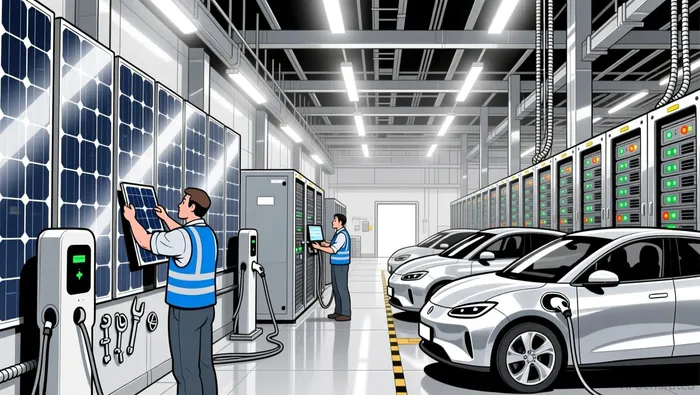
Silver's industrial demand has become a cornerstone of its bull case. The metal's unique electrical and thermal conductivity makes it indispensable in solar photovoltaic (PV) panels, EVs, and data centers. The Silver Institute reports that industrial demand accounts for 59% of global silver consumption, with solar PV applications growing at an annualized rate of 12.6% since 2015 according to industry data. By 2025, solar PV demand alone accounts for 29% of industrial silver consumption, driven by global renewable energy targets according to the Silver Institute.
The automotive sector is another major growth driver. EVs require 25–50 grams of silver per unit, compared to internal combustion engine (ICE) vehicles, and are projected to overtake ICE vehicles as the primary source of automotive silver demand by 2031 according to industry forecasts. Meanwhile, AI and data center expansion have created a surge in IT power demand, which has grown 5,252% since 2000, further boosting silver consumption according to market analysis.
The global silver market has been in a structural deficit for seven consecutive years, with a projected shortfall of 120 million ounces in 2025 according to market analysis. Over 70% of silver is produced as a byproduct of copper, zinc, and lead mining, meaning supply cannot be easily ramped up in response to higher prices according to industry reports. This inelasticity is exacerbated by the fact that new primary silver mining projects account for only 25–28% of global output according to industry data.
By 2030, solar PV demand alone is expected to require 48,000–54,000 tons of silver annually, but supply is projected to meet only 62–70% of this demand according to industry forecasts. Structural deficits are further compounded by geopolitical risks and mine production bottlenecks, creating a supply-driven bull market that is unlikely to abate soon.
Investment Demand: A New Era of Institutional Buying
Investment demand for silver has also surged in 2025, with silver-backed ETFs and exchange-traded products (ETPs) attracting $40 billion in inflows during the first half of the year according to market data. This institutional buying is directly tied to the Fed's dovish policy, as lower rates reduce the appeal of cash and bonds while pushing capital into inflation-hedging assets according to market analysis.
The gold-silver ratio, currently near 90:1, suggests silver is historically undervalued relative to gold, a trend often preceding bull market cycles according to market analysis. Central bank purchases and ETF inflows have further amplified this dynamic, with physical silver becoming a dual-purpose asset: a hedge against monetary debasement and a critical input for the green energy transition.
Risks and the Path Forward
While the case for silver is robust, risks remain. A global economic slowdown or liquidity corrections could temporarily pressure prices according to market analysis. Additionally, delays in Fed rate cuts due to stronger-than-expected economic data could weaken the dollar less than anticipated according to market forecasts. However, the structural drivers-industrial demand, supply deficits, and dovish monetary policy-remain intact, suggesting that silver's rally is far from over.
Analysts project silver could test $100 per ounce in 2026, driven by continued industrial demand and ETF inflows according to market forecasts. For investors, physical silver offers a unique combination of monetary and industrial value, making it a strategic asset in a world of structural inflation and technological transformation.
Conclusion
The dovish Fed regime, coupled with structural industrial demand and supply constraints, has created a compelling case for physical silver. As the green energy transition accelerates and monetary policy remains accommodative, silver's dual role as both a monetary hedge and an industrial input positions it as one of the most attractive assets in the commodities complex. For those seeking to hedge against inflation, diversify portfolios, or capitalize on the next industrial revolution, physical silver is a must-own.







Comentarios
Aún no hay comentarios