
The Case for Value Investing in a Momentum-Dominated Market
In recent years, the U.S. equity market has been increasingly dominated by momentum-driven strategies, with the S&P 500's performance heavily influenced by a narrow group of high-priced technology stocks. As of 2025, the S&P 500's price-to-earnings (P/E) ratio stands at approximately 22 times, a stark contrast to the Oakmark Fund's P/E ratio of 13 times. This divergence underscores a critical opportunity for investors to rebalance toward value-driven strategies in 2026, leveraging the Oakmark Fund's structural advantages in diversification, risk mitigation, and historical outperformance during market corrections.
The Risks of Momentum Concentration
The S&P 500's current composition reflects a dangerous overreliance on a handful of technology giants. Approximately 35% of the index is concentrated in the technology sector, with the top ten companies-accounting for just 2% of the index- representing 41% of its total market capitalization. This concentration, often referred to as the "Magnificent 7" (Alphabet, AmazonAMZN--, AppleAAPL--, MetaMETA--, MicrosoftMSFT--, NvidiaNVDA--, and Tesla), has driven much of the market's gains in recent years. However, such heavy weighting increases systemic risk, as demonstrated by the index's near-bear market dip in early April 2025 amid trade policy uncertainty.
In contrast, the Oakmark Fund maintains a sector allocation that prioritizes diversification. Less than 5% of its portfolio is invested in technology stocks, with its largest holding comprising under 3% of the fund. This approach not only reduces correlation with the S&P 500 but also insulates the portfolio from sector-specific shocks.
Value Investing's Edge: Low P/E and Active Share
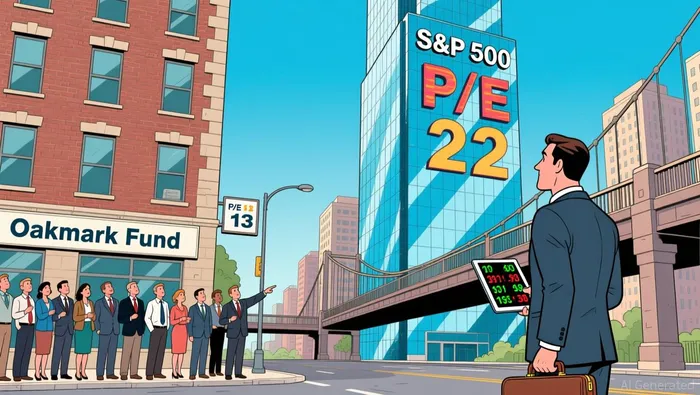 The Oakmark Fund's lower P/E ratio of 13 times in 2025 highlights its focus on undervalued, high-quality businesses. This valuation metric, significantly below the S&P 500's 22 times, suggests a more conservative approach to capital allocation. Furthermore, the fund's active share of 89.87% relative to the S&P 500 indicates a high degree of distinctiveness in its holdings, enabling investors to access a portfolio that diverges meaningfully from the broader market's momentum-driven trajectory.
Historical Outperformance During Corrections
While the Oakmark Fund matched the S&P 500's -16% decline during the 2022 market correction, it demonstrated resilience in 2023, outperforming the index during both the fourth quarter and the full year. In Q4 2023, the fund returned 12.92% compared to the S&P 500's 11.69%, and for the year, it delivered 30.89% versus the S&P 500's 26.29%. This performance underscores the benefits of active management and value-oriented strategies during periods of market volatility.
Momentum Excess and the Case for Rebalancing
Despite the success of momentum strategies in 2025- where the top quintile of U.S. stocks outperformed the S&P 500 by 43%-experts caution against overreliance on this approach. Goldman Sachs Research projects that global stocks may return 11% over the next 12 months, driven by earnings growth rather than valuation expansion. This shift suggests a more selective market in 2026, where diversified, value-focused portfolios like the Oakmark Fund could offer superior risk-adjusted returns.
Conclusion: A Strategic Shift Toward Value
As the U.S. equity market grapples with the risks of concentration and the limitations of momentum-driven gains, investors are increasingly recognizing the merits of value investing. The Oakmark Fund's low P/E ratio, reduced sector concentration, and historical outperformance during corrections position it as a compelling alternative to the S&P 500. By rebalancing toward value-driven strategies in 2026, investors can mitigate systemic risks while capitalizing on undervalued opportunities in a market poised for a more balanced trajectory.





Comentarios
Aún no hay comentarios