
The Case for Canadian Equities Amid Easing Rate Outlooks and Commodity Strength
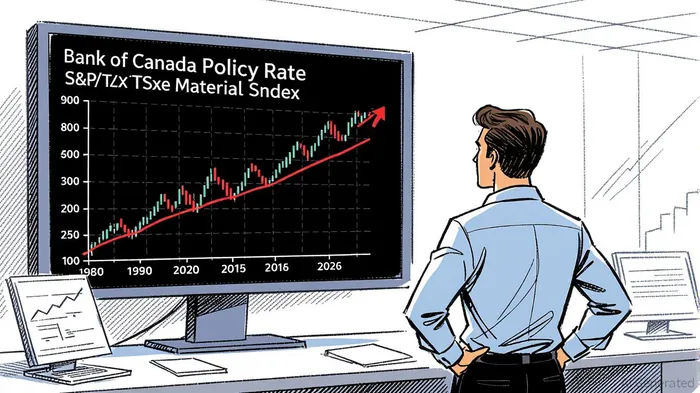
The Canadian equity market is at a pivotal juncture as central banks globally pivot toward rate cuts and commodity-linked sectors gain traction. With the Bank of Canada projected to reduce its policy rate to 2.25% by year-end 2025—marking two additional 25-basis-point cuts—investors are recalibrating their strategies to capitalize on the interplay between monetary easing and commodity dynamics [1]. This analysis explores how strategic positioning in the TSX’s energy and materials sectors can yield outsized returns amid a shifting macroeconomic landscape.
Central Bank Easing and Its Impact on Canadian Equities
The Bank of Canada’s rate-cutting trajectory is a direct response to a slowing economy, characterized by a softening labor market and trade tensions with the United States [1]. TD Economics forecasts two more cuts in 2025, with the next decision scheduled for September 17 [6]. These cuts are part of a broader global trend: the U.S. Federal Reserve and European Central Bank are also easing policy, with the Fed expected to cut rates three times by early 2026 [5].
Lower interest rates reduce borrowing costs for businesses and investors, directly supporting equity valuations. According to a report by Edward Jones, rate cuts are particularly beneficial for equities as they help maintain profit margins and encourage capital expenditure [4]. The TSX has already reflected this dynamic, with energy and mining stocks leading a 0.9% rise in early 2025 [4]. Markets are now pricing in a 90% probability of a September rate cut following a weak jobs report [3], underscoring the market’s anticipation of further monetary stimulus.
Commodity Dynamics: Gold and Oil as Macroeconomic Barometers
Commodity-linked sectors are central to the TSX’s performance, with gold and oil prices serving as barometers for global economic sentiment. Gold prices surged past $3,000 per ounce in mid-2025, driven by U.S. fiscal uncertainty, inflationary pressures from tariffs, and central bank demand [2]. The S&P/TSX Materials Index has risen roughly 25% year-to-date, reflecting strong demand for gold and base metals [1].
Oil, however, remains more volatile. While prices stabilized near $62.35 per barrel in August, concerns over global demand—particularly in China—and OPEC+ production adjustments have introduced uncertainty [1]. Yet, a weaker U.S. dollar and increased LNG takeaway capacity in North America have provided some tailwinds for the energy sector [4]. The interplay between rate cuts and commodity prices is critical: falling interest rates reduce the opportunity cost of holding non-yielding assets like gold, while energy markets remain sensitive to geopolitical risks and supply dynamics [4].
Strategic Sector Positioning: Energy and Materials Take Center Stage
Given these trends, strategic positioning in the TSX’s energy and materials sectors offers compelling opportunities. Energy stocks are poised to benefit from a potential rebound in oil prices if OPEC+ curtails production or global demand stabilizes. Meanwhile, materials stocks—particularly those tied to gold—are well-positioned to capitalize on sustained demand from central banks and inflation hedging [2].
Investment firms are already emphasizing high-quality commodity-linked equities with strong balance sheets and political stability [3]. For example, gold producers with low-cost reserves and robust exploration pipelines could outperform as prices test $4,000 per ounce under stagflationary scenarios [2]. Similarly, energy firms with exposure to LNG infrastructure may benefit from long-term structural demand shifts [4].
Risks and Considerations
While the case for Canadian equities is strong, risks persist. Trade tensions with the U.S. and geopolitical instability—such as the Israel-Iran conflict—could disrupt supply chains and weigh on commodity prices [1]. Additionally, the effectiveness of fiscal stimulus under Prime Minister Mark Carney remains uncertain, as rising core inflation could delay rate cuts [1]. Investors must also remain cautious about elevated valuations in the S&P/TSX, which, while attractively positioned for long-term value, require disciplined bottom-up stock selection [1].
Conclusion
The confluence of central bank easing and commodity strength presents a unique opportunity for investors in Canadian equities. As the Bank of Canada and its global counterparts pivot toward accommodative policies, sectors like energy and materials are likely to outperform. By strategically positioning in high-quality, commodity-linked equities, investors can navigate macroeconomic headwinds while capitalizing on the tailwinds of a rate-cutting cycle.
Source:
[1] Will the Bank of Canada cut rates in 2025? [https://stories.td.com/ca/en/article/bank-of-canada-interest-rate-prediction-june-2025]
[2] Gold 2025 Midyear Outlook: A High(er) for Long ... [https://www.ssga.com/us/en/institutional/insights/gold-2025-midyear-outlook-a-higher-for-longer-gold-price-regime]
[3] 'Exceptionally Weak' Jobs Report Prompts Markets to Price in 90% Odds of Rate Cut [https://www.theglobeandmail.com/investing/markets/inside-the-market/article-market-based-odds-of-boc-rate-cut-this-month-zoom-to-90-after-weak/]
[4] What Bank of Canada Rate Cut May Mean for Your Portfolio [https://www.edwardjones.ca/ca-en/market-news-insights/guidance-perspectives/boc-rate-cut]
[5] What's The Fed's Next Move? | J.P. Morgan Research [https://www.jpmorganJPM--.com/insights/global-research/economy/fed-rate-cuts]
[6] Bank of Canada Interest Rate Schedule 2025 [https://myperch.io/bank-of-canada-interest-rate-schedule/]







Comentarios
Aún no hay comentarios