
Carvana's Accounting Mirage and Looming Solvency Crisis
A Toxic Loan Book Built on Lax Underwriting
Carvana's business model hinges on originating subprime auto loans with virtually no underwriting rigor. According to a report by Hindenburg Research, the company approved 100% of applicants, creating a loan portfolio where 44% of asset-backed securities (ABS) deals are non-prime, and over 80% of those fall into the "deep subprime" category according to Hindenburg Research. This toxic mix has led to a delinquency crisis: 60-day delinquencies among Carvana's "prime" borrowers are four times the industry average according to Hindenburg Research.
The risks are compounded by a used car market in freefall. Used vehicle prices have plummeted 20.3% over three years, leaving 44% of loans for cars purchased since 2022 underwater according to Hindenburg Research. As borrowers struggle to keep up with payments, Carvana's reliance on loan extensions-a proxy for distress-has more than doubled in 2024, far outpacing peers according to Hindenburg Research.
Financial Engineering: Selling Loans to Prop Up Profits
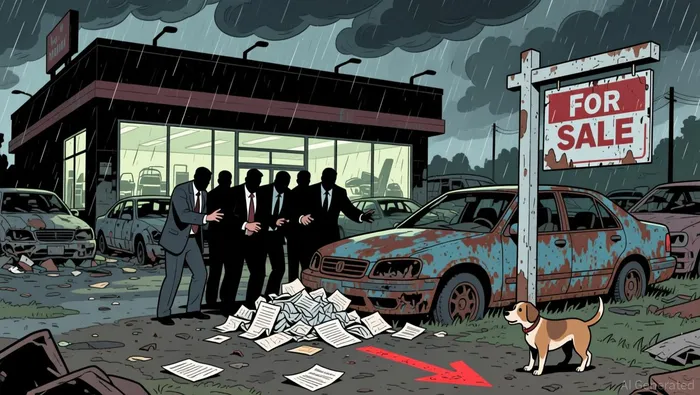
Carvana's survival depends on selling the loans it originates to third-party financiers. In the past nine months alone, it sold $6.15 billion in loans, with gains from these sales accounting for 2.2x the company's net income according to Hindenburg Research. This "originate-to-dump" strategy masks declining profitability and liquidity.
The company's largest buyer, Ally Financial, abruptly pulled back in 2024, ending a $3.6 billion deal that had accounted for 60% of Carvana's originations according to Hindenburg Research. While an unnamed third party (likely a Cerberus Capital trust) stepped in to purchase $800 million in loans, this lifeline raises red flags. Dan Quayle, a Carvana director and Cerberus chairman, sits at the center of this opaque transaction, blurring the lines between corporate governance and self-dealing according to Hindenburg Research.
Corporate Governance: A House of Cards
Carvana's governance issues run deeper than its loan book. The company generated $145 million in "other revenue" from related parties in 2023, including $138 million in commissions from DriveTime, a company to which Carvana offloaded cars at a premium according to Hindenburg Research. These transactions, coupled with an undisclosed SEC investigation and a mid-tier auditor (Grant Thornton) criticized for its fraud-detection capabilities, paint a picture of systemic dysfunction according to Hindenburg Research.
Meanwhile, CEO Ernest Garcia's insider sales-$939,347 and $511,105 in shares in late September 2025-have drawn scrutiny according to Investing.com and according to Investing.com. While the company reported record adjusted EBITDA of $601 million in Q2 2025, these sales suggest executives may be hedging against an impending collapse.
Broader Market Headwinds and Competitive Pressures
Carvana's struggles are not isolated. Ford and Amazon's expansion into online car sales has intensified competition, threatening Carvana's market share according to Seeking Alpha. Yet the company's reliance on subprime lending and financial engineering leaves it ill-equipped to adapt. With used car prices continuing to fall and subprime delinquencies surpassing 2008 levels according to Hindenburg Research, Carvana's solvency is increasingly tied to a house of cards.
Conclusion: A Mirage That Can't Last
Carvana's accounting tricks and aggressive loan sales have bought time, but they cannot mask a business model built on sand. As liquidity dries up, delinquencies rise, and corporate governance scandals mount, investors would be wise to heed the warning signs. The mirage is fading-and the solvency crisis is just around the corner.





Comentarios
Aún no hay comentarios