
Carter's: Oversold With Potential Catalysts
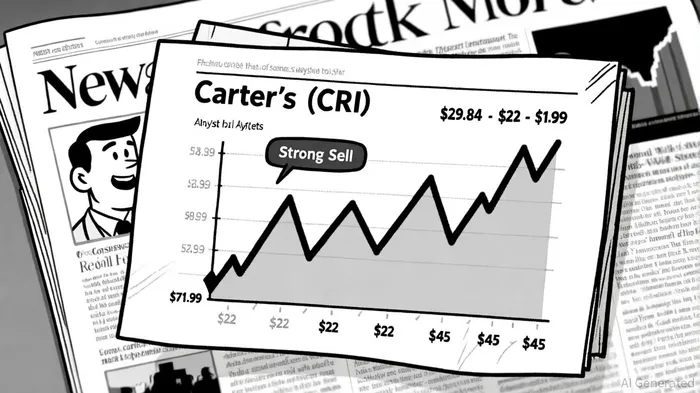
Carter's Inc. (CRI) has emerged as a compelling case study in market sentiment versus strategic potential. As of October 10, 2025, the stock trades at $29.84, a 9.8% decline from its one-month high of $33.08 and a staggering 57% below its 52-week peak of $71.99, according to Carter's price history. Despite a "Strong Sell" consensus from five Wall Street analysts-three "Sell" and two "Hold" ratings-the average twelve-month price target of $30.25, per the MarketBeat forecast, implies a 19.26% upside from current levels. This disconnect between bearish sentiment and embedded optimism raises critical questions: Is Carter'sCRI-- undervalued, or is the market correctly pricing in existential risks?
Near-Term Undervaluation: A Tale of Tariffs and Analyst Drift
Carter's stock has been battered by external headwinds and internal missteps. The Q2 2025 earnings report revealed a $125–150 million annual pre-tax earnings hit from U.S. import tariffs, with $35 million already impacting net income in the second half of fiscal 2025, as outlined in the Q2 2025 slides. Analysts have responded with skepticism: Barclays slashed its price target to $22 in July 2025, while Zacks Research downgraded from "Hold" to "Strong Sell" in August, as reported by Insider Monkey. Yet, these downgrades overlook Carter's proactive mitigation strategies. The company plans to shift sourcing from China (less than 4% of its supply) to Vietnam, Cambodia, and Bangladesh, while sharing costs with vendors to offset tariff impacts, according to the second-quarter report. By 2026, management aims to fully neutralize these costs-a timeline that may not yet be factored into current valuations.
Strategic Turnaround: Leadership, Costs, and Sustainability
Carter's leadership transition in early 2025-marked by the retirement of CEO Michael Casey and the appointment of Interim CEO Richard Westenberger-has introduced both uncertainty and opportunity. While the interim leadership team has incurred $17 million in transition costs (comprising $9.8 million in operating model improvements and $7.2 million in leadership expenses), it has also prioritized operational rigor, as noted by Panabee. SG&A expenses, however, remain a concern, rising $26 million to $273 million in Q2 2025 due to storage and store maintenance costs, per the Q2 earnings call.
The company's long-term vision, however, is more promising. Carter's has committed to sustainability under its Raise the Future™ platform, with 99% of apparel meeting OEKO-TEX® STANDARD 100 and 60% of packaging now using recycled materials, as detailed in the Raise the Future report. These initiatives align with growing consumer demand for ethical fashion and could differentiate Carter's in a crowded market. Additionally, the relaunched KIDCYCLE™ takeback program and AI-driven inventory management signal a shift toward circularity and efficiency.
Catalysts for Rebound: International Expansion and Digital Innovation
Carter's Q3 2025 results, though mixed, highlight underappreciated growth vectors. Net sales of $758 million exceeded guidance, driven by a 14% international revenue increase (18% in constant currency) in Canada and Mexico, according to the Q3 earnings call. The company plans to enter three new international markets by year-end, targeting $50 million in international revenue. Domestically, Carter's is leveraging AI to personalize its mobile app and optimize store performance, with a fleet segmentation strategy to close, relocate, or expand underperforming stores, outlined in a recent SWOT analysis.
A critical wildcard is the Baby category, which saw 10% growth in Q2 2025. With 25% U.S. market share in children's apparel, Carter's remains a household name. If the company can sustain this momentum while reducing SG&A bloat, its price-to-earnings ratio of 13.1x (vs. 15.4x for peers) suggests a valuation discount that may not reflect its brand strength, per the historical stock data.
Risks and Rewards
Investors must weigh near-term risks against long-term potential. The "Strong Sell" rating reflects concerns over margin compression and execution risks in international expansion. However, Carter's strategic pillars-sustainability, digital transformation, and cost discipline-align with macro trends. The stock's 19.26% upside from analyst targets, coupled with a 4% sales growth in Q2 2025, hints at a floor for the shares.
For those with a 12–18 month horizon, Carter's could offer asymmetric upside if its tariff mitigation and AI-driven efficiency gains materialize. Yet, the path to $30.25 remains fraught: the company must navigate supply chain volatility, retain key executives (eight received $250,000 retention awards), and prove that its "thoughtful investments" translate to profitability, as argued in a Seeking Alpha article.
Historical context from technical indicators also raises caution. The results reveal a cumulative loss of –44% over the period, with an average winning trade of 7.6% overshadowed by frequent losses averaging –8%. A maximum drawdown of –57% and a negative Sharpe ratio underscore the risks of relying solely on RSI oversold signals without additional safeguards like stop-loss thresholds or trend filters. This highlights the importance of combining technical signals with robust risk management in volatile retail stocks.
Conclusion
Carter's is a stock caught between pessimism and potential. While the "Strong Sell" consensus and tariff-driven earnings drag justify caution, the company's strategic pivot toward sustainability, international growth, and operational rigor presents a compelling case for a rebound. At $29.84, the stock appears undervalued relative to its intrinsic metrics and analyst price targets. For investors willing to stomach near-term volatility, Carter's offers a high-conviction opportunity in a sector poised for reinvention.
---
```





Comentarios
Aún no hay comentarios