
CarMax's Strategic Decline: Why the Used-Car Retailer Is Losing Ground to Disruptors
Strategic Misalignment: The Cost of Incrementalism
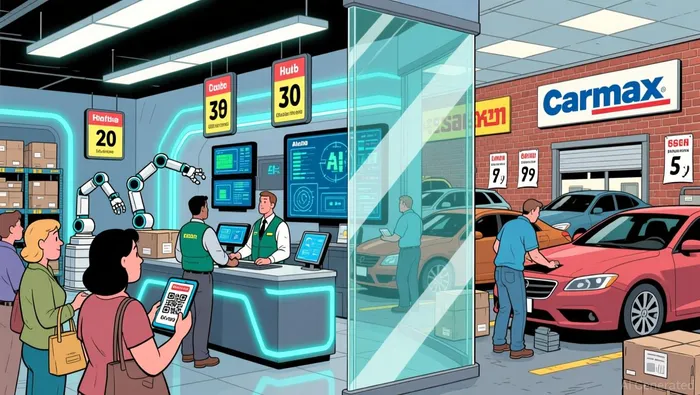
CarMax's 2023–2025 strategy has centered on expanding reconditioning capacity, optimizing sourcing for sub-$20,000 vehicles, and enhancing omnichannel options, as noted in a Investing.com SWOT analysis. While these moves align with short-term profit goals, they lack the transformative edge seen in Carvana's operations. Carvana, for instance, has built a throughput flywheel: faster vehicle intake, AI-driven reconditioning, and dense logistics networks have slashed costs per unit while boosting gross profit per unit (GPU) to $2,580 in Q2 2025, according to an Entrepreneur analysis. By contrast, CarMax's GPU growth has been modest, and its reliance on physical locations-over 160 superstores-incurs higher overhead and limits scalability, as described in the same Entrepreneur analysis.
The disconnect is further amplified by CarMax's captive finance model. While its CarMax Auto Finance (CAF) division offers stability, it faces headwinds from CECL (Current Expected Credit Loss) accounting rules, which require upfront loan loss provisions and distort GAAP earnings, as discussed in a WolfStreet article. Carvana, meanwhile, has leveraged third-party financing and debt restructuring to improve balance sheet flexibility, enabling it to reinvest in AI-powered customer service and logistics, as reported in a Wral Markets article.
Market Sentiment: Optimism vs. Execution Risk
Investor sentiment toward CarMax remains split. Analysts highlight its "steady, competent execution" and a consensus target price of $77.60, implying a 5.4% downside, according to a MarketBeat report. However, this optimism clashes with the company's operational realities. William Blair recently downgraded CarMax to "Market Perform," citing an anticipated 8%–12% decline in used unit comparable sales for Q4 2025 and a projected 8% revenue drop for FY2026, according to a William Blair report. The firm warned that CarMax's performance lags the broader used-car market, where demand for sub-$20,000 vehicles is surging due to new-car price inflation, as noted in a Investing.com SWOT analysis.
Carvana, despite a negative P/E ratio of -3.40, has captured market imagination. Its 75.4% YTD stock price increase (as of August 2025) reflects investor confidence in its scalable model, according to an Entrepreneur analysis. Carvana's Q2 2025 results-$3.54 billion in revenue and $159 million in net income-demonstrate the power of digital-first execution, according to the Entrepreneur analysis. Meanwhile, CarMax's Q1 2026 net profit of $210 million, up from $148 million a year prior, pales in comparison to the 28.8% YTD stock decline, as noted in a WolfStreet article.
Operational Challenges and Leadership Uncertainty
CarMax's struggles are compounded by macroeconomic headwinds. Used vehicle prices, which spiked 55% from mid-2020 to mid-2022, now face consumer resistance as inflationary fatigue sets in, according to a WolfStreet article. CarMax's dynamic pricing algorithm, designed to adjust online prices in real time, has inadvertently undermined its "no-haggle" brand promise at physical locations, according to a WolfStreet article. Disruptors like Carvana, with their streamlined online-first models, avoid such contradictions.
Compounding these issues is leadership uncertainty. CEO Bill Nash's departure on December 1, 2025, and the appointment of interim CEO David McCreight have created a vacuum in strategic direction, according to a William Blair report. Carvana, by contrast, has maintained consistent leadership and a clear vision, allowing it to pivot swiftly to cost-cutting and AI-driven efficiencies, according to a Wral Markets article.
Conclusion: A Market in Transition
The used-car retail sector is at an inflection point. CarMax's strategic focus on incremental improvements and physical infrastructure is increasingly at odds with the speed and agility of digital-first disruptors. While its omnichannel approach and captive finance model offer stability, they lack the transformative potential to redefine margins or capture market share in a rapidly evolving landscape. Carvana's success-driven by scalable logistics, AI integration, and a debt-optimized balance sheet-highlights the rewards of embracing digital transformation.
For investors, the choice is clear: CarMax represents a conservative bet on steady execution, while Carvana embodies the risks and rewards of a high-growth, tech-driven model. As the sector continues to shift, strategic agility-not just operational competence-will determine which players thrive.





Comentarios
Aún no hay comentarios