
CarMax's Securities Fraud Scrutiny: Navigating Risks and Opportunities in a Turbulent Market
The recent turmoil surrounding CarMaxKMX--, Inc. (KMX) has sent shockwaves through the automotive retail sector, with its stock price plummeting amid allegations of securities fraud and a string of underwhelming financial results. For investors, the company's unfolding saga presents a complex mix of risks and potential opportunities. This analysis evaluates CarMax's current challenges, regulatory exposure, and strategic adjustments, offering a framework for assessing its long-term viability.
The Catalyst: Earnings Disappointments and Legal Scrutiny
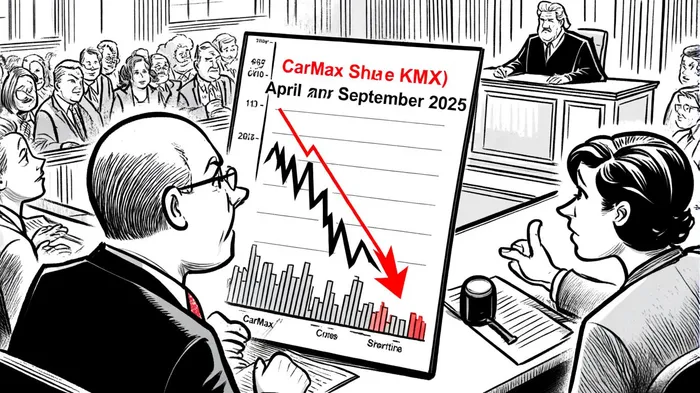
CarMax's troubles began in earnest on April 10, 2025, when the company released its fourth-quarter and full-year 2025 financial results. Earnings per share (EPS) of $0.58 fell short of analyst estimates by $0.08, and the company announced it would abandon previously stated long-term goals for revenue, unit sales, and market share, citing “broader macro factors” [1]. This disclosure triggered a 17% drop in its stock price, erasing roughly $13.61 per share in value [2].
The situation worsened on September 25, 2025, when CarMax reported second-quarter 2026 results. Revenue declined 6.0% year-over-year, with total retail used vehicle revenues falling 7.2% and gross profit dropping 5.6%. The company attributed these declines to inventory adjustments and a $71.3 million increase in loan loss provisions [3]. Shares fell as much as 24.8% during intraday trading, marking one of the steepest single-day drops in its history [4].
Multiple law firms, including the Law Offices of Frank R. Cruz and Glancy Prongay & Murray LLP, have since launched investigations into potential violations of federal securities laws. These probes focus on whether CarMax misrepresented or omitted material information in its financial disclosures, particularly around its strategic pivot and inventory management practices [5].
Financial Health and Strategic Adjustments
CarMax's Q3 2025 results further underscore its struggles. While retail unit sales rose 5.4% year-over-year, average selling prices declined by 4%, and wholesale vehicle revenues fell 10.5%. The company's net earnings for the first nine months of fiscal 2025 dropped 4.3%, driven by higher operating expenses and margin compression [6]. Analysts have pointed to inventory mismanagement as a key culprit, noting that CarMax had accelerated sales earlier in 2025 in anticipation of tariffs, leading to depreciation and reduced price competitiveness [7].
In response, CarMax has pledged to streamline operations. CEO Bill Nash emphasized a shift toward “agility” in inventory and pricing strategies, while the company announced $150 million in cost-cutting measures over 18 months through automation, AI tools, and contract renegotiations [8]. Additionally, CarMax Auto FinanceKMX-- (CAF) reported an 8% year-over-year revenue increase, offering a rare bright spot in an otherwise challenging environment [9].
Regulatory Risks and Investor Sentiment
The legal and regulatory risks facing CarMax are significant. If investigations confirm securities law violations, the company could face civil lawsuits, financial penalties, or even criminal charges against executives. The SEC's Whistleblower Program, which incentivizes insiders to report misconduct, adds another layer of uncertainty [10]. Such outcomes could further erode investor confidence, already shaken by the stock's volatility.
Investor sentiment remains deeply divided. While 12 analysts have set price targets in the past three months—ranging from $65 to $92—the average target of $77.67 reflects cautious optimism [11]. Bullish analysts highlight CarMax's diversified business model, including its omni-channel platform and CAF division, as long-term growth drivers. However, bearish views emphasize the company's weakened balance sheet and the reputational damage from the ongoing probes.
Opportunities Amid the Chaos
Despite the risks, some investors see potential in CarMax's current valuation. At a price-to-earnings (P/E) ratio of 8.5x (as of October 2025), the stock trades at a discount to its historical average of 14.5x and to peers in the Automotive Aftermarket sector [12]. If CarMax successfully executes its cost-cutting initiatives and stabilizes inventory levels, it could regain market share and restore investor trust.
Moreover, legal settlements—while costly—could provide clarity and a path to recovery. For example, the company's decision to “right size inventory” may eventually improve margins, and its focus on automation could enhance operational efficiency. Investors with a long-term horizon might also benefit from potential class-action settlements, which could stabilize the stock price once litigation concludes.
Historical backtesting of KMX's earnings releases from 2022 to 2025 reveals an average 30-day return of +4.6%, outperforming the S&P 500's -1.4% during the same period. However, the small sample size (5 events) and mixed short-term performance (win-rate ≤60% in early days) suggest caution when relying solely on earnings-day signals for trading decisions. This data underscores the importance of a long-term perspective for investors considering KMXKMX--, as the stock's volatility may mask gradual recovery potential.
Conclusion: A High-Stakes Reckoning
CarMax stands at a crossroads. The securities fraud investigations and financial underperformance have exposed vulnerabilities in its business model and governance practices. However, the company's strategic adjustments and undervalued stock price suggest there is still room for recovery. For risk-tolerant investors, CarMax could present a speculative opportunity if it navigates the legal and operational challenges successfully. For others, the regulatory uncertainty and market volatility may warrant caution.





Comentarios
Aún no hay comentarios