
Carlsmed's AI-Driven Spine Surgery Platform: Is the Premium Valuation Justified?
In the rapidly evolving landscape of medical technology, CarlsmedCARL-- Inc. (ticker: CARL) has emerged as a focal point of debate. The company's July 2025 IPO, priced at $15 per share, raised $100.5 million and valued the firm at $397.7 million post-offering. While this valuation is modest compared to industry giants like StrykerSYK-- (SYK) or Zimmer BiometZBH-- (ZBH), it reflects a cautious optimism in a sector grappling with broader IPO challenges. The question for investors is whether Carlsmed's AI-driven spine surgery platform justifies its current valuation, or if the market is overestimating its long-term potential.
Market Context: AI's Role in Reshaping Spine Surgery
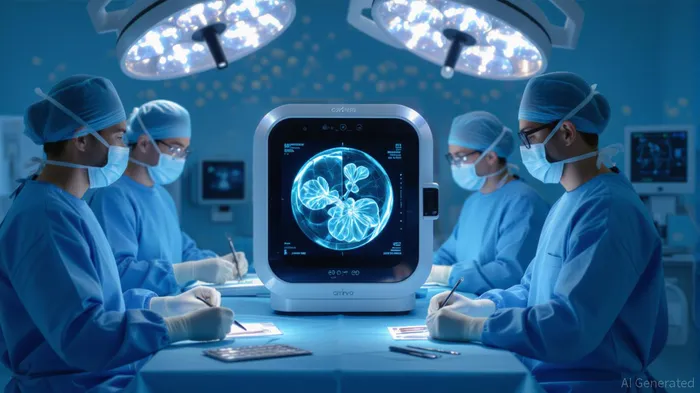
The global spine surgery market, valued at $13.4 billion in 2024, is undergoing a seismic shift driven by AI and 3D printing. According to Technavio, the market is projected to grow at a 5.8% CAGR, reaching $26.1 billion by 2031. AI is not just a buzzword—it is a transformative force. Major players like MedtronicMDT-- and Stryker are allocating up to 20% of R&D budgets to AI integration, aiming to reduce surgical complications by 30% and accelerate patient recovery. Carlsmed's aprevo® platform sits at the intersection of this innovation, leveraging AI for personalized surgical plans and implants.
The platform's clinical advantages are compelling. Carlsmed's interim data shows a 1.5% revision rate in adult spinal deformity cases, far below the industry average of 8.7%. This reduction in complications not only enhances patient outcomes but also aligns with healthcare systems' push for cost-effective solutions. With Medicare reimbursement secured for its cervical spine fusion platform, Carlsmed is uniquely positioned to capture a segment of the $4.6 billion cervical fusion market.
Financials and Valuation: A Tale of Two Metrics
Carlsmed's financials tell a story of promise and caution. In Q1 2025, the company reported a net loss of $5.7 million on $10.2 million in revenue, compared to a $5.4 million loss on $5.1 million in Q1 2024. While losses persist, revenue growth is robust, with a 2024 total of $27.2 million and a 2025 run rate expected to exceed $32 million. Gross margins of 74.9% in Q1 2025 highlight the scalability of its AI-driven model, particularly as 3D printing reduces supply chain costs.
The IPO's 12.4x revenue multiple is a stark contrast to the 25x+ valuations of established peers. This discount reflects both the company's unprofitability and the current risk premium in the healthcare IPO market. However, it also creates a margin of safety for long-term investors. If Carlsmed achieves its growth targets—particularly with the 2026 launch of cervical spine fusion products and expansion into knee/hip implants—the current valuation could appear undemanding.
Risks and Rewards: Navigating the AI Frontier
Investors must weigh several risks. First, Carlsmed operates in a highly competitive space. While its AI-driven approach is differentiated, Stryker and Zimmer Biomet have the resources to develop competing solutions. Second, the integration of AI into spine surgery faces regulatory and technical hurdles, including data standardization and cybersecurity concerns. Third, the company's reliance on unproven long-term outcomes for its AI platform could deter conservative investors.
Yet the rewards are equally significant. The AI-driven spine surgery market is expected to grow by $3.55 billion from 2025 to 2029, with AI contributing 20–25% of total sector growth by 2030. Carlsmed's first-mover advantage in cervical fusion, combined with its Breakthrough Device Designation, creates regulatory barriers for rivals. Moreover, its surgeon user base has grown to 199 as of June 2025, suggesting strong adoption.
Investment Thesis: A High-Conviction Play on AI-Driven Medtech
Carlsmed's IPO offers a compelling risk-reward profile for investors who recognize the long-term potential of AI in healthcare. The company's valuation is anchored to its current financials but discounted to reflect execution risks. Key catalysts include:
1. 2026 Cervical Fusion Launch: This expansion could unlock $4.6 billion in incremental revenue.
2. R&D and Supply Chain Efficiency: AI and 3D printing are poised to drive gross margins higher.
3. Cross-Application into Orthopedics: The aprevo® platform's potential in knees and hips could open a $50+ billion market.
For investors, the decision hinges on whether Carlsmed can scale its AI-driven model faster than competitors. The current valuation implies skepticism about its ability to capture market share, but the company's clinical advantages and regulatory momentum suggest otherwise.
Conclusion: A Calculated Bet on the Future of Spine Surgery
Carlsmed's premium valuation is justified if one assumes the market will eventually recognize the transformative potential of AI in spine surgery. While the path to profitability is uncertain, the company's technology, financial discipline, and strategic positioning make it an attractive high-conviction play. For those willing to tolerate short-term volatility in pursuit of long-term growth, CARL offers a rare opportunity to invest in the next wave of medtech innovation.
Investment Advice: Consider a position in CARL as a core holding within a diversified healthcare portfolio, with a 12–18 month time horizon. Monitor key metrics such as surgeon adoption rates, R&D efficiency, and regulatory progress in 2026.







Comentarios
Aún no hay comentarios