
Carlisle Companies (CSL): A High-Yield, Low-Cost Dividend Stock with Diversified Industrial Strength
In a low-growth investment environment, investors increasingly seek stocks that balance income generation with operational resilience. Carlisle CompaniesCSL-- (CSL) emerges as a compelling candidate, offering a 1.34% dividend yield[3] alongside a diversified industrial business model and disciplined cost structure. With 49 consecutive years of dividend increases[3], CSL's track record underscores its ability to sustain payouts even amid macroeconomic headwinds. This analysis explores how CSL's strategic operational framework and cash flow consistency position it as a high-yield, low-cost dividend stock.
Dividend Sustainability: A Foundation of Prudence
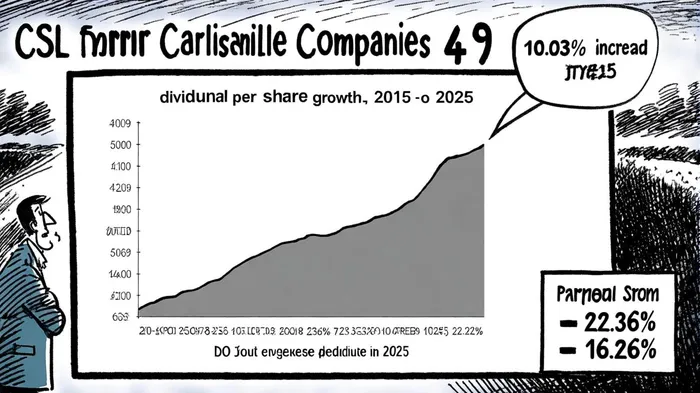
CSL's dividend yield of 1.34%[3] may appear modest compared to “mega-yield” stocks, but its sustainability is where the company shines. Over the past 12 months, CSLCSL-- distributed $4.10 per share in dividends, a 10.03% increase from the prior year[3]. This growth is underpinned by a trailing twelve-month (TTM) payout ratio of 22.36%[2], significantly lower than the S&P 500 industrials sector average of ~35%. Analysts project this ratio to decline further to 19.31% in 2025 and 16.26% in 2026[2], reflecting management's focus on balancing shareholder returns with reinvestment in operations.
Such a low payout ratio provides a buffer against earnings volatility. For instance, even if CSL's earnings per share (EPS) were to contract by 20%, the company could still maintain its current dividend level without needing to cut payouts. This prudence is critical in a low-growth environment, where companies with high payout ratios often face forced reductions during downturns.
Diversified Industrial Model: Mitigating Cyclical Risk
CSL's revenue is spread across three core segments: Construction Materials (37.02% of 2024 revenue[4]), Carlisle Weatherproofing Technologies (CWT, 12.98%[4]), and other industrial products. This diversification reduces exposure to any single market. For example, while residential construction softness in 2025 impacted CWT's performance[1], the Construction Materials segment offset some of these pressures with stable demand for insulation and roofing solutions.
Geographically, the U.S. accounts for 91% of total revenue[4], but CSL's international presence—$432.5 million from Europe and North America combined[4]—adds a layer of geographic diversification. This mix allows the company to capitalize on regional growth cycles while avoiding overconcentration in any one economy.
Operational Efficiency: The Engine of Cash Flow
CSL's low-cost structure is a cornerstone of its dividend sustainability. In Q2 2025, the company reported an operating margin of 16.8% and an adjusted EBITDA margin of 21.8%[1], outperforming peers in the industrials sector. These results stem from strategic automation projects, such as $3–$4 million quarterly EBITDA gains from CWT factory upgrades[1], and debt reduction initiatives that cut interest expenses by $3.8 million year-over-year[2].
The Carlisle Operating System (COS), a continuous improvement framework, further drives efficiency. Management aims to expand EBITDA margins by 50 basis points in 2025 through COS-driven cost reductions[4]. Such initiatives not only bolster profitability but also free up cash for dividends and buybacks. In H1 2025, CSL returned $700 million to shareholders via share repurchases[4], demonstrating confidence in its ability to generate consistent free cash flow.
Challenges and Mitigation Strategies
Despite its strengths, CSL faces headwinds. Organic revenue declined 3% in Q2 2025 due to lower volumes and higher unit costs[4], squeezing operating margins by 2.9 percentage points. However, management is addressing these challenges through strategic acquisitions, such as the $34 million-annual-synergy-generating acquisitions of Bonded Logic and ThermaFoam[4], and by leveraging the COS to offset inflationary pressures.
Conclusion: A Dividend Stock for the Long Haul
Carlisle Companies' combination of a low payout ratio, diversified revenue streams, and operational efficiency makes it a rare high-yield, low-cost stock in the industrials sector. While its 1.34% yield[3] may not be the highest, the company's 49-year dividend growth streak[3] and projected margin expansion[4] suggest a sustainable path for income-focused investors. In a low-growth environment where capital preservation and predictable cash flows are paramount, CSL's disciplined approach to capital allocation and cost management positions it as a resilient long-term holding.





Comentarios
Aún no hay comentarios