
Cardano's Vision for a Decentralized Internet: A Blockchain-Driven Revolution in Scalability and Governance
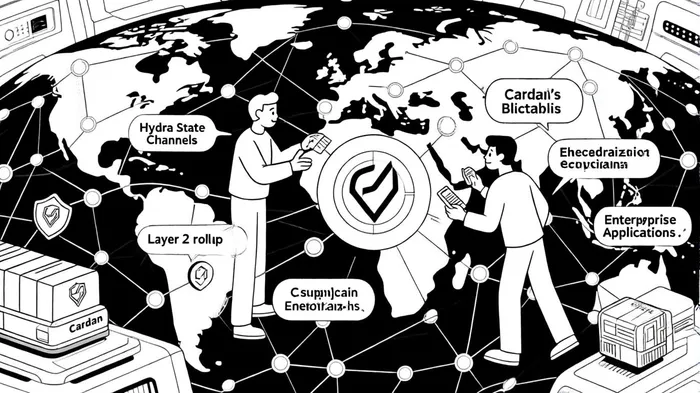
The internet, once hailed as a democratizing force, has increasingly centralized power in the hands of a few corporate giants. Enter blockchain—a technology poised to redefine the rules of the game. CardanoADA-- (ADA), founded by EthereumETH-- co-creator Charles Hoskinson, is not merely another cryptocurrency but a meticulously engineered platform aiming to disrupt internet infrastructure through scalable, interoperable, and governance-driven innovation. With a 2025 roadmap that marries academic rigor to real-world applicability, Cardano's ascent could signal a paradigm shift in how we conceptualize digital infrastructure.
Technological Foundations: Building for Billions
Cardano's 2025 roadmap is anchored in three pillars: scalability, interoperability, and decentralized governance. The Plomin hard fork, implemented in early 2025, marked a pivotal step in decentralizing network operations by enabling ADAADA-- holders to vote directly on protocol upgrades and treasury allocations [4]. This shift aligns with Hoskinson's vision of a “self-sustaining, community-owned internet,” where stakeholders collectively steer the network's evolution.
Scalability remains a critical focus. Cardano's Hydra state channels—a layer-2 solution—now enable millions of transactions per second with near-zero fees, addressing the throughput limitations that have plagued earlier blockchain networks [5]. Complementing this, Layer 2 rollups and the Ouroboros Leios and Peras protocols are designed to handle heterogeneous data types and cross-chain interactions, ensuring the platform can scale to billions of users by 2030 [1]. These advancements are not theoretical; the recent soft launch of Reeve, an enterprise-grade accounting solution, demonstrates Cardano's ability to integrate blockchain with legacy financial systems [4].
Governance as a Core Feature
Decentralized governance is no longer an afterthought for Cardano. The Constitutional Convention, a landmark event in Q2 2025, saw representatives from over 50 countries approve a draft constitution to formalize community-driven decision-making [3]. This framework includes on-chain voting, the election of a permanent governance committee, and annual budget planning, ensuring transparency and accountability. By empowering ADA holders to shape the network's future, Cardano is creating a self-regulating ecosystem that rivals traditional internet governance models in complexity and inclusivity.
Real-World Applications: From Traceability to Renewable Energy
Cardano's ambition extends beyond financial transactions. The Originate platform, launched in 2025, provides enterprises with tools to verify product authenticity and meet industry certifications, with its first major use case digitally certifying Georgian wine provenance [2]. Similarly, Veridian, an open-source credential verification system, is being piloted in healthcare and finance to enable privacy-preserving identity management. These applications underscore Cardano's role as a public digital infrastructure capable of solving real-world challenges like supply chain fraud and data silos [1].
Partnerships with institutions like the Pontifical Catholic University of Rio de Janeiro (PUC-Rio) further highlight Cardano's commitment to innovation. Collaborative projects in the renewable energy sector aim to leverage blockchain for transparent energy trading and carbon credit tracking, aligning with global sustainability goals [2].
Sustainability and Global Expansion
Cardano's proof-of-stake (PoS) consensus mechanism is a cornerstone of its environmental sustainability strategy. Unlike energy-intensive proof-of-work blockchains, Cardano's PoS model consumes less energy than a single household, making it a viable alternative for a carbon-conscious internet [5]. This advantage is amplified by the Mithril certificates initiative, which allows light clients to verify transactions without downloading the entire blockchain, reducing computational overhead [6].
Geographically, Cardano is expanding its footprint through workshops in over 100 countries, fostering local innovation and adoption. The Venture Hub, a new initiative supporting early-stage blockchain startups, is accelerating enterprise adoption by bridging the gap between academic research and commercial viability [2].
Investment Implications
Cardano's strategic roadmap positions it as a unique player in the blockchain space. While competitors like Ethereum and SolanaSOL-- focus on niche use cases, Cardano's holistic approach—combining academic research, enterprise integration, and community governance—creates a flywheel effect. The Plomin hard fork and Hydra's scalability breakthroughs address two of blockchain's most persistent pain points, while real-world applications in agriculture, energy, and finance validate its utility beyond speculative trading.
For investors, the key risks include regulatory uncertainty and competition from newer layer-1 blockchains. However, Cardano's first-mover advantage in governance and its growing ecosystem of enterprise partners mitigate these concerns. As Hoskinson has emphasized, the future of the internet is not a single platform but a composable infrastructure where interoperability and decentralization reign supreme. Cardano's 2025 roadmap suggests it is well-positioned to lead this transition.






Comentarios
Aún no hay comentarios