
Cardano's Strategic Rebound: Can the Return to NASDAQ ETFs and Whale Activity Signal a Major Bull Case for ADA?
Institutional Adoption: A Regulatory and Market-Driven Catalyst
Cardano's inclusion in the Nasdaq Crypto U.S. Settlement Price Index in June 2025 marked a pivotal regulatory milestone, according to a CoinEdition report. This benchmark, tracked by major financial institutions, positions ADAADA-- alongside BitcoinBTC-- and EthereumETH--, signaling growing institutional recognition. However, the final hurdle remains: the SEC's approval of a rule change to allow ADA inclusion in ETF portfolios, with a decision deadline of November 2, 2025, per the CoinEdition report. If approved, this would unlock access for institutional investors through regulated products, potentially injecting billions into the asset.
Grayscale's proposal to convert its Cardano Trust into a spot ETF further underscores institutional confidence, as outlined in a CExplorer article. With a final deadline of October 7, 2025, the approval of this product could mirror the inflows seen with Bitcoin ETFs, amplifying ADA's liquidity and price discovery. Notably, Cardano's designation as a "mature blockchain" under the Clarity Act, as reported by BlockNews, has cleared a critical regulatory barrier, aligning it with Ethereum and Bitcoin in terms of institutional legitimacy. Analysts project that an ETF approval could drive ADA to $3–$5 or even $10, depending on adoption rates, according to coverage from CoinEdition and BlockNews.
Whale Activity: Accumulation and Market Sentiment
On-chain data reveals a striking narrative of whale accumulation. In early October 2025, a single whale moved 67.8 million ADA ($54.3 million) from Coinbase to an unknown wallet, according to the CExplorer article, signaling long-term positioning amid a price decline. This aligns with broader trends: large holders accumulated 80 million ADA over two days in September 2025, defending critical support levels around $0.85, as noted by CoinEdition. Such activity suggests confidence in ADA's fundamentals, even as retail sentiment dipped to a 5-month low in mid-September (CoinEdition).
Derivatives demand also highlights institutional interest. Over $51 million in ADA derivatives were observed on Binance and $12 million on OKX, per CoinEdition, indicating hedging strategies and speculative positioning. Meanwhile, staking participation remains robust, with 67% of ADA staked and 4.83 million unique wallets active, according to a Currency Analytics report. This decentralized engagement reinforces network security and aligns with institutional-grade use cases in DeFi and real-world asset (RWA) tokenization.
On-Chain Metrics: NVT, MVRV, and Transactional Resilience
Cardano's Network Value to Transactions (NVT) ratio has surged to its highest level since June 2024, according to a Financial Analyst piece, raising concerns about overvaluation. Historically, elevated NVT ratios have preceded corrections, suggesting a potential disconnect between ADA's price and its transactional utility. However, this metric must be contextualized: ADA's market cap has expanded due to protocol upgrades like Hydra (Layer-2 scaling) and Ouroboros Leios, which enhance scalability and reduce costs (Currency Analytics).
The MVRV (Market Value to Realized Value) ratio offers a mixed picture. At 1.30 (CExplorer), ADA is undervalued compared to the 3.90 threshold for fair valuation. While short-term holders face negative profitability (-6.90%) (CExplorer), long-term holders are accumulating, as evidenced by rising mean coin age. This duality-undervaluation for short-termers versus accumulation by long-termers-highlights ADA's potential for a technical breakout.
Transaction volumes and active addresses further underscore resilience. Daily transactions averaged 2.6 million in Q3 2025 (Currency Analytics), while smart contract deployments (17,400 Plutus contracts) and DeFi TVL ($113 million in Liqwid Finance, according to a Forvest review) signal growing utility. These metrics, combined with whale activity, suggest a network primed for institutional inflows.
Risks and Counterarguments
Despite bullish signals, challenges persist. Regulatory uncertainty looms, with the SEC's ETF decision remaining a binary event. Competitive pressures from Ethereum and SolanaSOL--, coupled with macroeconomic factors like U.S. interest rate decisions, could dampen ADA's momentum (CoinEdition). Additionally, the NVT ratio's elevation raises questions about whether current valuations are justified by transactional activity (Financial Analyst).
Conclusion: A Bull Case with Caveats
Cardano's strategic rebound hinges on three pillars: regulatory clarity, institutional adoption, and on-chain resilience. The potential inclusion in ETFs, coupled with whale accumulation and protocol upgrades, creates a compelling narrative for ADA's long-term value. However, investors must remain cautious of overvaluation risks and macroeconomic headwinds. If the SEC approves the ETF and macro conditions align, ADA could see a multi-fold appreciation, particularly if it breaks through key resistance levels. 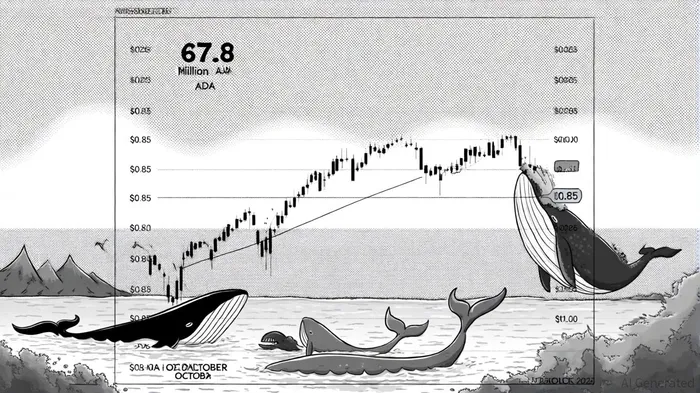






Comentarios
Aún no hay comentarios