
Cardano's Stagnant Ecosystem vs. Emerging Utility-Driven Rivals: Is ADA Losing Its Edge?
The blockchain landscape in 2025 is defined by a stark divergence between Cardano's methodical, research-driven approach and the rapid, utility-focused expansion of rivals like SolanaSOL--, AvalancheAVAX--, and Polygon. While Cardano's ecosystem has shown incremental progress-marked by 672 active developers, 2,020 projects, and real-world use cases in supply chain and tokenization-its growth lags behind platforms prioritizing throughput, scalability, and immediate enterprise adoption. This analysis evaluates Cardano's position in a shifting crypto landscape, comparing its strengths and weaknesses with those of its most formidable competitors.
Cardano's 2025 Progress: Stability Over Speed
Cardano's 2025 ecosystem updates highlight a focus on sustainability and governance. The Plomin hardfork enabled decentralized governance, while the updated Cardano Constitution formalized stakeholder participation. Developer activity, though robust in quality, remains constrained in quantity: 276 full-time developers out of 672 total, with TypeScript, JavaScript, and Aiken dominating smart contract development. The ecosystem now hosts 2,020 projects, including DeFi platforms like Cswap DEX and Butane Synthetics.
However, Cardano's base layer processes only "a few dozen transactions per second," a stark contrast to Solana's 1,100 TPS or Avalanche's near-instant finality. A November 2025 chain partition incident, though resolved within 14 hours, exposed vulnerabilities in its resilience compared to rivals like Solana, which processed 33 billion non-vote transactions in Q4 2025.
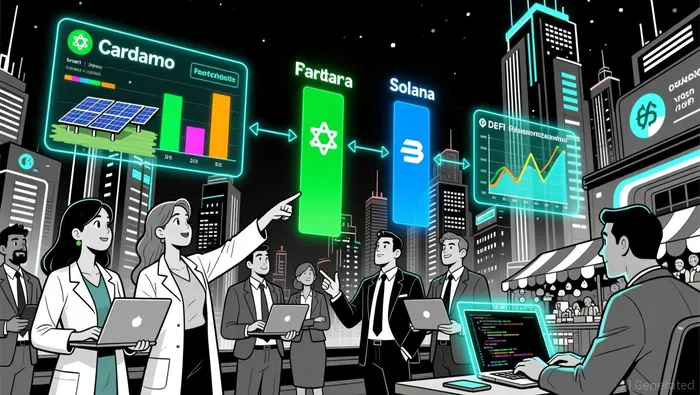
Solana and Avalanche: Speed and Scalability as Competitive Advantages
Solana's 2025 performance underscores its dominance in high-throughput applications. The network generated $2.39 billion in DeFi revenue, a 46% annual increase, while averaging 1,054 TPS. Its hybrid Proof of History (PoH) and Proof of Stake (PoS) consensus appeals to real-time trading and gaming projects, with platforms like Serum and Magic Eden driving adoption. Developer activity is also surging, with Solana's ecosystem attracting projects prioritizing speed and low costs.
Avalanche, meanwhile, leverages its subnet architecture to offer customizable blockchains for enterprises. Trader Joe and Pangolin have fueled its DeFi growth, while EVM compatibility simplifies Ethereum migration. By Q4 2025, Avalanche's focus on institutional tokenization and interoperability positioned it as a bridge between public and private blockchain use cases.
Polygon's Layer-2 Dominance and Real-World Utility
Polygon's 2025 growth is defined by its role as Ethereum's scaling solution. The network processed 1.4 billion transactions, driven by partnerships with Revolut, Flutterwave, and Stripe. Stablecoin adoption surged, with $3 billion in supply on Polygon by Q3 2025, including 52% of omnichain USDT0. Its focus on payments, remittances, and subscriptions has made it a preferred infrastructure for fintechs seeking low-cost, high-volume solutions.
While Cardano's developer community emphasizes foundational research, Polygon's 22.5 million weekly transactions in H1 2025 reflect a more pragmatic approach to adoption. Analysts project that Polygon's success hinges on its Polygon 2.0 upgrade and sovereign chains, but its current utility-driven model already outpaces Cardano's in enterprise relevance.
Developer Metrics: Quality vs. Quantity
Cardano's developer activity is characterized by academic rigor and long-term vision, but it trails in raw numbers. The 2025 State of the Blockchain report notes 680 monthly active developers across major chains, with CardanoADA-- placing 15th. Solana and Avalanche, by contrast, attract developers with EVM compatibility, high throughput, and immediate monetization opportunities.
Polygon's ecosystem, though not a direct competitor in developer tools, benefits from Ethereum's vast developer base. Its operational efficiency rankings in Q2 2025 highlight its appeal to projects seeking Ethereum's security with lower costs.
Investment Merit: A Tale of Two Strategies
Cardano's investment case hinges on its research-driven roadmap and real-world partnerships, such as World Mobile's telecom initiatives and Atala PRISM's identity solutions. However, its slower development cycle and lower throughput make it less competitive in DeFi and NFT markets dominated by Solana and Avalanche.
For investors prioritizing short- to medium-term growth, Solana's $2.39 billion in DeFi revenue and Polygon's $3 billion stablecoin supply offer clearer value propositions. Avalanche's subnet model also appeals to enterprises seeking customizable solutions. Cardano, meanwhile, remains a long-term bet on sustainability and governance, but its current metrics suggest it is ceding ground to faster-moving rivals.
Conclusion: Is ADAADA-- Losing Its Edge?
Cardano's 2025 progress demonstrates resilience and a commitment to academic rigor, but its ecosystem's growth is outpaced by utility-driven platforms prioritizing speed, scalability, and enterprise adoption. While ADA's methodical approach may yield long-term stability, investors seeking immediate returns should consider Solana, Avalanche, or Polygon, which have already proven their ability to scale and monetize. In a crypto landscape increasingly defined by real-world utility, Cardano's edge is narrowing-but not yet extinguished.







Comentarios
Aún no hay comentarios