
Cardano's Short-Term Vulnerability Amid Whale Profit-Taking and Derivatives Weakness
Cardano (ADA) has long been a focal point for investors seeking exposure to a blockchain with institutional-grade infrastructure. However, Q3 2025 has exposed a critical tension between bullish accumulation and bearish profit-taking, creating a volatile environment for retail investors. While institutional and whale activity suggests confidence in ADA’s long-term potential, short-term structural weaknesses—particularly in derivatives markets—pose significant risks.
Whale Accumulation vs. Profit-Taking: A Double-Edged Sword
According to a report by CoinCentral, CardanoADA-- whales have accumulated over 200–210 million ADAADA-- in Q3 2025, increasing their holdings to 10.3% of the total supply [1]. This accumulation, coupled with a 30% rise in institutional custody to $900 million, underscores confidence in ADA’s post-U.S. Clarity Act positioning as a “mature blockchain.” Yet, this optimism is tempered by aggressive profit-taking. On-chain data reveals that 30 million ADA were sold after a local peak at $1.01, with large wallets offloading 5.57 billion tokens amid a pullback to $0.92 [2]. Such activity signals caution, particularly as ADA struggles to reclaim key resistance levels like $1.00.
The divergence between accumulation and selling is further complicated by a shift in whale capital. Over $9 million has been redirected from ADA and LitecoinLTC-- into Remittix (RTX), a real-world payments infrastructure project with aggressive growth projections [4]. This migration highlights ADA’s structural limitations—namely, its underdeveloped DeFi ecosystem and liquidity constraints—which have made it less attractive for high-growth strategies.
Derivatives Market Weakness: A Looming Trigger
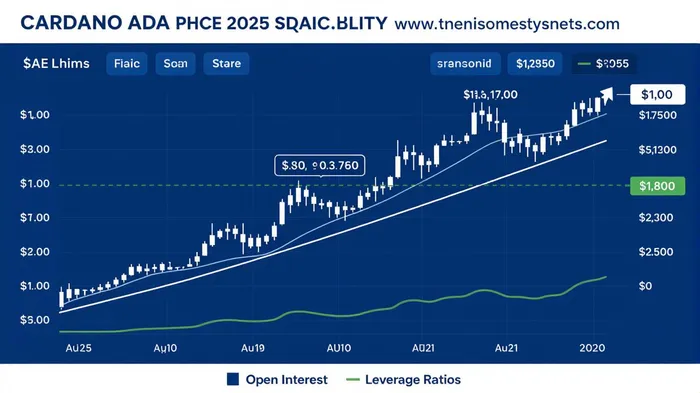
ADA’s derivatives market has become a focal point of instability. While open interest surged to $6.96 billion in August—a five-month high—this figure later declined by 6.66% to $1.66 billion, signaling a consolidation phase [5]. Retail investors, however, remain heavily exposed. A long-to-short ratio of 3.40 (77% long positions) indicates bullish sentiment but also vulnerability to rapid deleveraging [1]. Funding rates for ADA derivatives have turned positive at 0.0053%, and the long-to-short ratio climbed to 1.13, reflecting aggressive retail positioning [4].
The risks are amplified by leverage. Platforms offering up to 100x leverage have exposed traders to cascading liquidations, as seen in a $1 billion liquidation event triggered by Bitcoin’s drop from $124,000 to $118,000 [3]. ADA derivatives, with $47 billion in leverage, are particularly susceptible. Liquidation data shows that long positions account for $1.15 million of the $1.37 million in ADA liquidations, highlighting a long-heavy market [3]. If ADA breaks below $0.80, analysts warn of a potential slide to $0.70 or even $0.51 [2].
Retail Investor Positioning: A Fragile Equilibrium
Retail investors are caught in a precarious balance. While ADA’s price has surged 2.50% in the last 24 hours, with trading volume hitting $1.45 billion, EMA signals remain bearish [2]. This contradiction—short-term optimism vs. technical bearishness—reflects the market’s uncertainty. Additionally, ADA’s staking participation (over 60% of supply) contrasts with its weak DeFi traction, which accounts for less than 1% of global TVL [2]. This imbalance leaves ADA vulnerable to macroeconomic shocks and liquidity crunches.
The Grayscale ADA ETF narrative has further complicated positioning. With a 83% approval probability, the ETF could mirror Ethereum’s success, but its delayed approval has left retail investors in limbo. As Mitrade notes, ADA’s price remains range-bound near $0.80, with a recovery to $1.00 contingent on breaking out of this consolidation [3].
Conclusion: Navigating the Risks
Cardano’s short-term vulnerability stems from a collision of whale profit-taking, derivatives leverage, and retail overexposure. While institutional confidence and real-world use cases like Remittix offer long-term promise, the immediate outlook is fraught with risks. Retail investors must remain cautious, particularly as ADA’s derivatives market remains a tinderbox for liquidations. A breakdown below $0.80 could trigger a cascade of losses, compounding the challenges posed by ADA’s structural limitations. For now, the market is watching—waiting for a catalyst to tip the scales.
Source:
[1] Best Altcoins to Buy as Cardano Whale Wallets Expand [https://coincentral.com/best-altcoins-to-buy-as-cardano-whale-wallets-expand-massively/]
[2] Cardano Whale Selloff Sparks Concerns [https://www.mexc.co/en-IN/news/cardano-whale-selloff-sparks-concerns-ena-and-okb-join-weekly-gainers/84286]
[3] Cardano Price Forecast: ADA flaunts bullish structure [https://www.mitrade.com/au/insights/news/live-news/article-3-1036342-20250813]
[4] $9 Million Cardano Whale Picks Remittix Over Litecoin [https://coincentral.com/9-million-cardano-whale-picks-remittix-over-litecoin-as-analysts-eye-8000-gains-by-2026/]
[5] Cardano (ADA) ignites the crypto market with a surge in its futures volume [https://www.facebook.com/manuel.guevarra.369210/posts/cardano-ada-ignites-the-crypto-market-with-a-surge-in-its-futures-volume-reachin/749146017998609/]






Comentarios
Aún no hay comentarios