
Cardano's Short-to-Medium-Term Price Trajectory: Resistance Levels and On-Chain Momentum Analysis
Key Resistance Levels and Price Action
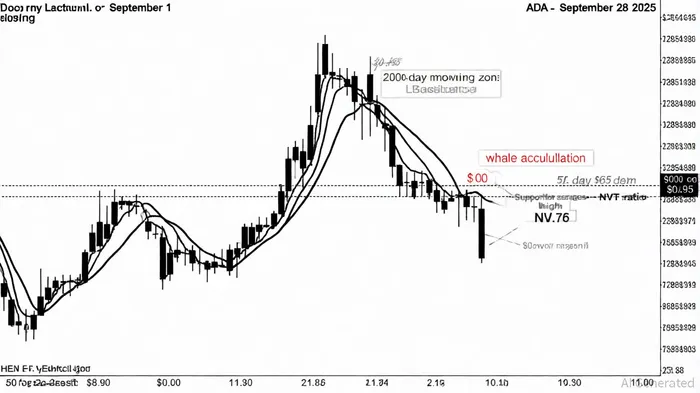
ADA's immediate resistance lies at $0.90, with a secondary target at $0.95. A breakout above $0.90 could signal renewed bullish momentum, potentially propelling the price toward $1.00, a psychological threshold last tested in early September, as noted in Bitget's ADA forecast. Conversely, a failure to hold above $0.84-currently the 50-day moving average-risks a retest of the $0.80 support level, with further downside potential toward the 200-day EMA at $0.7689, per CoinMarketCap's price prediction.
Whale accumulation has been a stabilizing force, with large holders adding 150 million ADA in recent weeks to defend the $0.80–$0.85 range, according to UnitTribune. This activity suggests confidence among institutional and long-term investors, even as retail sentiment remains cautious. Additionally, ADA's price action has been influenced by broader macroeconomic factors, including anticipation of a Federal Reserve rate cut in September, which could boost risk appetite, per CoinEdition.
On-Chain Momentum and Network Activity
On-chain metrics paint a mixed picture. While transaction volume has surged, with decentralized exchange (DEX) trading hitting $25.56 million weekly-a 19.18% increase from the prior week-ADA's price has diverged from this activity, according to ExchangeRates.org.uk ADA history. The Network Value to Transactions (NVT) ratio, a key indicator of valuation efficiency, has reached a 22-month high, signaling potential overvaluation and raising concerns about a price correction, as reported by The Financial Analyst.
Despite this, Cardano's ecosystem remains robust. The network processed over 114 million transactions in September, with smart contracts accounting for 35% of daily activity, according to CoinLaw statistics. Over 1.25 million wallets are actively staking ADA, reflecting strong user engagement. However, the NVT ratio's elevation suggests that market capitalization growth outpaces transactional utility, a bearish divergence often observed before downward corrections, according to Statista data.
Path Forward: Catalysts and Risks
The coming weeks will be pivotal for ADA. A sustained close above $0.8350 with increasing volume could trigger a recovery toward $0.87–$0.90, while a breakdown below $0.7928 may accelerate a test of the $0.735–$0.750 range, according to CryptoNews's price prediction. Regulatory developments, particularly the SEC's decision on Grayscale's ADA ETF, will also play a critical role. A positive outcome could inject institutional liquidity, whereas delays or rejections might exacerbate selling pressure.
Whale accumulation and the resolution of macroeconomic uncertainties-such as the Fed's rate policy-will further shape ADA's trajectory. If the network can maintain its current transaction volume while stabilizing the NVT ratio, the $1.00 target remains within reach. However, without a significant influx of buyer demand, the risk of a prolonged consolidation phase looms.
Conclusion
Cardano's short-to-medium-term outlook is a delicate balance between technical resilience and on-chain divergence. While whale activity and ecosystem growth provide a foundation for optimismOP--, elevated NVT ratios and regulatory uncertainty pose significant risks. Investors should closely monitor price action around $0.84 and $0.90, as well as broader macroeconomic signals, to gauge the likelihood of a sustained breakout.






Comentarios
Aún no hay comentarios