
Cardano's Roadmap to $6: Evaluating Catalyst Upgrades and Network Adoption in the 2025 Bull Run
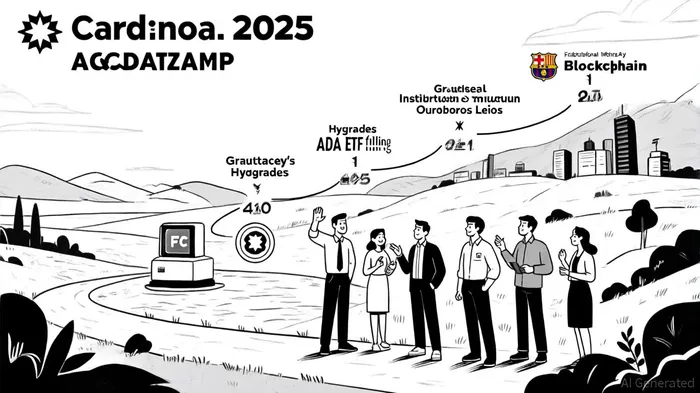
Cardano (ADA) has emerged as a formidable contender in the blockchain space, driven by a combination of technical innovation, institutional adoption, and strategic governance reforms. As the 2025 bull run gains momentum, the cryptocurrency's trajectory toward a potential $6 price target hinges on two critical pillars: infrastructure scalability and institutional confidence. This analysis evaluates how Cardano's Catalyst upgrades, layered architecture, and real-world partnerships are reshaping its value proposition.
Catalyst 2025: Future-Proofing Decentralized Innovation
Cardano's Catalyst governance framework has evolved into a cornerstone of its ecosystem, with 2025 marking a pivotal year for institutionalizing community-driven development. The Catalyst 2025 roadmap, spearheaded by Kriss Baird's team, introduces three new funding streams to address niche community needs, including retroactive public goods funding[3]. This model rewards projects that have already delivered value, ensuring merit-based allocation of resources. For instance, the Hermes development initiative, backed by a ₳5.16M budget, aims to streamline cross-chain interoperability, while UX enhancements are designed to lower entry barriers for non-technical users[2].
A key technical breakthrough is the Hydra layer-2 scaling solution, which enables parallel transaction processing through multiple “heads.” Stress tests have demonstrated over 1 million transactions per second (TPS), positioning CardanoADA-- to rival high-throughput platforms like Solana[2]. Complementing this, Ouroboros Leios and Peras are set to optimize block production and parallel processing, reducing latency while maintaining security[1]. Meanwhile, Mithril—a lightweight verification protocol—allows users to validate blockchain states without downloading the entire history, slashing synchronization times by 90%[3].
These upgrades are not just theoretical. The Voltaire-era governance reforms, including on-chain voting and decentralized constitution frameworks, empower ADAADA-- holders to directly influence protocol decisions[4]. By 2025, over $70 million in treasury funds has been allocated to development initiatives, reflecting a governance model that aligns stakeholder incentives[4].
Institutional Adoption: From ETF Filings to Real-World Utility
Institutional interest in Cardano has surged, with Grayscale Investments allocating 20% of its Smart Contract Platform Ex-Ethereum Fund to ADA, making it the second-largest holding after Solana[5]. This exposure is further amplified by the SEC's formal review of Grayscale's Cardano ETF application, a decision expected by August 2025[1]. If approved, the ETF could unlock billions in institutional capital, mirroring Ethereum's post-ETF surge in 2024.
Real-world partnerships are equally transformative. Cardano's collaboration with FC Barcelona has introduced blockchain-based NFTs, fan reward systems, and educational programs, embedding ADA into mainstream culture[5]. Meanwhile, EMURGO's Cardano Card—a debit card enabling ADA transactions in traditional retail—bridges the gap between digital assets and everyday spending[3]. Cross-chain integrations, such as Tokeo Wallet's XRP Ledger compatibility, further enhance interoperability, attracting developers and enterprises[3].
Quantifiable metrics underscore this momentum. ADA staking participation remains above 67%, with over 24 billion ADA locked in 3,200 pools, reinforcing network security[5]. Institutional custodians like Coinbase Custody and BitGo now hold $1.2 billion in ADA, signaling growing trust in the asset class[5]. Additionally, Cardano's DeFi ecosystem has seen total value locked (TVL) rise to $349 million, driven by platforms like Liqwid Finance, which now outpaces decentralized exchanges in liquidity[1].
Infrastructure Performance and Price Potential
Cardano's technical upgrades are directly tied to its price trajectory. The Vasil and Conway hard forks have reduced smart contract execution costs by 70%, spurring developer activity[1]. Meanwhile, zero-knowledge rollups and Hydra's Layer-2 scaling are expected to cut transaction fees to near-zero, making Cardano a cost-effective alternative to EthereumETH-- and Solana[2].
To quantify the impact, consider the following:
- TPS: Hydra's 1 million TPS capacity could support mass adoption in DeFi, gaming, and logistics[2].
- Cost Reductions: Transaction fees have dropped from $0.15 to $0.01 post-Vasil, improving user affordability[1].
- TVL Growth: A 300% increase in DeFi TVL since early 2025 highlights growing institutional and retail participation[1].
Challenges and the Path to $6
Despite these positives, risks persist. Regulatory uncertainty, particularly around the SEC's ETF decision, remains a wildcard. Additionally, competition from SolanaSOL-- and Ethereum's post-merge upgrades could divert developer attention. However, Cardano's research-driven approach, emphasis on security, and institutional-grade infrastructure provide a strong foundation.
If the ETF is approved and Hydra's scalability is fully realized, ADA could see a 10x surge from its current levels. A $6 price target would require a $72 billion market cap, achievable if institutional inflows mirror Ethereum's post-ETF trajectory and TVL grows 10-fold.
Conclusion
Cardano's 2025 roadmap is a masterclass in balancing technical rigor with real-world adoption. By addressing scalability, governance, and institutional trust, the platform is positioning itself as a viable alternative to Ethereum and Solana. For investors, the convergence of Hydra's TPS breakthroughs, Grayscale's ETF potential, and real-world utility projects creates a compelling case for long-term value. As the bull run unfolds, ADA's journey to $6 will depend on executing these upgrades while navigating regulatory and competitive headwinds.






Comentarios
Aún no hay comentarios