
Cardano’s Road to $3: Assessing ADA’s Viability in 2025–2031
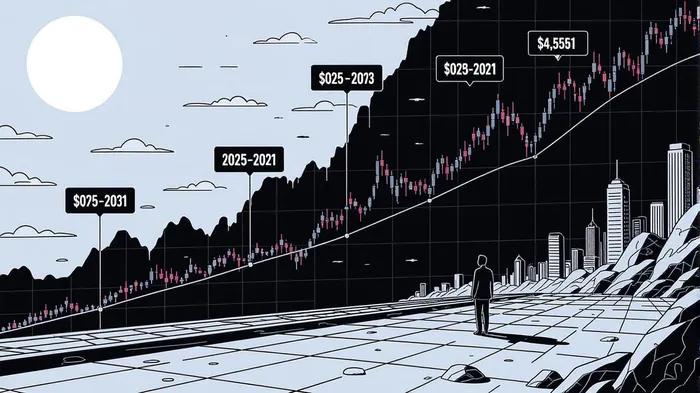
Cardano (ADA) has long been positioned as a research-driven blockchain platform with a focus on scalability, sustainability, and institutional-grade compliance. As of 2025, the cryptocurrency finds itself at a critical juncture: on-chain fundamentals suggest a maturing ecosystem, while market sentiment remains polarized between optimismOP-- and skepticism. To assess ADA’s viability in reaching $3 by 2031, we must dissect the interplay between technical progress, adoption metrics, and investor psychology.
On-Chain Fundamentals: A Mixed Bag of Progress and Challenges
Cardano’s on-chain metrics paint a nuanced picture. The network supports over 4.8 million wallets, with staking participation exceeding 67%—a testament to its decentralized security model [1]. Smart contract activity has surged, with Plutus-based deployments surpassing 17,400 and 1.6 million addresses interacting with dApps in 2025 [1]. These figures underscore Cardano’s growing utility in decentralized finance (DeFi) and enterprise applications.
However, recent data reveals troubling trends. Daily active addresses have plummeted by 65% between May and August 2025, while transaction volumes fell from $1.69 billion to $964 million during the same period [2]. This decline raises questions about user retention and competition from platforms like SolanaSOL-- and EthereumETH--. Despite these headwinds, Cardano’s ecosystem remains robust, with over 2,005 active projects and ongoing development of the Vasil and Conway upgrades, which have reduced contract execution costs and improved throughput [1].
Market Sentiment: The ETF Hype and Behavioral Biases
Market sentiment for ADAADA-- is heavily influenced by two factors: the pending Grayscale CardanoADA-- ETF approval and investor behavior patterns. The ETF, expected to be decided by October 26, 2025, could revolutionize ADA’s liquidity and institutional adoption [3]. If approved, it would provide a regulated vehicle for investors to gain exposure to ADA without navigating crypto exchanges—a move that historically boosted Bitcoin’s price post-ETF approval [5].
Yet, retail investor psychology complicates this narrative. Behavioral economics principles, such as the reflection effect and disposition bias, have amplified ADA’s price volatility. For instance, when ADA dropped to $0.6236 in July 2025, loss-averse retail investors sold at a loss. Conversely, when ADA surged to $0.9632 in August, many locked in profits prematurely, missing potential upside [4]. Institutional investors, however, have shown more discipline, with whale holders accumulating 130 million ADA during market dips [4].
Price predictions for ADA in 2025–2031 vary widely. In a bullish scenario, ADA could reach $3.38 if the crypto market cap hits $10 trillion [1]. A bearish case projects a drop to $0.50 if the market cap stagnates at $3 trillion [1]. These forecasts hinge on factors like DeFi adoption, regulatory clarity, and the success of scalability solutions like Hydra [4].
The Interplay Between Fundamentals and Sentiment
Cardano’s long-term viability depends on aligning its technical progress with market expectations. While on-chain upgrades like Hydra (aimed at achieving 1 million TPS) and on-chain governance are foundational, their impact is contingent on real-world adoption. For example, Cardano’s digital identity and supply chain solutions could drive enterprise adoption, but these use cases remain underdeveloped compared to Ethereum’s ecosystem [4].
The Grayscale ETF approval could bridge this gap by attracting institutional capital, which in turn could stabilize ADA’s price and reduce retail-driven volatility. However, regulatory scrutiny and competition from emerging chains like Solana pose risks. If Cardano fails to differentiate itself through innovation or partnerships, its market share could erode.
The Road to $3: A Realistic Outlook
Reaching $3 by 2031 would require ADA to achieve a market cap of approximately $1.2 trillion (assuming a 4% share of a $30 trillion crypto market). This scenario is plausible only if Cardano secures widespread institutional adoption, executes its roadmap flawlessly, and avoids regulatory setbacks. Key milestones include:
1. Hydra’s activation by 2026, enabling high-throughput transactions.
2. Grayscale ETF approval in late 2025, boosting liquidity.
3. Mainstream DeFi adoption, driven by cost-effective smart contracts and enterprise partnerships.
However, even if these milestones are met, external factors like macroeconomic conditions and regulatory shifts could derail ADA’s trajectory. For instance, a global economic downturn or stricter crypto regulations could suppress demand for risk assets like ADA.
Conclusion
Cardano’s journey to $3 is neither guaranteed nor implausible. Its on-chain fundamentals—particularly staking participation and smart contract growth—lay a solid foundation, but declining user activity and competition necessitate urgent innovation. Market sentiment, while optimistic about the ETF, remains fragile due to retail behavioral biases. For ADA to achieve its $3 target, it must balance technical execution with strategic adoption, leveraging regulatory milestones to attract institutional capital while addressing ecosystem weaknesses.
Source:
[1] Cardano Statistics 2025: Adoption Rates, Staking Insights [https://coinlaw.io/cardano-statistics/]
[2] Cardano ADA Faces Network Decline as DeFi Competition [https://www.btcc.com/en-US/square/ADA%20News/785464]
[3] Grayscale Registers Cardano and HederaHBAR-- Trusts, SEC Decision Still Looms [https://coinpedia.org/news/etf-news-grayscale-registers-cardano-and-hedera-trusts-sec-decision-still-looms/]
[4] Behavioral Economics and the ADA Price Rollercoaster [https://www.bitget.com/news/detail/12560604945968]
[5] Cardano ETF Approval Has Potential to Revolutionize [https://www.onesafe.io/blog/cardano-etf-approval-revolutionize-crypto-investing]






Comentarios
Aún no hay comentarios