
Cardano's Ouroboros Phalanx: A Game-Changer for PoS Security and Network Scalability
The Technical Edge: Phalanx's Defense Against PoS Vulnerabilities
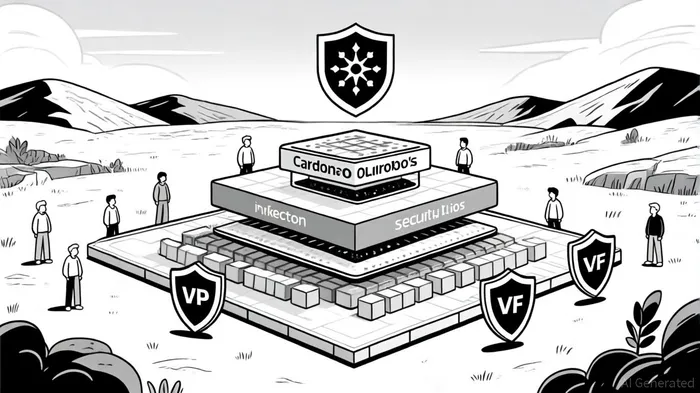
Proof-of-stake (PoS) systems, while energy-efficient, face unique risks like grinding attacks, where adversaries exploit randomness in block selection to manipulate outcomes. Cardano's Ouroboros Phalanx mitigates this by integrating a verifiable delay function (VDF), a cryptographic tool that requires computational puzzles to be solved in real time. This ensures that block producers cannot brute-force test seeds, effectively neutralizing grinding attacks, according to a Coinotag report.
The upgrade's implementation via a hard fork further strengthens its security model. By evolving randomness over two epochs (roughly 10 days), Phalanx prevents centralization risks and ensures fairer block distribution. Early benchmarks-mentioned in that Coinotag piece-suggest this could boost network efficiency by up to 20%, a critical metric for applications requiring high throughput. For investors, this translates to a platform that prioritizes long-term resilience-a rare trait in the volatile crypto landscape.
Security Audits and Formal Verification: Building Institutional Trust
Cardano's commitment to security extends beyond code. The platform has undergone rigorous forensic audits, including a recent examination of its ADAADA-- Voucher Program by law firm McDermott, Will & Schulte and accounting firm BDO. The audit confirmed that 99.7% of voucher ADA was redeemed without evidence of misconduct, directly countering allegations of key deletion or predatory practices, according to Cryptobriefing.
This emphasis on formal verification is not accidental. Cardano's consensus protocols-Ouroboros, Praos, and Genesis-are underpinned by peer-reviewed research and cryptographic proofs, a hallmark of academic-grade security as documented in Cardano research papers. Such transparency is increasingly vital as institutional investors demand auditable frameworks before allocating capital.
Scalability as a Strategic Advantage: The Leios Upgrade
While security is foundational, scalability determines a blockchain's utility. Cardano's upcoming Leios upgrade aims to push transaction throughput to 10,000 transactions per second (TPS) by decoupling block creation and validation processes. This multilayered architecture reduces finality times and positions CardanoADA-- to compete with EthereumETH-- and SolanaSOL-- in high-volume use cases like DeFi and cross-border payments, as covered by U.Today.
The implications for investors are clear: a scalable network attracts developers and enterprises, driving demand for ADA. This dynamic was evident during prior upgrades like Alonzo and Shelley, which historically correlated with price surges, according to a Bitpanda forecast. With Leios on the horizon, Cardano is primed to capture a larger share of the blockchain infrastructure market.
Institutional Adoption: A Tipping Point for ADA
Institutional interest in Cardano has surged, exemplified by T. Rowe Price's first crypto ETF, which includes ADA among its top holdings, according to Digital Journal. This signals a shift in perception-from speculative asset to institutional-grade infrastructure. Analysts project ADA could reach $2.50–$5 in 2026, driven by upgrades like Hydra (a Layer 2 solution) and sustained demand from institutional portfolios, as noted by Digital Journal.
Price forecasts for 2025 remain mixed, with optimistic scenarios pegging ADA at $1.50 and pessimistic ones at $0.60. However, the correlation between technical upgrades and price action suggests that Phalanx and Leios could act as catalysts, particularly if macroeconomic conditions stabilize.
The Investment Thesis: Balancing Risk and Reward
For infrastructure-focused investors, Cardano's approach offers a compelling risk-reward profile. Phalanx's VDF and formal verification reduce the likelihood of catastrophic security failures, while Leios's scalability improvements open doors to enterprise adoption. Meanwhile, institutional endorsements like T. Rowe Price's ETF provide a floor for ADA's value, even amid market volatility.
However, challenges remain. Regulatory uncertainty and competition from EVM-compatible chains could delay adoption. Yet, for those willing to bet on a platform that prioritizes academic rigor and long-term design, Cardano's upgrades present a rare alignment of technical innovation and market potential.
Conclusion
Cardano's Ouroboros Phalanx is more than a technical upgrade-it's a strategic pivot toward a future where security and scalability are no longer mutually exclusive. As blockchain infrastructure evolves, platforms that address these dual challenges will dominate. For investors, the question isn't whether to invest in Cardano, but whether they can afford to overlook a project that's redefining the rules of the game.






Comentarios
Aún no hay comentarios