
Cardano's Market Stability Amid Whale and Retail Investor Activity: A Deep Dive into On-Chain Behavior and Sentiment Alignment
Cardano (ADA) has emerged as a focal point of on-chain intrigue in late 2025, with conflicting signals from whale and retail investor behavior creating a complex narrative around its market stability. While large-scale selling by institutional holders has driven short-term volatility, accumulating activity and ecosystem upgrades suggest a longer-term resilience. This analysis unpacks the interplay between these dynamics, using on-chain data and sentiment metrics to assess ADA's trajectory.
Whale Activity: Bearish Pressure or Strategic Reallocation?
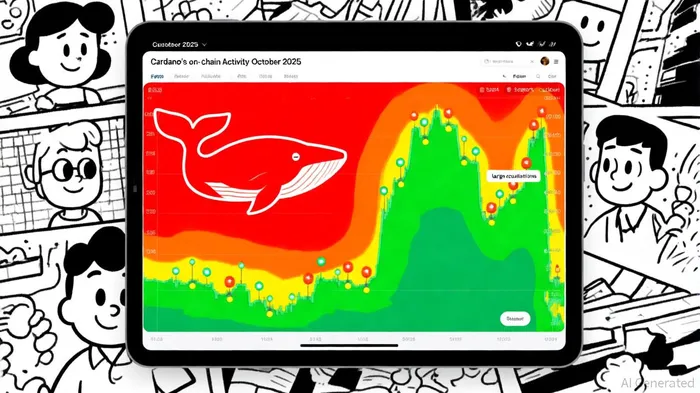
Over the past week, Cardano's blockchain witnessed a significant outflow of 270 million ADA-valued at approximately $218 million-transferred from Coinbase to unknown wallets, according to a Binance report. Such movements, often interpreted as bearish, have coincided with a 9.62% weekly price decline, according to a Coindoo analysis. However, the narrative is not uniformly negative. Whale holdings have decreased by 1.68% to 3.32 billion ADAADA--, yet this reduction has been offset by a surge in mid-sized and retail investor participation, the Coindoo analysis notes.
Notably, over 137 transactions exceeding $1 million each were recorded in a single day, signaling renewed interest from deep-pocketed investors. These contrasting patterns-massive offloading versus targeted accumulation-highlight the dual nature of whale behavior. According to on-chain analyst Ali Martinez, such activity could reflect "strategic liquidity management or staking preparations rather than outright pessimism," as reported in a TradingView article. For instance, the transfer of 67.8 million ADA ($54.3 million) from Coinbase to self-custody wallets in October suggests a shift toward long-term holding strategies, the TradingView article adds.
Retail Sentiment: Bearish Retrenchment and Frustration-Driven Bounces
Retail investor sentiment turned sharply bearish in September 2025, with a bullish-to-bearish commentary ratio of 1.5:1-the lowest in five months, according to a Coindesk piece. This pessimism coincided with a 5% price rebound, a phenomenon analysts attribute to "frustrated selling," as the Coindesk piece notes. Despite this, retail participation has not disappeared entirely. Transaction volume on the CardanoADA-- network hit a seven-month high of $52.26 billion in late November 2024, driven by over 8,900 whale transactions exceeding $100,000 each, according to the TradingView article. This historical correlation between retail inflows and price surges-such as a 26% ADA rally against BitcoinBTC-- in June 2025-suggests that bearish sentiment may eventually reverse, the Coindoo analysis suggests.
Sentiment Alignment and Market Stability
The key to Cardano's stability lies in the alignment-or misalignment-of whale and retail behaviors. While whale selling has intensified near-term bearish momentum, the simultaneous accumulation by large holders and increased retail inflows indicate a potential "buying the dip" strategy. Data from Santiment and IntoTheBlock reveals that whale balances fell by 1.68% in October, yet mid-sized investors added 3% to their ADA holdings, the Coindoo analysis reports. This divergence suggests that whales may be exploiting retail pessimism to accumulate at discounted prices, a pattern observed in other crypto markets during correction phases, as the Coindesk piece observes.
Fundamentals and Ecosystem Resilience
Beyond on-chain activity, Cardano's fundamentals remain robust. The network processes an average of 2.6 million daily transactions, with smart contracts accounting for 35% of activity, the Binance report notes. Upgrades like Hydra (layer-2 scaling) and Voltaire (governance enhancements) are positioning ADA for long-term utility, while the Starstream ZK-proof system aims to bolster privacy and scalability, according to a CardanoFeed analysis. The Cardano Foundation's 2025 roadmap further emphasizes stablecoin liquidity and DeFi growth, providing a structural foundation for sustained adoption, the Coindoo analysis adds.
Outlook: Navigating Volatility Toward a Potential Breakout
The immediate outlook for ADA remains mixed. Bearish technical indicators and whale selling pressure could test support levels below $0.90, the Binance report warns. However, bullish catalysts-such as the potential approval of an ADA ETF on October 26 and Bitcoin's surge to $125,000-could reinvigorate altcoin sentiment, the CardanoFeed analysis suggests. If ADA manages to break above $1.12 and sustain momentum, it may validate the strategic accumulation by whales and signal a broader market rotation toward undervalued layer-1 protocols, the Binance report adds.
Historical backtesting of support-level breaches from 2022 to 2025 offers additional context. When ADA's price fell below key support levels, the asset generated an average cumulative gain of ~9.7% over the next 30 days, outperforming the ~3% benchmark of a continuous buy-and-hold strategy, the Coindoo analysis shows. The win rate for these events remained above 57% through most of the 30-day horizon, peaking at 79% on day 25, the Coindoo analysis notes. While the signal is noisy and lacks statistically significant daily excess returns, these findings suggest that support-level rebounds have historically provided a modest edge for traders combining this trigger with tighter risk controls.
In conclusion, Cardano's market stability hinges on the delicate balance between whale-driven volatility and retail-driven resilience. While short-term selling pressure persists, the interplay of strategic accumulation, ecosystem upgrades, and historical price correlations suggests that ADA's fundamentals are well-positioned to weather the storm. Investors should monitor whale activity and retail sentiment shifts closely, as these on-chain signals may ultimately dictate the next phase of Cardano's journey.






Comentarios
Aún no hay comentarios