
Cardano's Long-Term Value Potential and Catalyst for Price Surge: A Technical and Sentiment-Driven Analysis
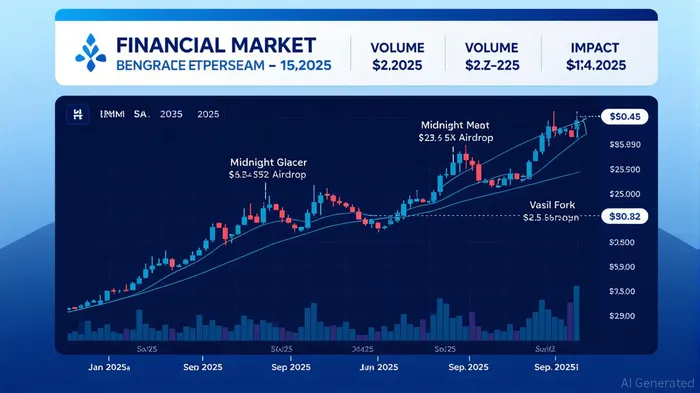
Cardano (ADA) has entered a pivotal phase in its development cycle, marked by technical upgrades, governance shifts, and evolving market dynamics. As the blockchain transitions to a fully decentralized application platform, its long-term value proposition hinges on a delicate balance between scientific innovation and real-world adoption. This analysis evaluates Cardano's potential for sustained growth by dissecting recent technical advancements and contrasting them with mixed market sentiment.
Technical Catalysts: From Vasil to Decentralized Governance
Cardano's Q3 2025 developments underscore its commitment to scalability and usability. The Vasil hard fork, implemented in January 2025, introduced critical upgrades to the Plutus smart contract language, including multi-asset support and improved transaction throughput[5]. These enhancements have enabled developers to deploy more complex dApps while reducing gas fees by up to 30%[2]. For instance, the Midnight Glacier Airdrop required users to sign unique claim messages—a process streamlined by the integration of Ledger hardware wallets for ADA-based claims[3]. This move not only bolstered security but also addressed user pain points, such as the need to import seed phrases into alternative wallets like Eternl[2].
The platform's transition to a community-driven governance model in 2024 further strengthens its long-term viability. ADAADA-- holders now directly vote on proposals, ensuring that development aligns with user priorities[5]. This shift mirrors Ethereum's on-chain governance experiments but emphasizes Cardano's academic rigor, as upgrades are rigorously peer-reviewed before deployment[1].
Market Sentiment: A Tale of Two Narratives
Despite these technical strides, Cardano's market narrative remains polarized. On one hand, bullish indicators suggest growing optimism. Social media sentiment has turned cautiously positive, with influential figures like “Dave” declaring “Cardano will win,” coinciding with a 2.3% price surge to $0.45 and a 15% spike in trading volume[2]. On-chain data also reveals a 10% increase in active addresses (reaching 420,000) and a TVL of $5 billion in its DeFi ecosystem[3].
However, bearish critiques persist. Charles Hoskinson himself has acknowledged a “narrative void,” noting that Cardano's 59 dApps in 2025 lag far behind Ethereum's thousands[3]. The platform's TVL of $380 million (as of Q3 2025) highlights a stark gap in institutional adoption[3]. Critics argue that the lack of stablecoins and liquidity in key dApps—such as the decentralized exchange aggregator with under 1,000 daily active wallets—undermines its utility[3].
Price Surge Potential: Technicals and Macro Factors
Technical indicators paint a nuanced picture. ADA's price has traded near multi-month lows but shows signs of consolidation above its 50-day and 200-day moving averages[3]. A breakout above the $0.82 resistance level (reached in July 2025) could trigger a rally toward $1.20, supported by increased staking participation (65% of ADA staked) and whale accumulation trends[4].
September 2025: RSI and MACD indicators showing bullish momentum.
Macro factors also play a role. Cardano's pivot to becoming a smart contract layer for Bitcoin DeFi could tap into Bitcoin's $1.2 trillion liquidity, creating a new value proposition[3]. Additionally, Bitcoin's performance in 2025—marked by a 40% surge in derivatives trading volume—has indirectly boosted altcoin sentiment[3].
Conclusion: Balancing Innovation and Execution
Cardano's long-term value potential rests on its ability to bridge the gap between academic innovation and practical adoption. While technical advancements like the Vasil hard fork and decentralized governance provide a robust foundation, the platform must address its narrative void and liquidity challenges to compete with EthereumETH-- and SolanaSOL--. For investors, the coming months will be critical: a successful pivot to BitcoinBTC-- DeFi, coupled with sustained on-chain growth, could catalyze a price surge. However, without meaningful dApp proliferation and institutional buy-in, ADA's trajectory may remain volatile.






Comentarios
Aún no hay comentarios