
Cardano's Emerging Privacy Ecosystem and Its Strategic Implications
The Privacy Imperative: A New Era for Blockchain
Privacy has long been a niche concern in blockchain, but 2025 marks a turning point. Regulatory scrutiny, corporate data governance demands, and consumer wariness of public transaction trails have amplified the need for privacy-centric solutions. Cardano's Midnight Privacy Chain addresses this by enabling confidential transactions through zero-knowledge proofs (ZKPs), a cryptographic method that verifies transactions without exposing sensitive data, according to a Coinotag analysis. This is not mere obfuscation; it's a structured approach to privacy that maintains auditability for compliance purposes, as noted in a Coinotag report.
The Midnight Chain's integration with Cardano's Hydra layer-2 scaling solution is particularly noteworthy. By distributing the native NIGHT token via Hydra, the network achieves high throughput (thousands of transactions per second) while avoiding mainnet congestion, as reported in a CryptoTimes article. This hybrid model-private yet verifiable-caters to both individual users and enterprises, such as healthcare providers or financial institutions, where data confidentiality is non-negotiable, according to the Coinotag analysis.
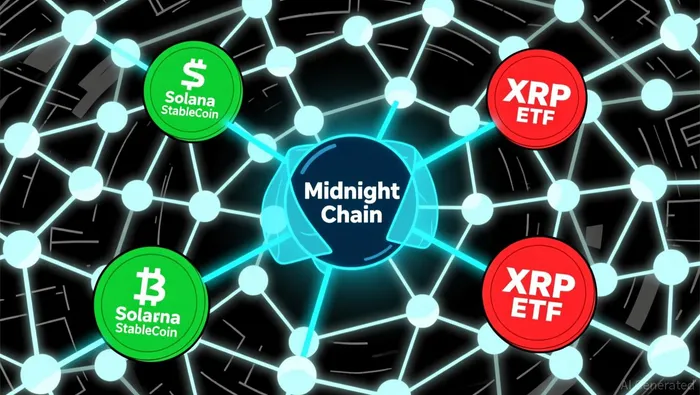
Strategic Positioning: Midnight vs. XRPXRP-- ETFs and SolanaSOL-- Stablecoins
While Cardano's privacy focus is unique, it competes indirectly with other 2025 trends. The XRP ETF, for instance, is gaining traction as a compliance-friendly alternative to BitcoinBTC-- and EthereumETH--, with Ripple's legal hurdles seemingly resolved, according to a Coinotag report. Similarly, Solana-based stablecoins are surging, driven by Western Union's USDPT stablecoin and the network's 39-week high in stablecoin transfer volume, as noted in a Coinotag analysis.
However, these innovations lack the privacy layer that Midnight introduces. XRP's strength lies in cross-border payments and regulatory clarity, but it does not inherently protect transaction data, according to the Coinotag analysis. Solana's speed and institutional adoption are undeniable, yet its ecosystem remains exposed to the same transparency risks as Ethereum. In contrast, Midnight's ZKP-based model offers a dual-layer value proposition: privacy for users and selective transparency for regulators, according to the Coinotag analysis. This duality is critical in markets like South Korea, where Cardano's Midnight Chain could thrive amid a $70 billion AI fund and growing corporate blockchain adoption, as noted in the Coinotag report.
Institutional and Retail Demand: A Convergence of Forces
The demand for privacy-centric solutions is not hypothetical. Retail investors have shown a 1,200% year-to-date surge in ZcashZEC--, a privacy coin, signaling a latent appetite for anonymity, according to the Coinotag analysis. Meanwhile, institutional investors are increasingly prioritizing projects with clear compliance frameworks. Midnight's design-using Google Cloud's Confidential Computing to secure data while allowing regulatory access-strikes this balance, as reported in a CryptoFrontNews piece.
This alignment is strategic. The Glacier Drop token distribution, managed by partners like BitGo and Sundae Labs, ensures a transparent rollout while leveraging Hydra's scalability, according to the CryptoTimes article. By minting all 24 billion NIGHT tokens as Cardano Native Assets (CNAs), the project also reinforces trust in its supply model, as noted in a Coinrise report. For investors, this represents a controlled, institutional-grade rollout of a privacy-focused asset.
Strategic Implications: Privacy as a Catalyst for Adoption
Cardano's broader ecosystem is also evolving. The Ouroboros Leios protocol upgrade and Hydra's real-world deployment via Midnight signal a maturation of the platform's infrastructure, as noted in the CryptoFrontNews piece. These upgrades are not isolated; they are part of a coordinated effort to address DeFi stagnation by integrating real-world assets (RealFi) and Bitcoin liquidity, as reported in a Coinotag analysis.
For investors, the implications are clear. Privacy is no longer a niche feature but a strategic differentiator. Midnight's launch could catalyze a shift in how blockchain is perceived-moving from a tool for speculative trading to a foundational infrastructure for private, compliant transactions. This is particularly relevant in sectors like healthcare, where data breaches cost corporations billions annually, and in DeFi, where trustless yet private lending models could emerge, according to the Coinotag report.
Conclusion: The Privacy-Driven Future
Cardano's Midnight Privacy Chain is more than a technical upgrade-it's a response to a market in flux. As XRP ETFs and Solana stablecoins capture headlines, Midnight addresses a deeper, unmet need: the ability to transact privately without sacrificing transparency for compliance. With its launch event on November 17 and a token distribution strategy that balances decentralization and control, Cardano is betting that privacy will be the next frontier for blockchain adoption.
For investors, the question is not whether privacy matters-it's whether they can afford to ignore it.






Comentarios
Aún no hay comentarios