
Cardano's Divergent Short-Term and Long-Term Outlook: A Strategic Entry Point for Investors?
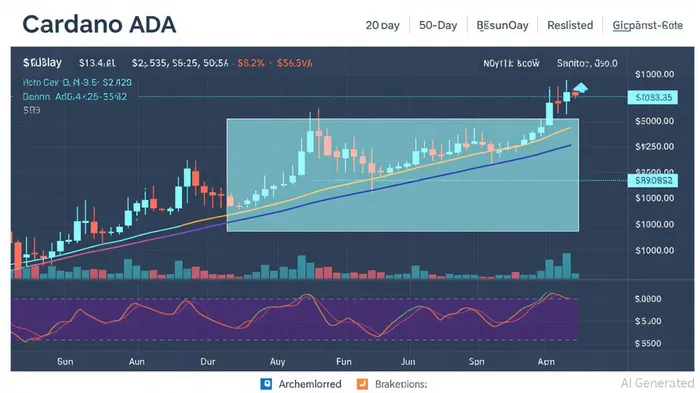
Cardano (ADA) stands at a crossroads in September 2025, where short-term technical indicators and long-term market fundamentals present a compelling divergence. For investors, this creates a nuanced opportunity to evaluate whether ADA's current price action—trading between $0.80 and $0.85—represents a strategic entry point amid conflicting signals.
Short-Term Technical Divergence: Caution Amid Optimism
Technical indicators paint a mixed picture for ADA's immediate trajectory. While moving averages suggest a “strong buy” rating, with ADAADA-- trading above its 30-day SMA and Fibonacci retracement levels[1], oscillators like the RSI and MACD reveal caution. The RSI remains neutral, hovering near 50, while the MACD shows bearish divergence, hinting at potential short-term weakness[2]. This divergence is compounded by whale activity: large investors recently sold 30M ADA, reversing prior accumulation and creating downward pressure[1].
Price action further underscores this tension. ADA has broken above critical resistance at $0.86 but faces a key test at $0.88–$0.89. A failure to hold above $0.85 could trigger a retest of support at $0.72–$0.68[3]. Derivatives data adds nuance: open interest stabilized at $1.74 billion, but declining 24-hour volume ($582M) suggests waning retail momentum[1].
Long-Term Fundamentals: Structural Strength and Catalysts
Contrast this with Cardano's long-term narrative, where structural upgrades and institutional adoption create a bullish foundation. The Plomin hard fork, which enhanced smart contract efficiency and network scalability, has already driven DeFi and NFT growth[1]. Institutional interest is also rising, fueled by Cardano's energy-efficient proof-of-stake (PoS) model and regulatory clarity. Whale wallets now control 10.3% of ADA's supply, signaling sustained accumulation[2].
A potential catalyst looms: a Grayscale CardanoADA-- ETF approval by October 2025. Analysts project ADA could surge to $1.80 if approved[3], while broader market conditions—such as U.S. Federal Reserve rate cuts—could drive a 15–30% increase by year-end[1]. These fundamentals position ADA as a long-term play, even as short-term volatility persists.
Market Cycle Positioning: Consolidation or Breakout?
ADA's current market cycle resembles its 2021 breakout phase, with price consolidating near key technical levels. Analysts draw parallels to this historical pattern, suggesting a potential continuation toward $1.00 and beyond[3]. However, declining trading volume and bearish whale activity highlight risks. The price range of $0.74–$1.24 reflects this uncertainty, with a first-wave upward move anticipated if ADA breaks above $0.88[1].
Strategic Entry Points: Balancing Risk and Reward
For investors, the key lies in aligning entry strategies with ADA's divergent signals. A measured approach would involve accumulating ADA at $0.88–$0.90 with stops below $0.85[3], capitalizing on the long-term thesis while hedging against short-term pullbacks. Conversely, a breakdown below $0.77 could trigger deeper retracements, making it a high-risk entry.
The broader crypto market's caution—ADA's 24-hour volume down 52%—adds complexity[1]. However, Cardano's ecosystem development, including cross-chain bridges and Layer 2 solutions, reinforces its long-term potential[2]. Investors must weigh these factors against macroeconomic risks, such as Fed policy shifts, which could amplify ADA's volatility.
Conclusion: A Calculated Bet on Divergence
Cardano's current phase embodies the classic tension between technical caution and fundamental optimism. While short-term indicators warn of bearish divergence and whale selling, long-term catalysts—including the Plomin fork, institutional adoption, and potential ETF approval—create a compelling upside case. For disciplined investors, ADA's $0.85–$0.88 range offers a strategic entry point, provided they align their risk tolerance with the asset's dual narrative.






Comentarios
Aún no hay comentarios