
Cardano's Diminished Prospects and the Rise of Remittix in 2026
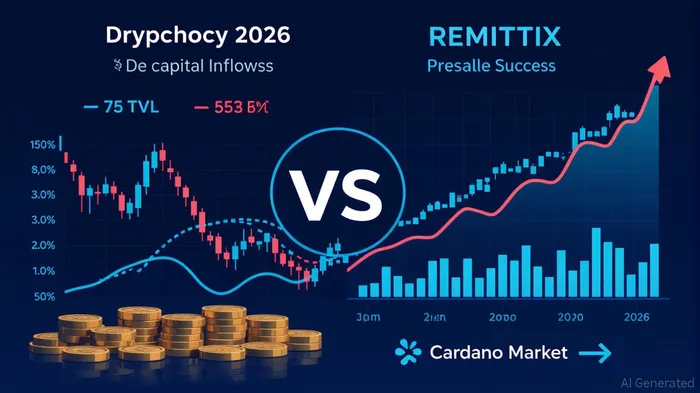
The Structural Challenges Facing Cardano
Cardano (ADA) has long been heralded as a research-driven blockchain with a peer-reviewed approach to scalability and sustainability. However, by 2026, its structural challenges have become impossible to ignore. Despite ambitious upgrades like the Vasil hard fork and the Hydra layer-2 solution, the platform has only 59 active decentralized applications (dApps) as of 2025, far below founder Charles Hoskinson's earlier projections of thousands by 2022 [1]. This underperformance has eroded investor confidence, with total value locked (TVL) stagnating at around $380 million—trailing Ethereum's $50 billion and Solana's $10 billion [1].
The root issue lies in Cardano's inability to define a compelling narrative. While technical upgrades like Ouroboros (its proof-of-stake consensus) are robust, they have not translated into real-world adoption. Critics like Arthur Hayes of BitMex have dismissed the platform as “irrelevant” in a market demanding immediate utility [1]. Hoskinson's pivot to positioning CardanoADA-- as a smart contract layer for BitcoinBTC-- DeFi remains unproven, with no significant traction in 2026 [1]. Meanwhile, ADA's price languishes near multi-year lows, reflecting a lack of institutional interest and open interest levels that trail major rivals [1].
The Rise of Remittix: A New Paradigm in Cross-Border Payments
In contrast, Remittix (RTX) has emerged as a high-return alternative, capitalizing on the $150 trillion global remittance market. The platform's unique value proposition—enabling instant, low-cost crypto-to-fiat transfers with no foreign exchange fees—has resonated with both retail and institutional investors. By 2026, Remittix's presale has raised over $24.7 million, with its RTXRTX-- token selling 658 million of 1.5 billion tokens by September 2025 [2]. This momentum is underscored by strategic exchange listings on LBank and BitMart, with plans to expand to five additional platforms in 2026 [2].
Remittix's beta wallet, launched in September 2025, allows users to send crypto to bank accounts in over 30 countries, bypassing traditional intermediaries. The platform's focus on financial inclusion—targeting underbanked populations—has attracted attention from venture capital firms and fintech investors. Its roadmap includes a global marketing campaign and a testnet phase to refine user feedback, positioning it as a scalable solution for cross-border payments [2].
Shifting Capital Flows: From Cardano to Remittix
The capital reallocation between Cardano and Remittix is stark. While Cardano's TVL remains stagnant, Remittix's presale has drawn over $24.7 million in 2026, with institutional investors eyeing its potential to disrupt traditional remittance services [2]. Exchange listings further highlight this shift: Cardano has seen no new institutional-grade listings in 2026, whereas Remittix's presence on LBank and BitMart has boosted liquidity and visibility [2].
Institutional adoption metrics also favor Remittix. The platform's audited codebase (by CertiK) and focus on regulatory compliance have attracted early-stage institutional backing, while Cardano's “narrative void” continues to deter large-scale capital inflows [2]. This divergence is emblematic of a broader trend: investors are prioritizing projects with immediate utility over those with theoretical scalability.
Conclusion: A Tectonic Shift in Investor Priorities
Cardano's struggles in 2026 underscore a critical lesson for the crypto market: technical innovation alone is insufficient without a clear value proposition. Remittix's rise, by contrast, demonstrates the power of solving real-world problems—specifically, the inefficiencies in global remittances. As capital flows increasingly favor projects with tangible use cases, Cardano's diminished prospects and Remittix's rapid ascent reflect a tectonic shift in investor priorities. For those seeking high returns, the data is clear: the future belongs to platforms that bridge crypto and traditional finance, not those that merely aspire to.






Comentarios
Aún no hay comentarios