
Cardano's Deepening Bear Case: Why ADA Faces a 36% Drop Despite Upcoming Upgrades
Cardano (ADA) has long been positioned as a third-generation blockchain with a research-driven approach to scalability and governance. Yet, as 2025 draws to a close, the project finds itself in a precarious position: despite a slate of ambitious upgrades, on-chain fundamentals and market sentiment suggest a deepening bear case. ADA's price has fallen nearly 58% year-over-year, with recent data indicating a 36% decline in market capitalization over the past month. This analysis unpacks the conflicting signals from on-chain metrics, whale behavior, and technical indicators to explain why ADAADA-- remains vulnerable to further downside, even as foundational upgrades loom.
On-Chain Fundamentals: A Tale of Two Halves
Cardano's on-chain activity in 2025 has been marked by stark contrasts. Q3 2025 saw a 19.2% surge in daily active addresses and a 15.7% increase in transactions suggesting growing network utility. However, Q2 painted a bleaker picture: daily transactions plummeted 29% to 22,600, while active addresses fell 36% to 31,200. This volatility underscores a lack of consistent demand, with the network's adjusted on-chain volume surging to $6 billion in Q3 but failing to sustain momentum.
Transaction fees, a critical metric for user adoption, also tell a mixed story. While the average fee remains affordable at $0.12 USD according to data, Q2 saw a 45% drop in USD fees and a 29% decline in ADA fees driven by reduced transaction volume, driven by reduced transaction volume and ADA's price depreciation. This dynamic highlights a self-reinforcing cycle: lower fees attract users, but insufficient volume fails to justify price recovery.
Market Sentiment: Whales, Dumps, and Divergent Signals
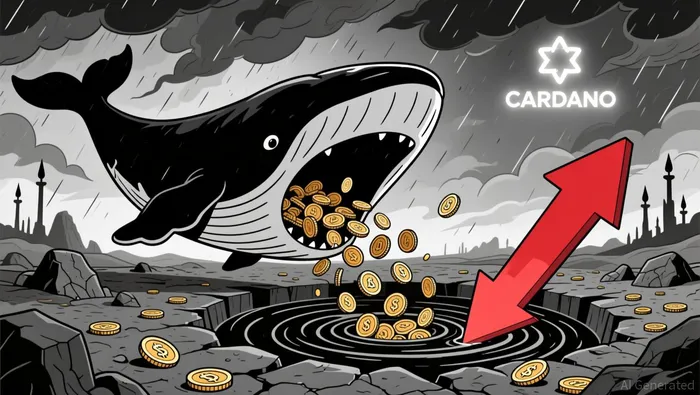
The bearish narrative is further reinforced by whale activity and exchange flows. Despite net outflows of -$3.02 million in recent weeks, which typically signal long-term confidence, a single whale dumped 440 million ADA over the past month, exacerbating selling pressure. This mass liquidation pushed ADA below $0.52-a support level since 2024-and triggered a technical breakdown.
Technical indicators corroborate the bearish bias. The MACD and RSI show increasing downward momentum, while sustained spot outflows (e.g., $2.50 million in 24 hours according to data) reflect weak demand for private wallet holdings. ADA's current consolidation near $0.398 is a critical juncture: a break below $0.38 would expose the coin to a potential drop toward $0.32.
Futures data adds nuance. A "Taker Buy Dominant" environment in derivatives suggests short-term buyer interest, yet this has not translated into a sustained price rebound. This divergence between on-chain accumulation and price action points to a fragile market structure, where institutional buyers may be testing support levels without broader retail participation.
Upgrades vs. Reality: Can Innovation Offset Bearish Momentum?
Cardano's 2025 roadmap includes transformative upgrades such as the Ouroboros Leios consensus protocol promising a 50% increase in TPS and the Hydra Layer-2 solution, which demonstrated 1,000 TPS per head according to reports. The Midnight protocol, set to launch in 2026, aims to attract privacy-conscious users with programmable data protection according to analysis. These advancements are undeniably significant, yet their market impact remains muted.
The disconnect between innovation and price performance is stark. Total Value Locked (TVL) in Cardano's DeFi ecosystem has collapsed to $219 million from a peak of $729 million in late 2024, despite these upgrades. This suggests that while Cardano's infrastructure is improving, its ability to attract liquidity and user activity lags behind competitors like EthereumETH-- and SolanaSOL--.
Institutional moves-such as ADA's inclusion in the Nasdaq Crypto Index and partnerships with Google Cloud according to reports-are positive catalysts. However, these developments have not offset the broader bearish sentiment. A recent $5 million treasury loan to boost exchange listings according to data may improve ADA's visibility, but it does little to address the underlying issue: a lack of immediate demand.
The Path Forward: A High-Stakes Gamble
The bear case for ADA hinges on three key factors:
1. Whale Behavior: Continued large-scale dumping, as seen in the 440 million ADA liquidation, will likely deepen the bearish trajectory.
2. Technical Breakdowns: A failure to reclaim $0.46 could trigger a cascade of stop-loss orders, accelerating the decline toward $0.32.
3. TVL Stagnation: Without a meaningful increase in DeFi activity, Cardano's upgrades may remain theoretical rather than practical value drivers according to analysis.
Optimists point to the December 2025 launch of the NIGHT token according to reports and the DeepSeek AI model's $10 price target according to data as potential turning points. However, these scenarios depend on a broader crypto market recovery and sustained institutional adoption-uncertainties that weigh heavily on short-term sentiment.
Conclusion
Cardano's on-chain fundamentals and market sentiment paint a picture of a project caught between innovation and inertia. While upgrades like Hydra and Midnight represent long-term value, they have yet to translate into immediate price action. The bearish case is further solidified by whale outflows, technical breakdowns, and a TVL that continues to erode. For ADA to avoid a 36% drop-and potentially reclaim its 2024 support levels-it must first address the structural weaknesses in demand and liquidity. Until then, the bear case remains firmly entrenched.







Comentarios
Aún no hay comentarios