
Cardano's Declining Trading Volume: A Harbinger of Stalled Price Recovery?
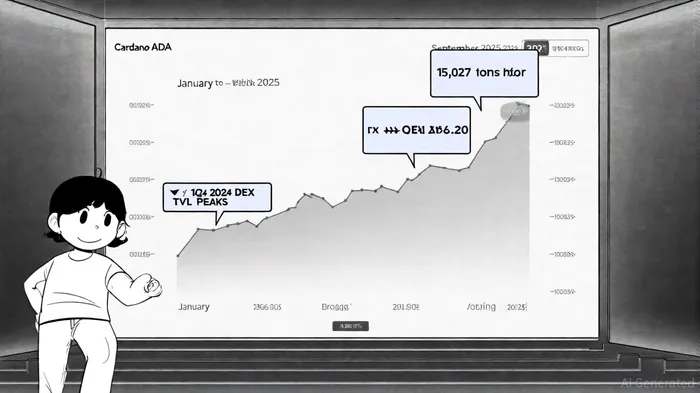
Cardano (ADA) has entered a critical juncture in 2025, marked by a sharp decline in trading volume and mixed signals about its price recovery potential. As of September 2025, ADA's 24-hour trading volume plummeted by 36.5% to $1.13 billion, coinciding with a 5.77% drop in price over seven days[1]. This divergence between volume and price raises questions about the sustainability of ADA's recent rebound and whether the broader market is losing faith in its on-chain fundamentals.
On-Chain Dynamics: A Tale of Two Metrics
Cardano's on-chain activity reveals a fractured narrative. While the network achieved a milestone of 15,027 holders for a project as of September 6, 2025—a sign of broad user distribution and liquidity depth[1]—other metrics tell a darker story. Daily active addresses, a proxy for network participation, fluctuated wildly, peaking at 50,800 in January 2025 before collapsing to 52,380 by December 2024, the lowest in seven days[3]. This decline aligns with a 17% price drop during the same period[4], underscoring the fragile relationship between usage and valuation.
Decentralized exchange (DEX) total value locked (TVL) further highlights the ecosystem's struggles. Cardano's DeFi TVL surged to an all-time high of $708 million in December 2024[4], only to retreat to $611 million by September 2025[1]. The largest DEX, Minswap, mirrored this trend, reflecting reduced investor confidence in Cardano's DeFi applications. Meanwhile, metrics like mean coin age and MVRV ratio suggest accumulation by long-term holders[2], yet these signals are overshadowed by whale selling pressure. Over 270 million ADAADA-- tokens were liquidated in a single week in September 2025[6], exacerbating short-term volatility.
Investor Sentiment: From OptimismOP-- to Skepticism
Investor sentiment for ADA has swung dramatically in 2025. Early September saw sentiment hit a 5-month low, with Santiment data indicating a sharp bearish shift among retail traders[2]. This followed a 30% price correction over the prior month and whale dumping of 30 million ADA tokens[2]. However, the narrative isn't entirely negative. In July 2025, ADA's sentiment score reached 83 out of 100, outperforming most crypto peers[1], driven by optimism around the U.S. SEC's recognition of Cardano's smart contract use case in government services[5].
The disconnect between sentiment and on-chain activity is striking. Despite a 4-month high in social sentiment in March 2025[5], daily transaction counts on CardanoADA-- fell 70% compared to late 2024[5]. This suggests that bullish enthusiasm has not translated into tangible network usage, a critical gap for price recovery.
Historical Volume-Price Correlations and Broader Context
Historical patterns reinforce the challenges ADA faces. In July 2025, ADA briefly surged 6% amid a broader crypto rally, supported by high-volume activity around $0.590[4]. Yet, the rally collapsed within hours, illustrating the token's susceptibility to bearish momentum. Similarly, Q4 2024 saw ADA's DEX volume surge 271% to $8.9 million[2], but this growth has since reversed, with Q3 2025 volume surging 111% only to collapse in September[3].
Cardano's struggles are amplified by its position in the broader market. Its TVL of $380 million in 2025 pales in comparison to Ethereum's $97 billion and Solana's $11 billion[2], highlighting a lack of adoption despite protocol upgrades like Leios and Hydra. External factors, such as Bitget's delisting of ADA pairs, have further eroded liquidity[1], compounding the issue.
The Path Forward: Upgrades vs. Realities
Cardano's future hinges on its ability to bridge the gap between protocol innovation and real-world adoption. The Plomin hard fork's improvements to smart contract efficiency and NFT utility[3] are positive steps, but they must be paired with increased dApp activity. Charles Hoskinson's vision of transforming Cardano into a BitcoinBTC-- layer-2 chain by May 2025[6] could unlock new value, particularly if Bitcoin's price reaches $250,000–$500,000 as projected[6]. However, technical indicators suggest further short-term declines, with some analysts warning of a potential 57% drop[6].
For ADA to recover, it must demonstrate that its on-chain upgrades translate into measurable usage. Until then, the interplay of declining volume, bearish sentiment, and weak TVL will likely keep the token in a state of limbo.






Comentarios
Aún no hay comentarios