
Cardano (ADA) vs SEI: Evaluating Long-Term Value and Scalability in the Next Crypto Cycle
The Technical Innovation Race: Cardano's Academic Rigor vs SEI's Performance-Driven Approach
Cardano (ADA) and SEISEI-- represent two distinct philosophies in blockchain innovation. CardanoADA--, a third-generation platform, continues to prioritize academic rigor and peer-reviewed research in its development. The Basho era of its roadmap, now in full swing, focuses on scalability through a layered architecture that separates transaction processing (settlement layer) from smart contract execution (computational layer), according to the Cardano Developer Portal. This design enables parallel processing and reduces bottlenecks, with the Hydra protocol already demonstrating 100,000+ TPS in testnet conditions, per the CoinLaw Cardano statistics. Meanwhile, SEI's 2025 "Giga" roadmap targets 5 gigagas per second throughput and 250,000 TPS via innovations like asynchronous execution, multi-proposer consensus, and storage optimization, according to the Sei Labs Giga Roadmap.
SEI's technical approach is more aggressive in performance metrics, leveraging a dual application layer to decouple execution and consensus. This allows for parallel validation of transactions, achieving sub-400ms finality and Web2-level speed, according to a CryptoIndustry review. However, Cardano's methodical, research-driven model ensures robustness, with its settlement layer already handling 400+ TPS under optimal conditions, as reported in CoinLaw's Cardano statistics. While SEI's metrics are impressive, Cardano's layered architecture offers a more modular path to scalability, enabling incremental upgrades without compromising security.
Ecosystem Development: Community-Driven Governance vs Aggressive Funding Strategies
Cardano's ecosystem thrives on decentralized governance through Project Catalyst, which has allocated $150 million to 2,000+ proposals since its inception. The 2025 roadmap emphasizes Fund13 and Fund14 allocations, with 46.5 million ADAADA-- distributed for open-source development, enterprise R&D, and ecosystem growth, according to Cardano Foundation F13 selections. Notable projects include SmartCodeVerifier and Machine Learning Xccelerated Health, bridging blockchain with healthcare, as highlighted by Cardano Spot. The Cardano Foundation's strategic allocation of 180 million ADA in voting stake further underscores its commitment to transparency and community-driven innovation.
SEI, on the other hand, has adopted a high-velocity funding model to accelerate ecosystem growth. In 2025, the Sei Foundation launched a $750K GitcoinGTC-- funding round retroactively rewarding projects that demonstrated measurable impact post-V2 launch, per the Gitcoin funding announcement. This initiative, split into Consumer-Facing Contributions (dApps, NFTs) and Infrastructure & Tooling (developer tools), leverages quadratic funding to prioritize community-driven projects, according to the Sei Blog funding round. SEI's ecosystem now hosts 500+ DeFi projects, including SeiSwap and SeiLend, with daily active addresses surpassing 1 million, according to the Gate.io ecosystem status.
While Cardano's governance model fosters long-term sustainability, SEI's aggressive funding strategies risk over-saturation of the ecosystem. However, SEI's focus on enterprise adoption-via EVM compatibility and CosmosATOM-- IBC interoperability-positions it as a strong contender for institutional use cases, as outlined in the Sei Foundation vision.
Comparative Analysis: Scalability, Adoption, and Risk Factors
Scalability:
- Cardano's layered architecture and Hydra protocol provide a gradual, secure scaling path, ideal for enterprise adoption. However, its academic approach may delay deployment of cutting-edge features.
- SEI's Giga roadmap delivers Web2-level performance but relies on untested large-scale implementations. Its quantum validation model could face bottlenecks under extreme load.
Adoption:
- Cardano's 35% smart contract activity and 1.6 million daily active addresses highlight its growing utility in DeFi and enterprise sectors, based on CoinLaw's Cardano statistics. Partnerships like the ChainlinkLINK-- oracle integration have also expanded interoperability, as noted by The Currency Analytics.
- SEI's 300,000 TPS and 1 million daily active addresses demonstrate rapid user growth, driven by high-frequency trading capabilities and DeFi innovation, per Gate.io's ecosystem status.
Risk Factors:
- Cardano's reliance on peer-reviewed research may slow iteration compared to SEI's agile development.
- SEI's aggressive funding could lead to project fragmentation if not aligned with long-term vision.
Conclusion: Positioning for the Next Crypto Cycle
For investors prioritizing long-term value and institutional adoption, Cardano's academic rigor and modular scalability offer a resilient foundation. Its governance model and enterprise use cases (healthcare, supply chain) align with real-world utility, though execution speed may lag.
SEI, meanwhile, appeals to those seeking high-performance, short-to-medium-term gains. Its Giga roadmap and ecosystem funding create a fertile ground for DeFi and Web3-native applications, but its technical complexity and reliance on unproven scaling mechanisms pose risks.
In the next crypto cycle, both projects could thrive-Cardano as a secure, scalable infrastructure and SEI as a high-speed execution layer. However, investors must weigh Cardano's methodical innovation against SEI's bold, performance-driven approach. 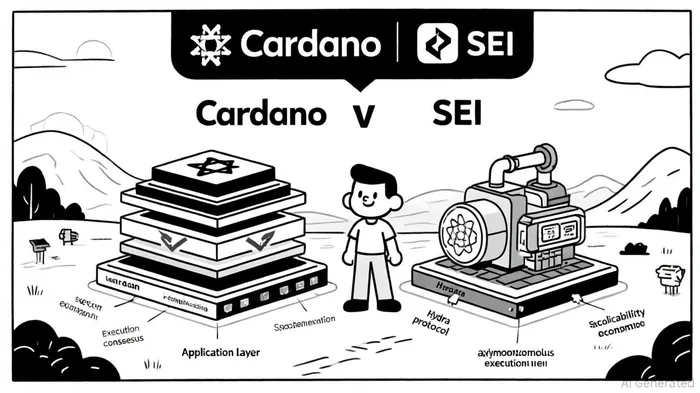






Comentarios
Aún no hay comentarios