
Cardano's ADA Price Action and Institutional Sentiment: A Breakout on the Horizon?
Cardano (ADA) has long been a focal point for investors seeking exposure to a research-driven blockchain with ambitious scalability goals. As of September 2025, the token sits at a critical juncture, with technical indicators and institutional activity aligning to suggest a potential breakout. This article dissects ADA's price action, on-chain momentum, and institutional sentiment to evaluate whether the $1 psychological barrier—a long-standing resistance level—is within reach.
Technical Analysis: A Tipping Point at $1
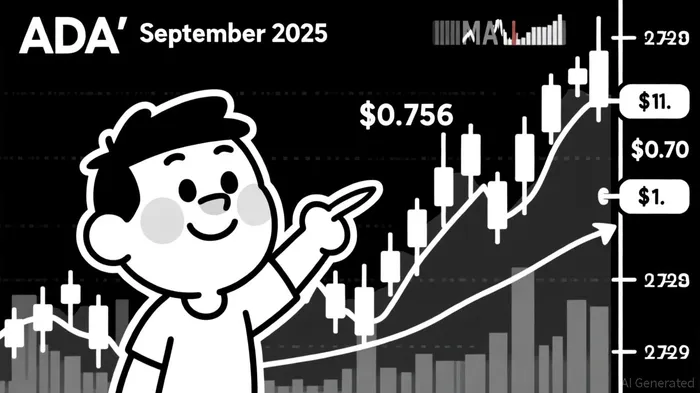
ADA's price trajectory in September 2025 has been defined by its proximity to key support and resistance levels. The $1 threshold, last tested in mid-August, remains a pivotal psychological and technical barrier. According to a report by The Currency Analytics, ADAADA-- has shown signs of upward momentum, with rising mean coin age and whale accumulation indicating increased long-term holder activity[1]. If bulls succeed in pushing ADA above $1 with strong volume, Fibonacci extension levels suggest a potential target of $1.20[1].
However, the path to a breakout is not without risks. The elevated Market Value to Realized Value (MVRV) ratio and declining transaction volume highlight the possibility of profit-taking or reduced utility-driven demand[1]. Meanwhile, technical indicators like the Relative Strength Index (RSI) and Moving Average Convergence Divergence (MACD) signal neutral to bullish momentum[5]. Crucially, ADA must overcome the 50-day and 200-day Simple Moving Averages (SMAs) to confirm a long-term reversal[5].
Support levels at $0.756 and $0.70 are equally critical. A breakdown below these levels could trigger further retracement, eroding bullish sentiment[3]. For now, the market appears to be in a holding pattern, with traders closely watching for a decisive move either above $1 or below $0.70.
Historical data from 2022 to 2025 reveals that ADA's resistance breakouts have historically generated positive returns. Specifically, 51 valid breakouts were identified, with an average cumulative return peaking at +10.8% around day 21. However, the win-rate peaks at 63% on day 4 and declines thereafter, suggesting that the momentum is strongest in the first 2–3 weeks post-breakout. After day 23, the edge decays, indicating the importance of timely exit strategies. These findings underscore the need for disciplined position management, including stop-losses and profit targets, to optimize risk-adjusted returns[4].
Institutional Sentiment: A Quiet Bullish Build-Up
While retail traders debate ADA's technicals, institutional investors have been quietly accumulating. Year-to-date institutional inflows into ADA reached $73 million by mid-2025, placing it just behind SolanaSOL-- in terms of institutional interest[3]. CoinShares data underscores ADA's status as one of the most actively traded altcoins by institutional investors[3].
This inflow is driven by two factors: Cardano's technical upgrades and the anticipation of regulatory clarity. The Plomin hard fork, which improved smart contract efficiency and network scalability, has attracted institutional attention[5]. Additionally, the $96 million treasury allocation for the Hydra scaling solution—a layer-2 protocol designed to boost transaction throughput—has reinforced Cardano's appeal as a secure, research-backed platform[5].
Institutional adoption is further bolstered by Cardano's decentralized governance model, which transitioned to fully elected members in 2025[5]. This shift has enhanced community trust and protocol transparency, critical factors for institutional investors prioritizing long-term sustainability.
ETF Approval: The Wild Card in ADA's Trajectory
The most significant catalyst for ADA in 2025 remains the pending U.S. Securities and Exchange Commission (SEC) decision on a CardanoADA-- ETF. As of September 2025, the SEC has delayed its decision until October 26, 2025[2]. Grayscale's application for a spot ADA ETF, submitted in February 2025, aims to provide traditional investors with regulated exposure to the token[5].
If approved, the ETF could unlock a new wave of institutional capital. According to Gate.com, an ADA ETF would not only legitimize the token in traditional finance but also stabilize its price and increase liquidity[5]. Polymarket traders currently assign a 62% probability to approval[5], reflecting growing optimism.
The regulatory outcome is inextricably linked to ADA's price action. A green light from the SEC would likely trigger a surge in demand, potentially propelling ADA toward $3–$5 in the next cycle[2]. Conversely, a rejection could exacerbate selling pressure, particularly if investors perceive the token as lacking institutional validation.
Conclusion: A Confluence of Factors
Cardano's ADA is at a crossroads. Technically, the token is poised for a breakout above $1, supported by whale accumulation and bullish momentum indicators. Institutionally, the project has attracted significant capital inflows, driven by its research-driven roadmap and scalability upgrades. The pending ETF decision, however, remains the wildcard—its outcome could either catalyze a new bull run or expose ADA to renewed volatility.
For investors, the key takeaway is clear: ADA's next move hinges on a combination of technical execution, institutional adoption, and regulatory clarity. Those willing to navigate the uncertainty may find themselves positioned for a significant upside—if the bulls get their way.






Comentarios
Aún no hay comentarios