
Cardano's 4x Upside Potential: A Strategic Deep Dive into Altcoin Recovery and ADA's Path to $1.20
Cardano (ADA) has long been positioned as a third-generation blockchain with a focus on scalability, sustainability, and institutional-grade infrastructure. As the cryptocurrency market enters a new phase of consolidation and innovation, ADA's recent network upgrades, on-chain activity, and strategic roadmap are generating renewed optimism for a 4x upside potential. This analysis explores the technical, institutional, and ecosystem-driven factors underpinning ADA's trajectory toward $1.20 by 2026–2027.
Network Upgrades: The Foundation for Scalability and Utility
Cardano's Vasil Hard Fork (September 2022) marked a pivotal upgrade, enhancing smart contract efficiency and reducing transaction costs. This laid the groundwork for a partial price recovery, with ADAADA-- reaching $0.458 post-upgrade. However, the more transformative developments are unfolding with the Leios scaling solution, part of the Ouroboros consensus redesign. As of January 2026, Leios is 67% complete, aiming to boost transaction throughput to 1,000 TPS while preserving decentralization. This upgrade, funded by a $71M community initiative, is critical for addressing Cardano's historical scalability limitations and attracting enterprise use cases.
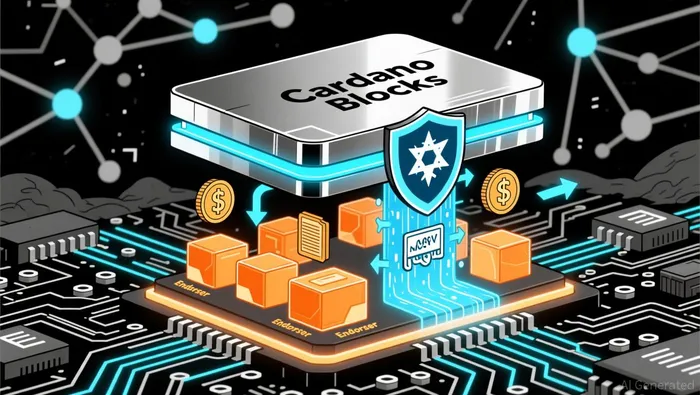
The Leios upgrade introduces a two-tier block system-Endorser Blocks for non-sensitive transactions and Reference Blocks for ordered processing- reducing MEV risks and increasing throughput by 30–60 times. Complementing this, the Hydra layer-2 solution, launched in October 2024, enables off-chain microtransactions, further enhancing scalability. These advancements position CardanoADA-- to compete with EthereumETH-- and SolanaSOL-- in DeFi and NFT ecosystems, where transaction speed and cost efficiency are paramount.
On-Chain Activity: Accumulation and Ecosystem Growth
Q4 2025 data reveals robust on-chain activity, with 150,000–450,000 daily active addresses and 1.3 million staking wallets, reflecting strong community engagement. Notably, 1.2 billion ADA tokens have accumulated at the $0.35 level, signaling a potential breakout and algorithmic sell-offs if this support is breached. Transaction volume on Cardano DEXs surged to 125 million ADA weekly, driven by demand for privacy-focused tokens like Midnight (NIGHT).
ADA's inclusion in all six crypto index ETPs analyzed underscores its perceived stability and long-term appeal, attracting both retail and institutional investors. Meanwhile, the network hosts 4.83 million unique wallets, with 67% of ADA staked-a testament to decentralized governance and security. These metrics highlight Cardano's transition from a speculative asset to a utility-driven infrastructure, supported by real-world adoption in digital identity, decentralized storage, and enterprise partnerships.
Institutional Adoption and Regulatory Catalysts
The Grayscale spot ADA ETF application, currently under SEC review, represents a potential game-changer. If approved, it could unlock institutional demand akin to BitcoinBTC-- and Ethereum ETFs, with Grayscale's Smart Contract Fund already allocating 18.55% of its holdings to ADA. This aligns with Cardano's strategic focus on institutional readiness, including Tier-1 stablecoin integrations, Pyth Oracle data feeds, and EMURGO's Cardano Card, which enables ADA usage via Apple Pay and Google Pay.
The Cardano Foundation's Q4 2025 report emphasizes fiscal discipline through "Treasury Seasons," requiring projects to demonstrate measurable impact on adoption, TVL, and transaction volume to secure funding. This framework attracts corporate investors by offering transparency and auditable governance, while a 99.98% service-level uptime goal meets institutional reliability standards.
Technical Analysis: Path to $1.20
ADA's price action in Q4 2025 has been range-bound between $0.33 and $0.48, with open interest rebounding to $794 million despite declining trading volume. A breakout above $0.48 could target $0.65, with long-term indicators suggesting a retest of the December 2025 high of $1.26. Key resistance levels, such as $0.36 and $0.39, are critical for sustaining bullish momentum.
Analysts project ADA could reach $0.945 in 2025 and $1.376 in a bullish scenario, with a $2 milestone by 2030 contingent on adoption trends and regulatory clarity. The Leios upgrade's success, coupled with Hydra's layer-2 scalability, could reduce price volatility by increasing utility and attracting long-term holders.
Strategic Roadmap: 2030 Vision and Beyond
Cardano's 2030 roadmap outlines ambitious targets: 1 million monthly active wallets, 324 million annual transactions, and $3 billion in TVL according to analysis. The Midnight Partner Chain, launching in mid-2026, aims to expand privacy features and enterprise use cases. These milestones hinge on the successful execution of Leios and Hydra, as well as continued developer engagement-bolstered by a revamped Developer Portal as reported.
Risks and Considerations
While the case for ADA's 4x upside is compelling, risks persist. Delays in Leios deployment or competition from Layer 1 rivals could hinder growth. Additionally, broader market conditions, including regulatory shifts and macroeconomic factors, remain critical variables.
Conclusion
Cardano's strategic upgrades, on-chain strength, and institutional alignment create a compelling narrative for a 4x upside to $1.20 by 2026–2027. The Leios and Hydra upgrades address scalability, while accumulation trends and ETP inclusion signal growing confidence. If the SEC approves the Grayscale ETF and the ecosystem meets its 2030 targets, ADA could cement itself as a cornerstone of the next crypto bull run. For investors, the key is to monitor execution risks and leverage technical indicators to time entry points in this high-conviction altcoin.







Comentarios
Aún no hay comentarios