
Cardano's 2025 Price Outlook: Assessing Realistic Targets Amid Emerging Market Shifts
In 2025, the blockchain landscape remains a battleground of innovation and adoption, with EthereumETH--, SolanaSOL--, PolkadotDOT--, and CardanoADA-- each carving distinct niches. For Cardano (ADA), the year has been defined by a delicate balance between academic rigor and market pragmatism. While Ethereum's institutional dominance and Solana's consumer-centric speed dominate headlines, Cardano's methodical approach to scalability and sustainability has quietly positioned it as a long-term contender.
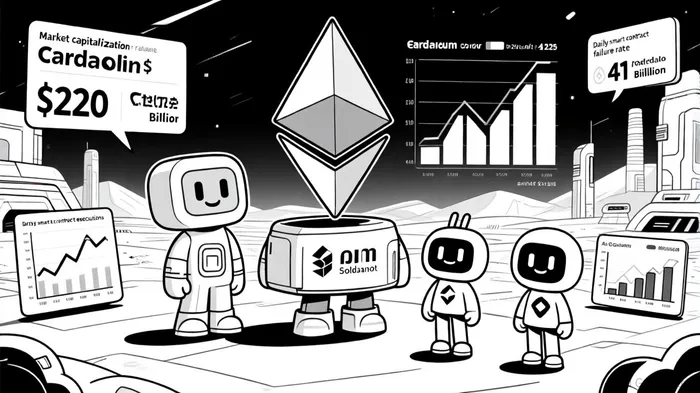
Comparative Blockchain Adoption: Cardano's Niche in a Crowded Market
Ethereum's $220 billion market cap and 7 million smart contracts underscore its role as the Web3 bedrock, according to a MadDevS comparison. Its PoS transition and Layer 2 solutions have slashed energy consumption by 99.95%, yet its 1.9% contract failure rate remains a vulnerability, per CoinLaw statistics. Solana, meanwhile, has leveraged its 1,000–3,000 TPS throughput and $0.02 fees to capture consumer-facing applications, epitomized by high-profile projects like Trump's token, as noted in The Currency Analytics. Polkadot's $12 billion valuation and Wasm-based parachains highlight its interoperability edge, though its smaller ecosystem limits mass appeal, according to a CoinEdition analysis.
Cardano, with a $41 billion market cap, occupies a middle ground. Its two-layer architecture (CSL/CCL) and 0.7% contract failure rate signal reliability, while its carbon-neutral ethos resonates in an era of ESG scrutiny, as noted in the MadDevS comparison. However, daily smart contract executions (52,000) lag behind Ethereum's 7 million, exposing gaps in developer activity, according to CoinLaw. This dichotomy—technical robustness versus adoption velocity—defines Cardano's 2025 challenge.
Market Psychology: Institutional Hype vs.
Regulatory Headwinds
Investor sentiment toward ADAADA-- is split. On one hand, the 67% staking rate and partnerships like EMURGO's Cardano Card and Tokeo's Mastercard integration demonstrate real-world utility, reported by The Currency Analytics. On the other, delays in major upgrades and SEC scrutiny loom large. A spot ADA ETF approval, with an 83% projected chance by October 2025, could catalyze institutional inflows akin to Bitcoin's ETF surge, again noted by The Currency Analytics.
Technically, ADA's symmetrical triangle pattern suggests a potential breakout to $1.20–$2.00 by year-end, contingent on the Chang hard fork enabling on-chain governance, per CoinEdition. Yet macroeconomic risks—geopolitical tensions, Fed rate hikes—remain wildcards. As one analyst notes, "Cardano's price is a pendulum between its research-driven promise and the market's impatience for immediate results."
Price Outlook: Realistic Targets Amid Diverging Forces
Bullish scenarios hinge on three pillars:
1. Hydra's Layer 2 Deployment: Scaling throughput to 1 million TPS could attract DeFi projects seeking Ethereum alternatives, as discussed in the MadDevS comparison.
2. Institutional Adoption: Grayscale's investments and the ADA ETF approval could inject billions into the network, a dynamic The Currency Analytics highlights.
3. Regulatory Clarity: A non-security classification by the SEC would unlock global liquidity.
Conservative price targets range from $0.60 to $0.85, with optimistic forecasts reaching $1.50. However, bearish risks—SEC crackdowns, Solana's DeFi surge, or Ethereum's dominance—could cap ADA at $0.50.
Conclusion: A Calculated Bet in a Shifting Ecosystem
Cardano's 2025 trajectory reflects the broader tension in blockchain: the clash between academic precision and market urgency. While Ethereum and Solana dominate today, Cardano's focus on sustainability and governance may yet carve a niche for long-term investors. For ADA to break through, it must convert technical superiority into tangible adoption—a test of both code and community.






Comentarios
Aún no hay comentarios