
Cardano's 100x Price Potential Amid Shifting Market Dynamics and Institutional Infrastructure Trends
The 2026 crypto landscape is being reshaped by macro-driven liquidity shifts and institutional adoption, creating a fertile ground for blockchain platforms that align with regulatory clarity and infrastructure readiness. As Delphi Research notes, global liquidity and evolving digital asset regulations are driving BitcoinBTC-- higher, while institutional capital flows into crypto ETFs and ETPs, with over $12 billion in inflows by late 2025. This backdrop sets the stage for a critical question: which LayerLAYER-- 1 blockchain is best positioned to capitalize on the next institutional-driven cycle?
Cardano (ADA) emerges as a compelling candidate, contrasting sharply with underperforming peers like SolanaSOL-- (SOL) and traditional altcoins. While Solana's high throughput and DeFi TVL ($8.36 billion) have fueled short-term momentum, its governance model and centralization risks expose vulnerabilities. CardanoADA--, by contrast, is leveraging its methodical, research-driven approach to governance and infrastructure to address institutional demands for auditability, scalability, and compliance.
Institutional Infrastructure and Governance: Cardano's Strategic Edge
Cardano's governance framework, now in its "Voltaire" phase, has introduced on-chain voting and treasury mechanisms that enable decentralized decision-making. This aligns with institutional expectations for transparent, auditable systems. The recent activation of the Pentad and Intersect governance structures has accelerated upgrades, including the 70 million ADA Treasury proposal to onboard tier-one stablecoins, institutional custody solutions, and cross-chain bridges. These integrations aim to transform Cardano into a globally competitive financial network, addressing liquidity gaps and enabling real-world asset (RWA) distribution.
In contrast, Solana's governance remains centralized, with a limited number of validators and validator clients like Firedancer facing scalability challenges. While Solana's 65,000 TPS theoretical throughput is impressive, its history of network outages and validator concentration risks undermine institutional trust. 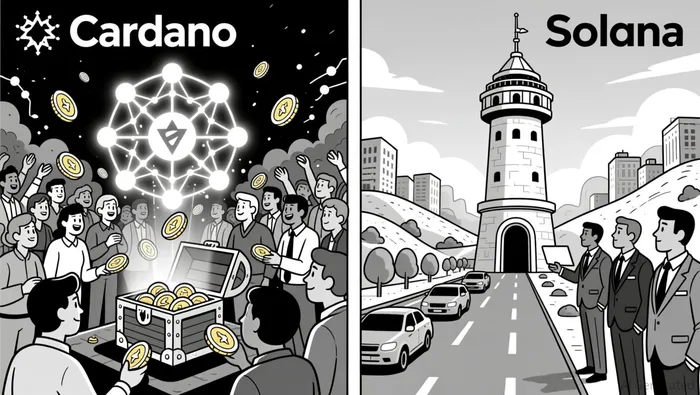 Cardano's Ouroboros Leios upgrade, targeting 10,000+ TPS by 2026, prioritizes security and decentralization-key attributes for institutional adoption.
Real-World Adoption and Institutional Partnerships
Cardano's real-world adoption is gaining traction through strategic partnerships and use cases. The Midnight sidechain, launched in late 2025, offers privacy-focused features and selective disclosure capabilities, attracting institutional investors seeking compliance-friendly solutions. Additionally, Cardano's enterprise-grade applications-such as digital identity (Atala PRISM) and supply chain tracking- position it as a platform for regulated sectors.
Solana, despite its DeFi dominance, lacks comparable institutional-grade infrastructure. Its TVL of $8.36 billion dwarfs Cardano's $173 million, but this metric overlooks Solana's reliance on speculative activity and developer churn. Cardano's focus on formal verification and academic rigor ensures its infrastructure meets institutional standards, as highlighted by Delphi's emphasis on privacy technologies and stablecoin integration as critical infrastructure.
Santi's Valuation Critique and Cardano's Response
Santi Santos' skepticism about Layer 1 valuations in 2026 underscores the need for sustainable growth models. Many projects, including underperforming Layer 1s, are overvalued relative to their utility. Cardano's approach counters this critique by prioritizing execution over hype. The 70 million ADAADA-- budget for integrations- approved by the Constitutional Committee and Delegated Representatives-demonstrates a commitment to measurable outcomes. This contrasts with Solana's speculative ecosystem, where TVL growth has not translated into lasting institutional partnerships.
Macro-Driven Liquidity and the 100x Thesis
Delphi Research forecasts that macro liquidity easing and institutional inflows will sustain Bitcoin's upward trajectory in 2026. For altcoins, the key differentiator will be infrastructure readiness. Cardano's alignment with institutional standards-through custody solutions, stablecoin liquidity, and governance transparency-positions it to capture a disproportionate share of this capital.
Charles Hoskinson's vision for Cardano as "civic infrastructure" further strengthens its long-term appeal. By embedding blockchain into identity, governance, and social coordination, Cardano moves beyond speculative finance to address real-world problems as discussed in the Pentad series. This aligns with Tiger Research's prediction that regulated infrastructure will dominate the 2026 crypto landscape.
Conclusion: Why Cardano, Not Solana, Is the 100x Play
While Solana's performance metrics are impressive, its governance and institutional readiness lag behind Cardano's. The latter's focus on formal verification, decentralized governance, and real-world utility creates a flywheel effect: institutional adoption drives liquidity, which fuels further infrastructure development. With a 4% TVL increase in 2026 and a $70 million ADA Treasury proposal, Cardano is primed to outperform peers in the next institutional cycle.
As Santi Santos warns, many Layer 1s will fail to justify their valuations by 2026. Cardano's disciplined execution, however, positions it as a rare outlier-capable of delivering the 100x returns that align with macro-driven liquidity and institutional infrastructure trends.






Comentarios
Aún no hay comentarios