
Car-Mart's Deteriorating Financial Trajectory: A Cautionary Tale of Declining Used Vehicle Sales and Liquidity Risks
America's Car-MartCRMT--, Inc. (CRMT) has long been a key player in the subprime automotive finance sector, but its recent financial performance raises troubling questions about its long-term sustainability. Despite modest quarterly improvements, the company's full-year fiscal 2025 results reveal a deteriorating trajectory marked by declining used vehicle sales volumes and persistent liquidity risks. These trends, compounded by broader market dynamics, suggest a company struggling to adapt to shifting consumer preferences and economic pressures.
Used Vehicle Sales: A Sliding Scale
According to the company's quarterly report, Car-Mart sold 57,022 retail units in fiscal 2025, a 1.7% decline from the 57,989 units sold in 2024. While the fourth quarter of 2025 saw a 2.6% increase in sales volumes to 15,649 units, this quarterly gain masks a broader annual contraction. The average retail sales price also fell by $316 year-over-year to $17,240, reflecting aggressive pricing strategies to maintain affordability in a competitive market, as the report notes.
This decline in sales volumes contrasts with the broader U.S. automotive market, where used vehicle sales have consistently outpaced new car sales since 2020. Industry data from Vinaudit shows used car sales averaging 36.2 million units annually compared to 15.6 million new car sales in 2024. However, Car-Mart's internal figures suggest its own used vehicle sales may be lagging behind industry trends. The company's average retail units sold per store per month dropped from 31.4 in 2024 to 30.9 in 2025, according to the company's SEC filings, indicating operational inefficiencies or declining consumer demand at the store level.
Liquidity Metrics: A Fragile Safety Net
Car-Mart's liquidity position, while showing marginal improvement, remains a critical concern. As of April 30, 2025, the company's debt-to-finance receivables ratio stood at 51.5%, down from 52.6% in 2024, according to the earlier-cited report. However, this slight reduction does little to offset the long-term trend of declining liquidity. Historical data from Macrotrends reveals the current ratio-a measure of short-term solvency-fell from a range of 1.89 to 2.03 in 2020 to 1.49 as of January 31, 2025. A current ratio below 2.0 signals a reduced ability to meet immediate obligations, raising red flags for creditors and investors.
The debt-to-finance receivables ratio, another key metric, has also shown only incremental improvement. While the 2025 Q4 figure of 51.5% reflects a marginal decline from 52.6% in 2024, the lack of historical detail in the company's filings obscures whether this represents a reversal of a longer-term trend or merely a temporary fluctuation. Given the company's reliance on financing receivables to sustain operations, any deterioration in this metric could amplify leverage risks during economic downturns.
Broader Market Pressures and Strategic Challenges
Car-Mart's struggles are not isolated but are symptomatic of broader challenges in the automotive retail sector. Rising interest rates, inflation, and consumer awareness of depreciation have driven demand toward used vehicles, yet Car-Mart's sales volumes have failed to keep pace with industry averages, as the Vinaudit data shows. The company's gross profit margin, while improved to 36.4% in Q4 2025, likely reflects tighter margins from discounted pricing rather than operational efficiency, according to the corporate report.
Moreover, the company's focus on subprime borrowers-those with limited access to traditional financing-exposes it to higher default risks. As credit markets tighten, Car-Mart may face increased delinquencies, further straining liquidity. The company's ability to navigate these challenges will depend on its capacity to innovate in underwriting and inventory management, areas where recent quarterly results suggest only incremental progress.
Conclusion: A Ticking Time Bomb?
Car-Mart's financial trajectory, while not yet in freefall, reveals a company grappling with declining sales volumes, margin pressures, and fragile liquidity. The modest improvements in Q4 2025 offer little reassurance against the backdrop of a full-year sales decline and a current ratio that has eroded by nearly 20% since 2020. For investors, the risks are clear: a business model reliant on used vehicle sales and subprime financing is particularly vulnerable to macroeconomic shifts. Without a strategic pivot to address these headwinds, Car-Mart may find itself unable to sustain its position in an increasingly competitive and volatile market.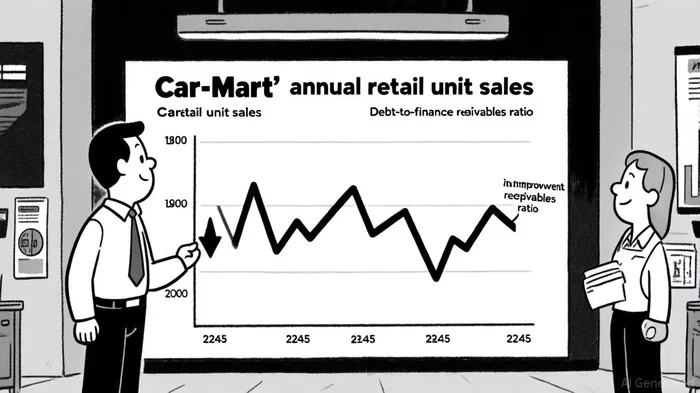





Comentarios
Aún no hay comentarios