
Capitalizing on the Resilience Revolution: Investment Opportunities in Institutional Food Services
The institutional food services sector is undergoing a profound transformation, driven by the closure of legacy cafeteria models and the urgent need to rebuild supply chains and operations for resilience. These shifts, accelerated by global disruptions and evolving consumer demands, present compelling investment opportunities for those who can navigate the complexities of modern food systems. By analyzing recent trends, case studies, and financial outcomes, this article outlines how investors can capitalize on the sector's pivot toward efficiency, sustainability, and technological innovation.
Supply Chain Innovations: Building Resilience Through Regionalization and Digital Tools
Post-legacy cafeteria closures have forced institutions to rethink their supply chains, prioritizing regional access, continuity, and digital transformation.
A 2025 report by GoodSource highlights that institutions are increasingly adopting regional sourcing strategies to mitigate risks from global disruptions, such as the avian flu or geopolitical shocks. For example, healthcare and corrections facilities have
diversified their supplier networks and implemented redundant logistics systems to ensure uninterrupted meal service during crises.
Digital tools are also playing a critical role.
, and are enabling institutions to reduce waste, optimize procurement, and enhance compliance with food safety standards. These technologies not only cut costs but also align with growing institutional mandates for sustainability.
A mid-sized casual dining chain, for instance, achieved .
Operational Efficiency: From Dark Kitchens to Dynamic Pricing
Operational efficiency has become a cornerstone of institutional food services, particularly in sectors like schools, hospitals, and senior living facilities. The pandemic's social distancing measures
forced rapid adoption of delivery models and ""-dedicated preparation spaces without dine-in capacity-which remain integral to post-closure strategies. .
Dynamic pricing and menu optimization are further enhancing profitability.
Post's Q3 2025 financial results underscore this trend, with its foodservice segment growing due to higher-margin products like liquid egg formats, which offer cost and labor advantages over shell eggs. Such shifts reflect a broader industry move toward value-added offerings that cater to institutional buyers' demands for convenience and consistency.
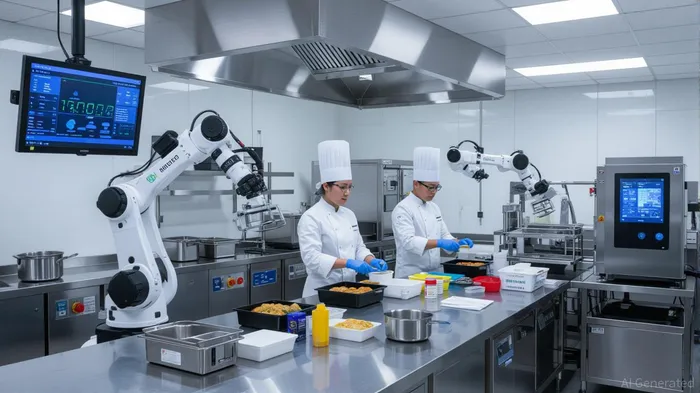
Financial Outcomes: Measurable Returns from Restructuring
Investment returns in institutional food services are increasingly tied to measurable operational metrics.
Post's restructuring efforts, for example, included plant closures and strict SG&A discipline, which offset retail segment declines and supported margin stability. Similarly, institutions that adopted continuity planning-such as diversified sourcing and automated order fulfillment-
in net operating income within 12 months.
Environmental sustainability is also driving financial performance.
A 2025 study in the Philippines found that operational efficiency metrics like resource management and process optimization correlated strongly with customer satisfaction, a critical factor for institutions competing for contracts. Investors who prioritize ESG (environmental, social, and governance) criteria are thus well-positioned to capture both financial and reputational value.
Future Outlook: Navigating Risks and Opportunities
While the sector's resilience is evident, challenges remain.
Avian flu disruptions and inflationary pressures could test supply chains, but companies with agile models-like Post's balanced approach of share repurchases and selective acquisitions-are better equipped to weather volatility.
Emerging opportunities lie in AI-driven demand forecasting, modular kitchen designs, and partnerships with regional cooperatives to secure stable ingredient supplies.
Investors should also monitor regulatory shifts, such as stricter food safety standards or subsidies for sustainable practices, which could reshape competitive dynamics. For now, the key is to back firms that combine technological agility with regional resilience, ensuring they can adapt to both short-term shocks and long-term trends.
Conclusion
The institutional food services sector is no longer about merely filling plates-it's about building systems that are as efficient as they are resilient. By investing in supply chains that prioritize regional access, digital tools that enhance transparency, and operational models that embrace innovation, stakeholders can unlock significant value. As the sector continues to evolve, those who act decisively will find themselves at the forefront of a reimagined food economy.







Comentarios
Aún no hay comentarios