
Capitalizing on Mid-Cap AI-Infrastructure Developers Post-Fed Rate Cut
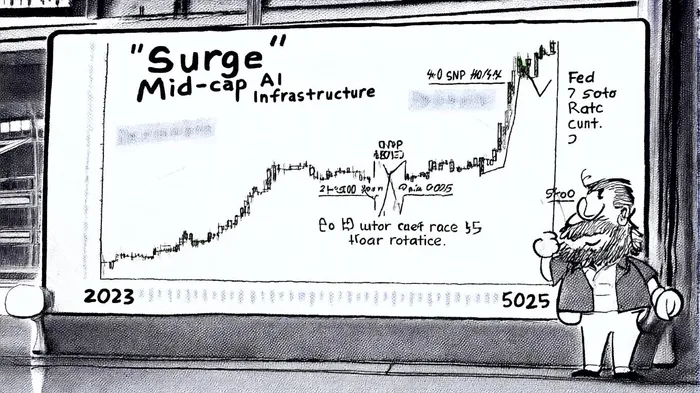
The Federal Reserve's dovish pivot in 2024 and 2025 has catalyzed a seismic shift in capital allocation, particularly within the AI infrastructure sector. As interest rates declined, investors began reallocating capital from defensive sectors to high-growth opportunities, with mid-cap AI infrastructure developers emerging as prime beneficiaries. This strategic sector rotation, coupled with valuation arbitrage opportunities, presents a compelling case for investors seeking to capitalize on the next phase of AI-driven innovation.
Strategic Sector Rotation: From Large-Cap Dominance to Mid-Cap Momentum
Historically, large-cap tech giants like NvidiaNVDA-- dominated the AI narrative, but the landscape has evolved. By 2025, the focus shifted to mid-cap firms specializing in semiconductors, data centers, and energy solutions—critical enablers of AI scalability. For instance, Microsoft's $80 billion investment in AI-powered data centers[5] and Meta's $65 billion allocation[5] underscored the sector's infrastructure demands, driving demand for mid-cap suppliers. Companies like JabilJBL-- (JBL) and Digital Ocean (DOCN) exemplify this trend, with JBLJBL-- leveraging AI for 97% defect detection in manufacturing[4] and DOCNDOCN-- achieving 16% revenue growth in Q3 2023[4].
The Fed's rate cuts further amplified this rotation. A 50-basis-point cut in September 2024 spurred a 3% surge in the Nasdaq 100, with AI stocks like Nvidia and ASMLASML-- rising 5%[4]. Analysts, including Dan Ives of Wedbush, argue that these cuts are the “missing piece” for AI growth[4], as reduced borrowing costs ease financial pressure on mid-cap firms. This dynamic is evident in companies like TaskUsTASK-- and QualysQLYS--, which are expanding agentic AI services and cybersecurity solutions[1], respectively.
Valuation Arbitrage: Attractive Multiples in Mid-Cap AI Infrastructure
Valuation metrics highlight the sector's appeal. As of Q2 2025, mid-cap AI infrastructure companies traded at P/E ratios ranging from 31.15 to 40.13[6], significantly lower than the 27.25 multiple for large-cap tech firms[1]. Similarly, EBITDA multiples for mid-cap players ranged from 19.23 to 25.19[3], offering a discount to the high-growth expectations embedded in large-cap valuations. This gapGAP-- represents a valuation arbitrage opportunity, as mid-cap firms with product leadership—such as SoundHoundSOUN-- (SOUN) and Rekor SystemsREKR-- (REKR)—demonstrate revenue growth of 19% and 268% respectively[4], outpacing broader market indices.
The sector's beta values (1.6–2.2)[4] further justify its risk-reward profile. While volatility remains a concern, the AI infrastructure phase outlined by Goldman Sachs[3] suggests that mid-cap firms are well-positioned to capture demand as AI adoption scales. For example, energy providers like Constellation EnergyCEG-- and BWX Technologies[5] are capitalizing on the power needs of AI-driven data centers, a trend expected to grow at 2.4% CAGR through 2030[2].
Strategic Considerations: Balancing Growth and Macro Risks
Despite the optimism, macroeconomic risks persist. A potential recession or increased tariffs could delay datacenter build-outs[2], pressuring mid-cap firms. However, companies with strong founder profiles and product differentiation—such as InnodataINOD-- and MasTec—have shown resilience, even amid sector-wide corrections like the DeepSeek event in late 2024[5]. Investors must also weigh the sector's high volatility against its growth potential, ensuring diversification and hedging strategies align with risk tolerance.
Conclusion: A High-Conviction Play in the AI Infrastructure Era
The confluence of Fed rate cuts, sector rotation, and valuation arbitrage creates a compelling case for mid-cap AI infrastructure developers. As enterprises transition from AI pilots to full-scale deployments[2], mid-cap firms offering specialized solutions—whether in semiconductors, cloud computing, or energy—are poised to outperform. While macro risks linger, the sector's growth trajectory, supported by hyperscale investments from tech giants and venture capital[2], underscores its long-term potential. For investors, the key lies in identifying companies with durable competitive advantages and aligning their portfolios with the next phase of AI innovation.





Comentarios
Aún no hay comentarios