
Capitalizing on Medicare Advantage Growth: Demographic and Regulatory Tailwinds in 2025
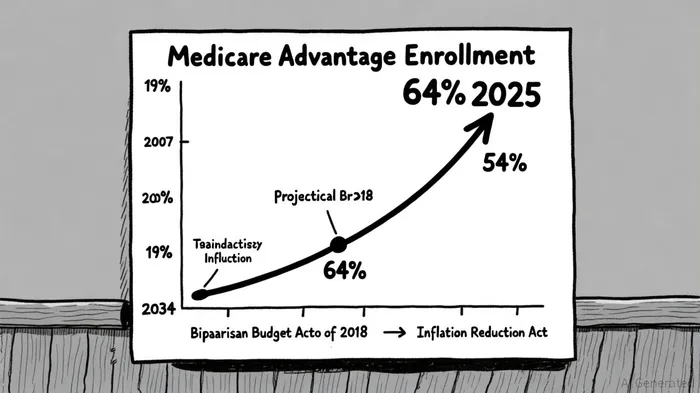
The U.S. health insurance sector is undergoing a seismic shift, driven by the explosive growth of Medicare Advantage (MA) enrollment and a regulatory landscape reshaping benefit structures. For investors, this presents a unique opportunity to align with demographic and policy-driven tailwinds. By 2025, MA enrollment had surged to 54% of eligible beneficiaries, a stark contrast to the 19% recorded in 2007 [1]. With the Congressional Budget Office projecting this figure to reach 64% by 2034 [1], the implications for capital allocation are profound.
Demographic Tailwinds: An Aging Population Fuels Demand
The aging of the Baby Boomer generation is the primary catalyst for MA's expansion. By 2034, the U.S. Census Bureau estimates that 20% of the population will be aged 65 or older, creating a massive pool of beneficiaries seeking supplemental healthcare coverage. According to a report by the Kaiser Family Foundation (KFF), MA enrollment in 2025 totaled 34.1 million out of 62.8 million eligible beneficiaries [1]. This growth is not merely a function of population size but also of shifting preferences: beneficiaries increasingly favor MA's integrated benefits, such as vision, dental, and hearing, over traditional Medicare.
Special Needs Plans (SNPs) exemplify this trend. In 2025, SNPs accounted for 21% of MA enrollment, with 83% of these plans catering to dually eligible Medicare-Medicaid beneficiaries [1]. The Bipartisan Budget Act of 2018, which made SNPs a permanent fixture in the MA program, has further accelerated their adoption. For instance, Chronic Condition SNPs (C-SNPs) saw a 70% enrollment surge in 2025 compared to 2024 [1]. Investors targeting this niche could prioritize companies with robust SNP networks, as these plans often command higher risk-adjusted revenue due to their focus on high-need populations.
Regulatory Tailwinds: Policy Shifts Redefine the MA Landscape
Regulatory changes in 2025 have created both challenges and opportunities. The Inflation Reduction Act's (IRA) impact on Part D drug pricing has forced MA plans to adapt. As noted by Milliman, the average value of Part C benefits declined by $11.60 per member per month in 2025, while Part D deductibles jumped from $63 in 2024 to $230 [3]. These adjustments have prompted insurers to pivot toward value-based supplemental benefits, such as bathroom safety devices, which saw increased adoption [4].
However, the IRA's downward pressure on drug costs also stabilizes MA premiums. The Centers for Medicare and Medicaid Services (CMS) projected a 15% reduction in average monthly premiums for 2026, from $16.40 to $14.00 [2]. This stability is critical for investor confidence, as it reduces the volatility of revenue streams. Additionally, the 2025 shift from copays to coinsurance for brand-name drugs has incentivized insurers to optimize formulary management, a skill that can differentiate high-performing plans in a competitive market.
Financial Dynamics: Balancing Risk and Reward
While MA enrollment growth is robust, investors must navigate evolving financial dynamics. The 2025 KFF report highlights that out-of-pocket limits for MA enrollees averaged $5,320 in-network and $9,547 combined, below federal caps [4]. This suggests that plans are effectively managing cost-sharing, a key factor in retaining beneficiaries. However, the rise in prior authorization requirements—particularly for skilled nursing facility stays and inpatient care—signals a shift toward cost containment. Insurers with advanced data analytics capabilities to streamline prior authorization processes may gain a competitive edge.
The 2026 CMS projection of 48% MA enrollment (34 million beneficiaries) contrasts with historical trends suggesting stability or growth [2]. This discrepancy underscores the importance of monitoring enrollment behaviors. For example, the 2025 surge in Part B premium rebates—76% of individual MA enrollees paid only the Part B premium—could signal a broader trend of cost-conscious beneficiaries prioritizing low-cost plans [4]. Insurers that can scale low-premium, high-value plans may capture market share in this environment.
Strategic Investment Opportunities
To capitalize on these trends, investors should focus on three areas:
1. SNP-Centric Insurers: Companies with established SNP networks, particularly those targeting dually eligible populations, are well-positioned to benefit from the 48% enrollment growth attributed to SNPs in 2025 [1].
2. Technology-Driven Payers: Insurers leveraging AI for risk adjustment, prior authorization automation, and formulary optimization can mitigate the financial pressures of the IRA while improving operational efficiency [3].
3. Supplemental Benefit Innovators: Firms expanding into non-traditional benefits (e.g., telehealth, transportation) may differentiate themselves in a market where 76% of enrollees prioritize low Part B premiums [4].
Conclusion
The confluence of demographic demand and regulatory evolution is reshaping the MA landscape. While challenges like benefit compression and prior authorization complexity persist, the long-term trajectory of MA enrollment—projected to reach 64% by 2034 [1]—offers a compelling case for strategic investment. By targeting SNP expansion, technological innovation, and supplemental benefit differentiation, investors can align with the sector's most promising growth vectors.







Comentarios
Aún no hay comentarios