
Capitalizing on Market Oversold Conditions: 2 Dividend Stocks Trading at Attractive Value Levels
In the current market environment, where macroeconomic uncertainty and sector rotation have left many high-quality dividend stocks trading at significant discounts, contrarian investors are finding fertile ground for value-oriented strategies. By combining discounted cash flow (DCF) analysis with a focus on durable cash flows and prudent payout ratios, investors can identify opportunities where market pessimism may be overdone. Two such stocks-The Kraft Heinz Company (KHC) and Johnson & Johnson (JNJ)-stand out as compelling candidates for long-term, income-focused portfolios.
Kraft Heinz: A High-Yield Bargain with Structural Resilience
The Kraft HeinzKHC-- Company, a staple of the global packaged food sector, trades at a 45% discount to its intrinsic valuation, according to Morningstar. This discount reflects broader market skepticism about the sector's growth prospects, despite the company's dominant market share in essential consumer goods. With a dividend yield of 5.86% as of August 2025, according to FullRatio, KHCKHC-- offers one of the most attractive income streams among large-cap equities.
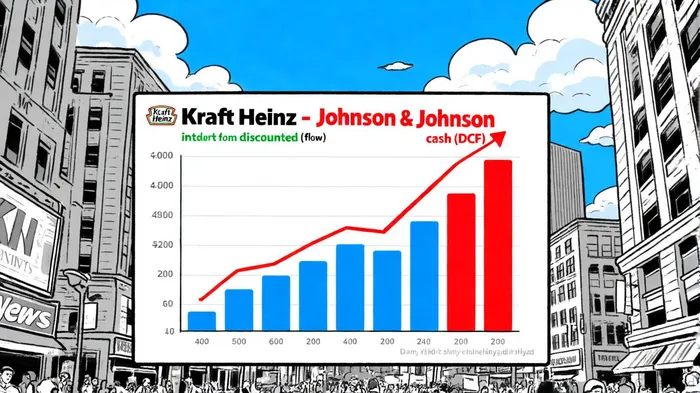
A DCF analysis of KHC's cash flows reveals a compelling case for undervaluation. Historical data from 2018 to 2021 projects free cash flows to rise from $159 million to $524 million by 2026, per MarketBeat. Even with a conservative discount rate, the intrinsic value calculation suggests the stock is significantly undervalued. While the company's payout ratio of 111% based on operating free cash flow raises concerns about sustainability, according to Panabee, its robust liquidity position-$6.5 billion in cash reserves as of Q2 2025, which Panabee also highlights-provides a buffer against short-term volatility. For contrarian investors, this represents a high-risk, high-reward opportunity: a company trading at a steep discount to its cash-generating potential, with a dividend yield that dwarfs most peers.
Johnson & Johnson: A Dividend Titan with Steady Fundamentals
In contrast to KHC's aggressive yield, Johnson & JohnsonJNJ-- offers a more conservative but equally compelling proposition. With a 2.9% dividend yield and a payout ratio of 54%, according to FinanceCharts, JNJ balances income generation with financial prudence. The healthcare giant's diversified business model-spanning pharmaceuticals, medical devices, and consumer health-provides a stable cash flow base, even in downturns.
DCF analysis of JNJ's 2023–2025 financials underscores its value. Revenue grew from $85.2 billion in 2023 to $88.8 billion in 2024, with operating income reaching $20.8 billion in 2024, per MarketBeat. While the company's capital expenditures and acquisitions (e.g., a $18.6 billion net outflow in 2024, per MarketBeat) temper near-term free cash flow, its long-term reinvestment rate remains disciplined. A 10-year DCF model using a 9% discount rate and 4% terminal growth rate suggests an intrinsic value of $185–$190 per share, compared to its current price of $165, per MarketBeat. This implies a potential 10–15% upside for patient investors.
Risks and Considerations
Both stocks carry risks. KHC's high payout ratio and exposure to commodity price swings could strain its dividend if margins contract. JNJ, meanwhile, faces regulatory headwinds in its pharmaceutical segment and margin pressure from generic competition. However, these risks are already priced into the stocks, making them more forgiving for long-term holders.
Conclusion: Patience as a Strategic Advantage
For contrarian investors, the key is to distinguish between temporary disfavor and permanent damage. Kraft Heinz and Johnson & Johnson exemplify companies where market pessimism has created entry points for those willing to look beyond short-term noise. By anchoring decisions to DCF analysis and dividend durability, investors can position themselves to benefit from eventual mean reversion-a hallmark of value investing.
As always, these opportunities demand rigorous due diligence and a long-term horizon. But in a market where fear often overshadows fundamentals, the rewards for disciplined contrarians can be substantial.





Comentarios
Aún no hay comentarios