
Capitalizing on Fear: How Investor Sentiment Drives Market Opportunities
The 2025 VIX Surge: A Confluence of Crises
The 2025 VIX spike was not an isolated event but a culmination of geopolitical tensions, trade-war escalations, and macroeconomic uncertainty. According to a report by , the April 2025 surge was driven by the Trump administration's aggressive tariff policies on autos, Chinese goods, and EU products, which triggered a 10% two-day drop in the S&P 500-the worst decline since 1987. By November 2025, the fear index had surged again, reflecting broader concerns over AI-driven valuations, inflationary pressures, and Middle East tensions.
These spikes coincided with record-high levels on the Economic Policy Uncertainty (EPU) index, underscoring how policy-driven volatility can amplify market corrections. As stated by , the April 2025 VIX level mirrored the panic of 2008 and 2020, yet the subsequent stabilization highlighted the resilience of markets to absorb shocks when fundamentals remain intact.
Defensive Sectors: The Safe Havens in a Storm
Amid such volatility, defensive sectors like utilities, consumer staples, and healthcare emerged as relative safe havens. Equity managers, as noted by Russell Investments, began shifting portfolios toward these sectors due to their "healthy balance sheets and stable growth" according to research. Utilities, in particular, demonstrated undervaluation potential, with regulated cash flows and low sensitivity to global supply chains. For instance, PG&E Corporation (PCG) and Dominion Energy (D) saw their valuations decouple from broader market declines, offering attractive entry points for long-term investors.
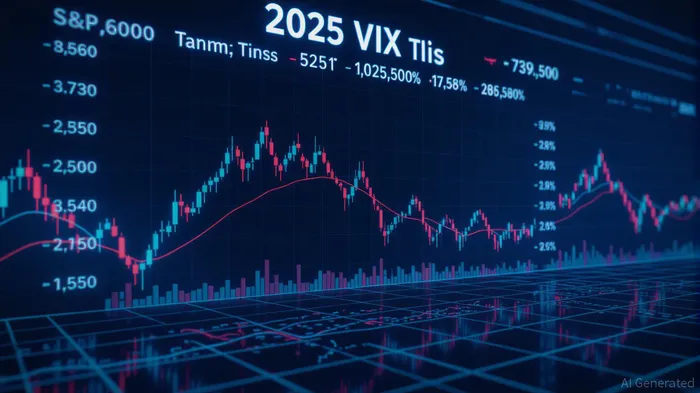
The rationale for defensive positioning is rooted in historical patterns. During the November 2025 spike, defensive stocks outperformed cyclical peers like Consumer Discretionary and Industrials, which faced headwinds from anticipated economic slowdowns according to market analysis. Bernstein Research emphasized that defensive sectors provide "a cushion against downside risks while maintaining growth potential," a critical trait in environments marked by earnings volatility and geopolitical uncertainty according to their insights.
Strategic Entry Points: Timing the Fear-Driven Dips
The key to capitalizing on fear-driven volatility lies in identifying strategic entry points. The April 2025 VIX spike, for example, created a buying window for undervalued equities as panic-driven selling overcorrected fundamentals. Russell Investments highlighted that sectors like pharmaceuticals and energy were repositioned to mitigate inflationary tail risks, with companies such as Brookfield Infrastructure and Eversource Energy showing strong operational metrics according to market analysis.
Similarly, the November 2025 spike, which saw the VIX settle at 48.35, presented opportunities for systematic investors. As Investing.com noted, defensive stocks like healthcare providers and utilities were "less encumbered by tariffs and macroeconomic headwinds," making them ideal for diversification. The spike also underscored the importance of sector rotation, with investors pivoting away from overvalued tech stocks to balance portfolios against systemic risks according to sector analysis.
Conclusion: Fear as a Catalyst for Resilience
The 2025 VIX spikes illustrate a timeless market truth: fear distorts prices, but it also creates asymmetric opportunities. For risk-aware investors, the path forward involves a disciplined focus on defensive sectors with durable cash flows and low volatility. By leveraging fear indicators as contrarian signals, investors can transform market turbulence into a strategic advantage-positioning portfolios to thrive in both stormy and calm conditions.







Comentarios
Aún no hay comentarios