
Capitalizing on Crypto Exchange Sign-Up Incentives in Q4 2025–Q1 2026: Strategic Onboarding and Referral-Driven Growth as Catalysts for Retail Investor Participation and Platform Value Creation
The crypto exchange landscape in Q4 2025–Q1 2026 is defined by a fierce competition for retail users, driven by aggressive sign-up incentives and referral programs. Platforms like Binance, Bybit, and MEXC have weaponized these strategies to reduce user acquisition costs (CAC), deepen liquidity pools, and drive valuation growth. For investors, understanding how these mechanisms translate into platform value creation is critical.
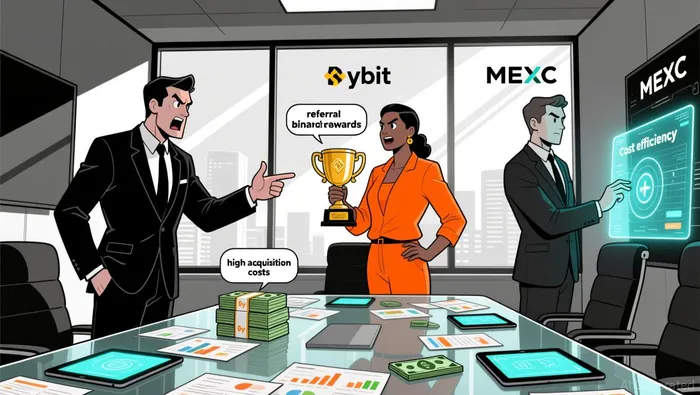
The Referral Arms Race: A Cost-Effective Growth Engine
Referral programs have evolved from side experiments to core growth strategies, with exchanges offering tiered rewards, multi-level commissions, and on-chain incentives. Binance's $100 welcome package and 20% lifetime trading fee discount, Bybit's $30,100+ crypto bonus, and MEXC's 8,000 USDT reward path exemplify this trend. These programs leverage the network effect: users incentivized to invite peers create a flywheel of organic growth.
Data from B2B SaaS benchmarks highlights the efficiency of referral-driven acquisition. Referral channels report an average CAC of $150, significantly lower than traditional paid methods. This cost advantage is amplified in crypto, where trust and peer recommendations are key to user activation. For instance, CoinsPaid's multi-level affiliate structure offers ongoing commissions, fostering long-term loyalty. Such models reduce churn and increase customer lifetime value (LTV), directly boosting platform profitability.
Strategic Onboarding: From Friction to Activation
Onboarding remains a critical bottleneck in crypto adoption. Exchanges like Bybit and Binance have streamlined KYC processes and integrated educational tools to accelerate user activation. Bybit's 2025 user base grew from 50 million to 80 million, while Binance hit 300 million registered users, driven by a tripartite operating model under Abu Dhabi's FSRA framework. These platforms reduced time-to-value (TTV) by simplifying trading interfaces and offering instant access to rewards.
Regulatory clarity also plays a role. The repeal of SAB 121 and the proposed GENIUS Act have reduced accounting complexity for stablecoin issuers, encouraging institutional participation. This creates a virtuous cycle: clearer regulations → more institutional users → deeper liquidity → higher platform valuations.
Case Studies: Quantifying the Impact
Binance Alpha 2.0 onboarding added 17 million users and generated $1 trillion in trading volume, showcasing how targeted incentives can scale user bases. Bybit's TradFi Referral Program offers up to 30% commission on referral earnings, directly linking user growth to trading volume. Bybit's 24-hour spot volume reached $9.1 billion in December 2025, underscoring the correlation between referral activity and liquidity.
MEXC's focus on altcoin innovation-highlighting projects like Mantle (MNT) and ArbitrumARB-- (ARB)-attracted niche traders seeking high-growth opportunities. This strategy not only diversified its user base but also positioned the platform as a hub for emerging DeFi trends, contributing to a $779 million valuation.
Valuation Implications: From User Growth to Market Cap
The total crypto market cap contracted from $4 trillion in Q3 2025 to $2.9 trillion by year-end, yet referral-driven platforms demonstrated resilience. Binance's $34 trillion trading volume and Bybit's 80 million users reflect their ability to retain activity despite macroeconomic volatility. Institutional adoption, particularly via spot Bitcoin ETFs, further solidified valuations.
For exchanges, user growth and trading volume are proxies for network effects. A platform with 300 million users and $9.1 billion daily volume commands a higher valuation than one relying on paid ads. This is evident in venture capital trends: Q3 2025 saw $4.59 billion invested in crypto startups, with later-stage deals capturing 56% of capital.
The Road Ahead: Q1 2026 Outlook
As we enter Q1 2026, the focus will shift to sustaining growth amid regulatory scrutiny and macroeconomic headwinds. Platforms that integrate AI-driven personalization in onboarding and expand into TradFi assets (e.g., gold, forex) will likely outperform. The U.S. crypto exchange market, valued at $10.24 billion in 2025, is projected to grow at a 24.89% CAGR to $48.5 billion by 2033, underscoring long-term potential.
Investors should prioritize exchanges with:1. Scalable referral mechanics (e.g., multi-level commissions).2. Regulatory alignment (e.g., ADGM licenses).3. Diversified revenue streams (e.g., TradFi integration).
Conclusion
Q4 2025–Q1 2026 has proven that referral-driven growth and strategic onboarding are not just marketing tactics but foundational to crypto exchange valuations. As the industry matures, platforms that balance user acquisition with institutional credibility will dominate. For investors, the key is to identify exchanges where referral programs directly correlate with trading volume, user retention, and regulatory progress-metrics that will define the next phase of crypto's evolution.






Comentarios
Aún no hay comentarios