
Capitalizing on S&P 500 Volatility Through Strategic Options Pair Trading
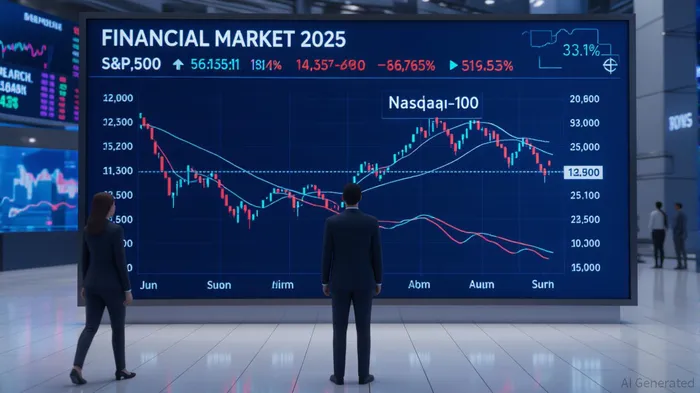
The Case for a Strategic Pair Trade in August 2025
August 2025 has emerged as a pivotal month for volatility-driven strategies, with macroeconomic uncertainty and seasonal liquidity shifts creating fertile ground for options pair trading. The S&P 500 and Nasdaq-100, historically correlated at 0.90–0.95, have shown subtle but meaningful divergence in recent weeks. This divergence, coupled with elevated implied volatility (VIX up 22% in six weeks), presents a high-probability, low-risk opportunity to capitalize on relative strength and weakness between the two indices.
Macro Conditions and Volatility Dynamics
The August 1 jobs report—a critical catalyst—revealed a mere 73,000 new jobs added, far below the 102,000 forecast. This, combined with downward revisions to prior months' data, has triggered a 1.6% drop in the S&P 500. Meanwhile, the Nasdaq-100, though down 2.2%, has held closer to its 50-day moving average, reflecting its tech-heavy bias and historical August resilience.
The Volatility Index (VIX) has surged to 20.21, while the Nasdaq-100's VOLQ index stands at 20.21, indicating a synchronized but elevated volatility environment. However, the S&P 500's 30-day implied volatility (SPY at 0.1328) suggests it is more overbought, creating an asymmetry in risk-reward profiles.
The Pair Trade Strategy: Long Nasdaq-100, Short S&P 500
Given the S&P 500's vulnerability to liquidity headwinds (TGA at $550 billion, below its $850 billion target) and its technical resistance at 45,000 on the DJIA, a strategic options pair trade can be constructed:
- Long Nasdaq-100 Call Options: Buy at-the-money (ATM) calls on the Nasdaq-100 (e.g., QQQ or NDX) to capitalize on its historical August upward bias and strong tech earnings momentum.
- Short S&P 500 Put Options: Sell ATM puts on the S&P 500 (e.g., SPY) to hedge against a potential overreaction to macroeconomic data (e.g., August 13 CPI release).
This strategy leverages the tight correlation between the indices while exploiting the Nasdaq-100's structural advantages. The Nasdaq-100's 15-year August average gain of 130 points and its 44% rally from April lows provide a bullish floor, while the S&P 500's overvaluation and liquidity risks create a bearish ceiling.
Risk Management and Execution
- Position Sizing: Allocate 60% to Nasdaq-100 calls and 40% to S&P 500 puts to reflect the indices' relative volatility.
- Stop-Loss Triggers: Close the trade if the S&P 500 breaks below its 200-day SMA or the Nasdaq-100 drops 5% below its 50-day SMA.
- Catalysts to Monitor:
- August 13 CPI Release: A hotter-than-expected reading could amplify S&P 500 volatility.
- Nvidia (NVDA) Earnings: A strong report could reinforce Nasdaq-100 momentum.
Conclusion: A Low-Risk, High-Probability Play
The August 2025 market environment—marked by thin liquidity, macroeconomic ambiguity, and divergent index behavior—offers a rare window for disciplined options traders. By pairing long Nasdaq-100 calls with short S&P 500 puts, investors can hedge against systemic risks while capturing the Nasdaq-100's seasonal strength. This strategy aligns with historical tendencies and current technical indicators, making it a compelling case for capitalizing on volatility without overexposure.
As the month progresses, keep a close eye on the VIX-VOLQ convergence and the TGA's trajectory. In a market where every basis point of volatility is priced, precision and timing will separate winners from the noise.







Comentarios
Aún no hay comentarios