
Capitalizing on the 2025 Mining Boom: Why Gold and Copper Miners Are Poised for 2026 Growth
The global mining industry is entering a pivotal phase in 2025, driven by structural supply constraints and surging demand for critical metals like gold and copper. As the world grapples with geopolitical tensions, energy transition imperatives, and macroeconomic volatility, miners with robust operational discipline and strategic foresight are uniquely positioned to capitalize on these dynamics. This analysis explores how gold and copper miners are leveraging supply-demand imbalances to drive growth in 2026 and beyond.
Copper: A Deficit-Driven Bull Market
Copper is at the epicenter of the 2025-2026 commodity boom, with supply deficits projected to tighten the market further. J.P. Morgan Global Research forecasts a global refined copper deficit of approximately 330,000 metric tons in 2026, driven by mine closures and production delays at key operations such as Indonesia's Grasberg Mine and Chile's Quebrada Blanca. The International Copper Study Group (ICSG) corroborates this, warning of a 150,000 metric ton deficit in 2026 due to bottlenecks in concentrate availability. These constraints are pushing prices toward record highs, with J.P. Morgan anticipating an average of $12,075 per metric ton in 2026.
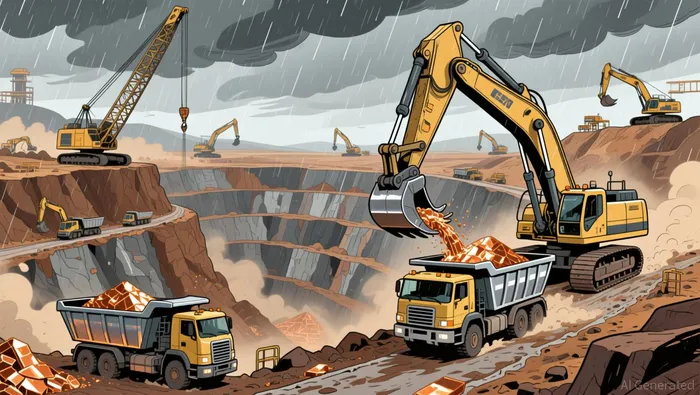 Goldman Sachs, while slightly more conservative, forecasts an average of $10,710 per ton in the first half of 2026, with a long-term target of $15,000 by 2035. The divergence in projections reflects short-term volatility but underscores a shared consensus: structural demand from electrification, grid infrastructure, and artificial intelligence (AI) will outpace supply. For instance, data centers and AI infrastructure alone are expected to add 475,000 metric tons of copper demand by 2026.
Gold: A Safe-Haven Asset in a Volatile World
Gold's appeal as a safe-haven asset is intensifying amid macroeconomic uncertainty and a global easing cycle. Goldman Sachs projects gold prices to rise 14% to $4,900 per ounce by December 2026, driven by central bank demand and potential U.S. Federal Reserve rate cuts. This aligns with broader trends, including geopolitical tensions and inflationary pressures, which are sustaining upward momentum in the gold market.
The metal's role as a hedge against systemic risks is further reinforced by its inclusion in central bank reserves. As global policymakers prioritize liquidity and stability, gold's demand is expected to remain resilient, providing a tailwind for miners with strong operational performance and capital discipline.
Strategic Positioning: Miners with a Competitive Edge
Leading gold and copper miners are strategically positioned to capitalize on these trends. For copper, companies like Freeport-McMoRanFCX-- (FCX), Anglo American (AAL), and Teck ResourcesTECK-- (TCK) are highlighted for their disciplined capital allocation and operational efficiency. Freeport-McMoRan, for example, is advancing its Grasberg Minerals District restart plans, which could significantly boost production capacity.
In gold, Barrick Gold Corp (ABX), Newmont Corporation (NEM), and AngloGold Ashanti (AGG) are poised to deliver record free cash flow and operational reliability. Barrick is targeting a 30% increase in gold equivalent ounces by 2030. The company's proposed spin-off of its North American gold assets aims to mitigate geopolitical risks and focus growth on stable jurisdictions. Additionally, Barrick's recent settlement with Mali has restored production at the Loulo-Gounkoto mine, enhancing its operational resilience.
Exploration projects are also gaining momentum, with junior miners like Gladiator Metals and Marimaca Copper advancing high-grade discoveries. Gladiator's Whitehorse Copper Project in Yukon and Marimaca's oxide project in Chile exemplify how exploration-driven growth can tighten supply-demand balances and support price appreciation.
Investment Outlook: Navigating Risks and Opportunities
While the outlook for gold and copper miners is bullish, investors must remain cognizant of short-term risks, including U.S. tariffs on refined copper and geopolitical disruptions. However, the long-term fundamentals-structural deficits, energy transition demand, and macroeconomic tailwinds-suggest that these risks are likely to be temporary.





Comentarios
Aún no hay comentarios